 Skip to content
✨ New Year Offer: Up to 20% off ·
Begin 2026 with something handmade ✨
✨ New Year Offer: Up to 20% off ·
Begin 2026 with something handmade ✨

What Makes Handwoven Jewelry Different? Inside the Knots — TibetanTwist


What Makes Handwoven Jewelry Different? Inside the Knots — TibetanTwist
Early morning light comes through the studio window. Our hands warm a length of waxed cord between thumb and finger, and the first half hitch goes down on a cream thread. There is no mold, no hot pour, no machine-stamped pattern in this room — only rope, color, and the slow pull of a knot tightening into shape. TibetanTwist is an independent handmade handwoven jewelry brand inspired by botanicals, nature and color, and we thought we’d open the back door and show you how every piece on our site actually gets made.
Why a Knot, Not a Mold
The fastest way to tell a handwoven piece from a poured one is to look at the back. On a cast bracelet, the back is a flat, glossy negative of the front — every detail inside the mold, every curve exactly repeated. On a handwoven piece, the back is a quiet, mirror-language of knots, wraps, and crossings. You can count them. You can run your fingertip along them. Each thread has a beginning, a route, and an end that was burned down by a small flame held in the other hand.
A handwoven piece is slow-made in the deepest sense: nothing is repeated exactly. Two bracelets from the same spool, by the same pair of hands, will always drift in color placement and knot tension — by a hair, by a stitch. That drift is what makes them one of a kind. We are not chasing defect; we are leaning into the small unevenness that tells you another human, with another pulse, was here at the table.
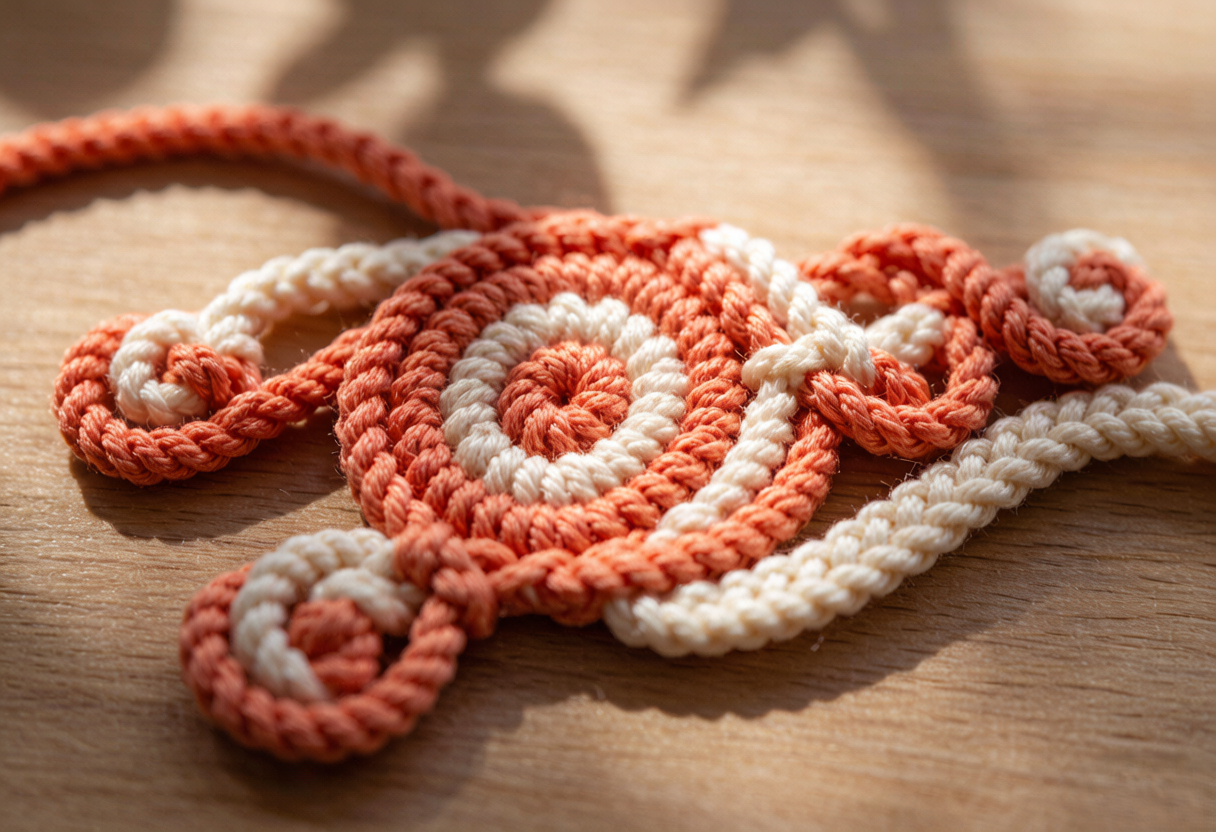
The Waxed Cord Under Your Fingertips
Most of our bracelets start with a single material: waxed cord. It is cotton — soft, breathable, kind to skin — sealed with a thin beeswax coating that lets the threads sit close and lock the knot tighter than a dry cord ever could. When you pull a fresh strand, the wax lets the knot sing a small, almost felt-not-heard squeak. That tiny sound means the knot is set.
We choose waxed cotton because it ages in plain sight. A waxed cord bracelet, worn daily, picks up the oils of your wrist, the dust of your week, the slow fade of sun on a sleeve. After months it develops a patina — softer to the touch, slightly deeper in tone — that no factory finish can copy. A poured resin bracelet tends to stay the same forever and ends up looking not loved, just old.
The cord arrives in our studio on small wooden spools — coral, sage green, monsoon sky blue, cream, oxblood red, honey gold. We do not dye threads into Pantone colors. We look at a peony, a pine needle, an after-rain wall, and we thread-close to what we saw. That is why a peony pink next to a pine green, in our palette, reads the way two flowers in the same bed actually read: not a swatch, a garden.
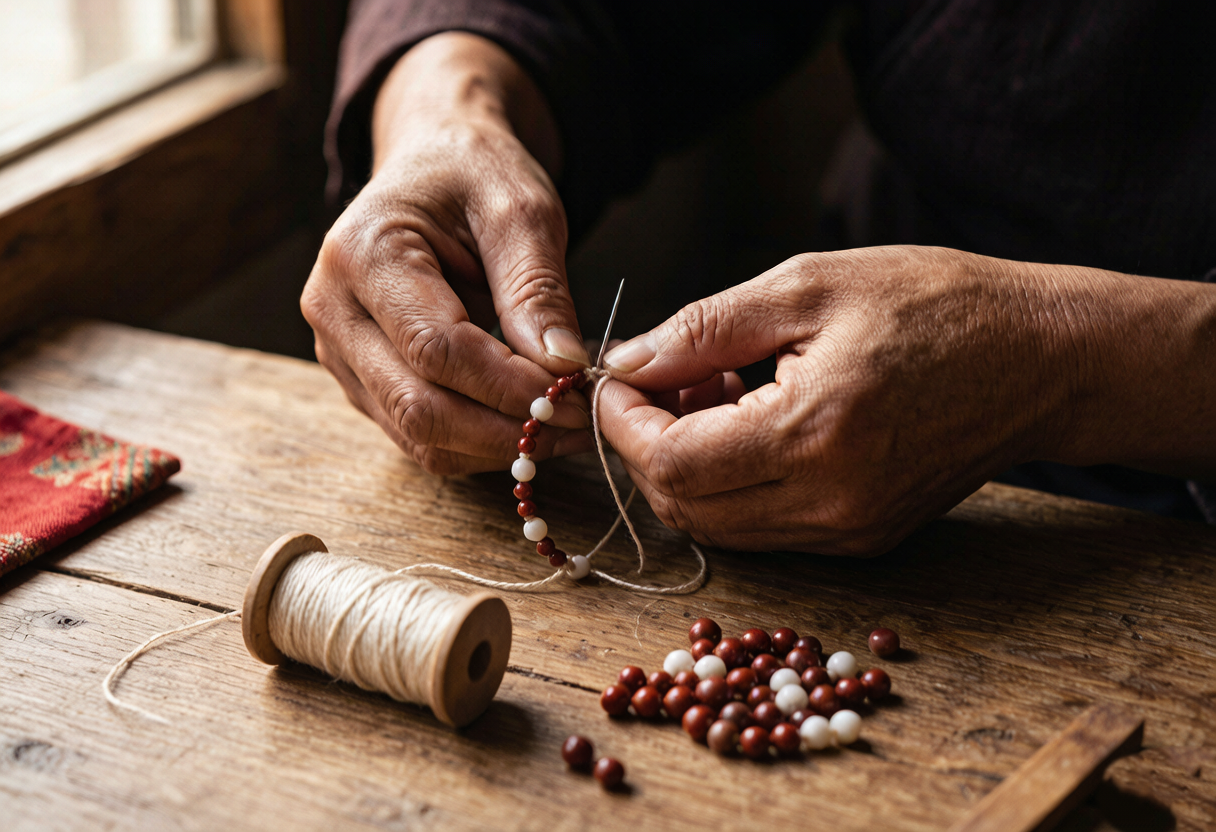
Color Picked From Real Gardens
People often ask where our palettes come from. The honest answer is a walk. We keep a small notebook — sketches of petals, watercolors of soil after rain, threads we tested against real leaves until the green felt right. Botanical-inspired jewelry, for us, is not a marketing line: it is the way the studio decides what to put on the table next.
Take the pale blush and monsoon sky blue pair we worked on for a long-time wearer. The blush came from a peony we passed every morning for a week; the blue came from a sky held for ten minutes just before rain. The bracelet that came off the board — a pale-blush and monsoon-blue handwoven bracelet — carries both of those moments in its thread order. None of that is explained by the product name. It lives in the rope.
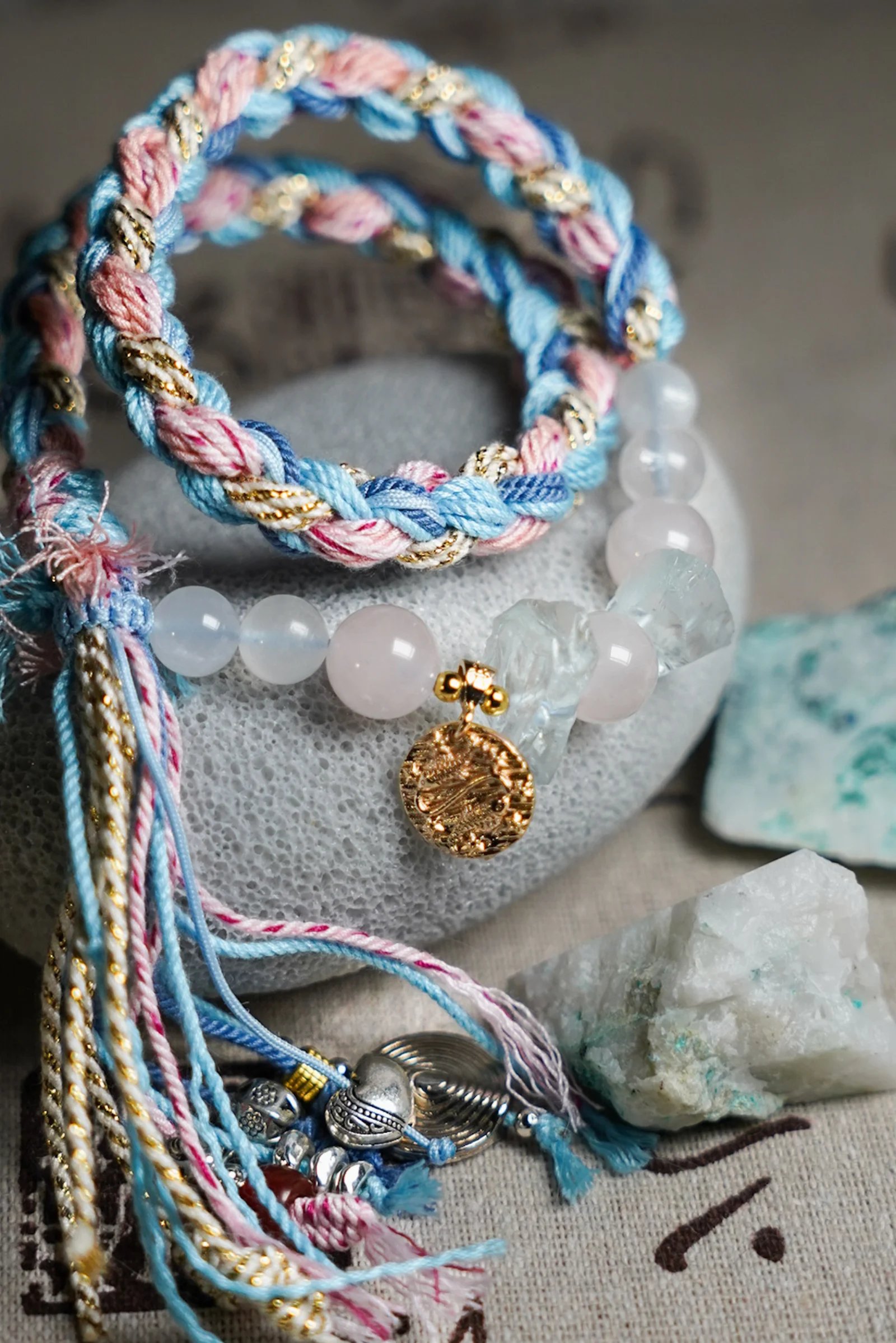
The same logic runs through every cord story on our shelves: peony pink and pine green pair like roots, oxblood red and cream pair like autumn on snow. To see how a single palette can shift from bracelet to necklace to bag charm, browse our collection of one-of-a-kind handwoven pieces.
How to Spot a Truly Handwoven Piece
A few small checks will tell you almost everything.
- Look at the back. Knots, not shine. If you can see a smooth, glossy negative, it was poured, not knotted.
- Run a strand. Waxed cord has a faint drag under the pad of your finger — almost a small grab. Resin and metal feel uniformly smooth.
- Count the cord ends. A real handwoven bracelet has clean, burned-down thread ends tucked into a knot, not a flat glued cap.
- Watch the color. Waxed cord has a soft, slightly uneven absorption. If a color looks neon-perfect, it is probably acrylic.
- Feel the weight. Waxed cotton is light, almost weightless. If the piece has heft, it is likely a poured core.
If a piece passes all five of those quiet tests, what you are holding is genuinely handwoven — knot by knot, by hands, in a small studio, in a small window of time.
If you’d like to see this craft up close, our deep-brown and forest-green handwoven bracelet and our monsoon-blue and blush handwoven bracelet show two very different sides of the same weave. For a bolder take on red-and-gold threadwork, our oxblood and gold handwoven bracelet sits closer to a sunset palette. Browse the full bracelet collection to see how the same knots travel across a range of handwoven color stories.
Every piece we ship starts with a thread, a hand, and a knot pulled into place under morning light. If this kind of slow-made work pulls on you, sign up for letters from the studio — one quiet email, once a month, with new palettes, new keepsakes, and the small stories behind the knots.
Nature, woven by hand. Color, woven into stories.
