 Skip to content
✨ New Year Offer: Up to 20% off ·
Begin 2026 with something handmade ✨
✨ New Year Offer: Up to 20% off ·
Begin 2026 with something handmade ✨

Unique Handwoven Jewelry: Why No Two Pieces Are Alike

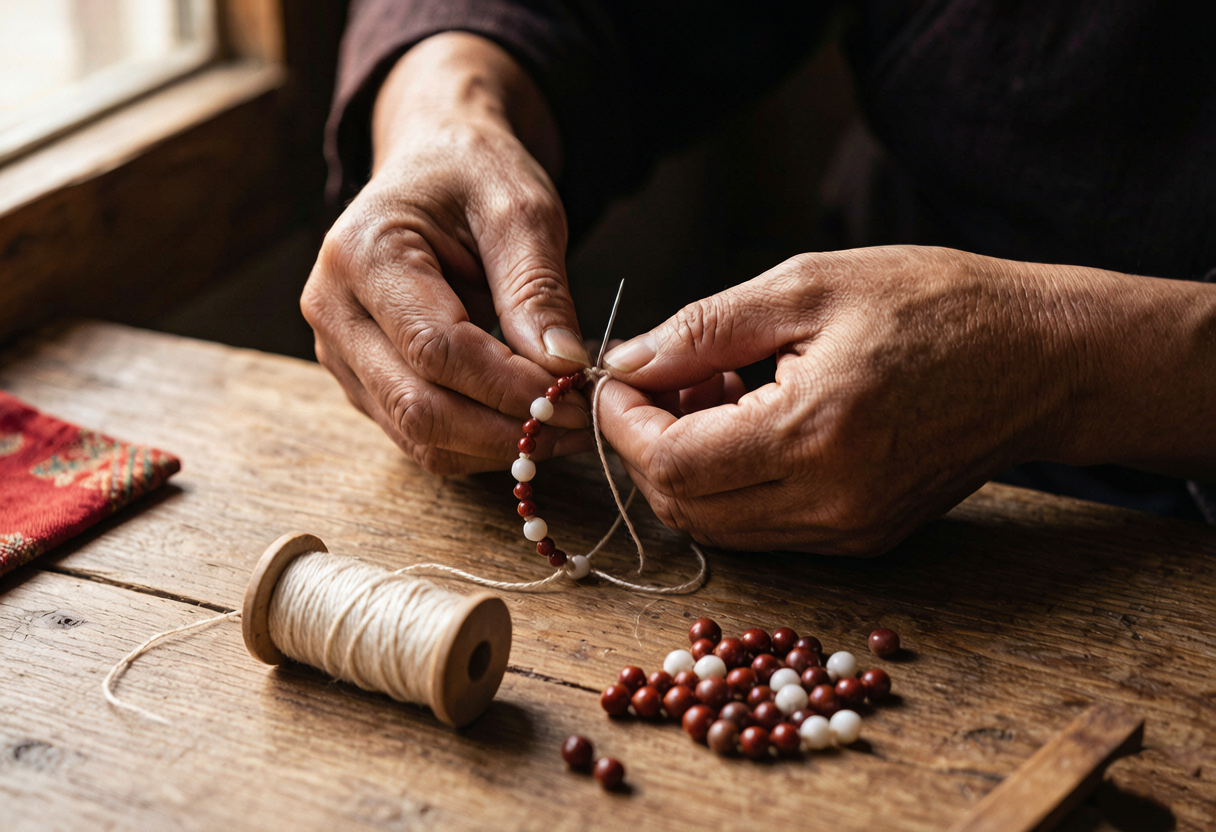
Pick up a handwoven bracelet and hold it to the light. The cord twists a little differently at the second knot. The stone carries a pattern no other stone on earth repeats. The tension in the loops holds the memory of the hour it was made. That is not a flaw. That is the point.
At TibetanTwist, we do not chase factory perfection. We chase the honest mark of hands, fiber, and time. Every piece in our collection is made by hand, one at a time. No templates. No assembly line. Just cord, color, and the small decisions that make a thing impossible to duplicate. When you buy a piece from our shop, you are not buying a product. You are buying a specific object that exists nowhere else.
People sometimes ask if we can make two bracelets that match exactly. The answer is always the same: we can make two bracelets from the same palette, using the same knots, on the same afternoon. But they will not be identical. The first will carry the morning’s crisp tension. The second will carry the afternoon’s settled rhythm. Both will be true. Neither will be a copy.
The Hand Leaves a Trace
A machine can stamp out ten thousand identical links. A hand cannot. When we knot a bracelet, the cord passes through fingers that are slightly warmer or cooler than they were an hour ago. The tension shifts with posture. The angle of a loop changes because the artisan paused to glance at a reference photo, or because late-afternoon light hit the bench differently and the color of the cord suddenly looked different against the wood.
These traces are invisible to the casual eye, but they are there. They live in the microscopic differences between two square knots made by the same person on different days. They live in the way a cord end is tucked — tightly today, more loosely tomorrow. They live in the slight asymmetry of a pattern that was counted by eye rather than by algorithm. They give the piece a pulse.
Consider the simplest act in our process: pulling a cord tight. On a humid day, the waxed fiber grips differently. The hand has to pull harder, and the knot seats deeper into itself. On a dry day, the cord slides more easily. The knot settles with a lighter touch. Both bracelets will last. Both will hold. But they will not be twins. They will be siblings — related, recognizable, but unmistakably separate.
This is why we say our work is one of a kind, not because we try to make every piece different, but because difference is the natural outcome of working by hand. The goal is not uniformity. The goal is honesty. A handwoven bracelet should look like it was made by a person, not extruded by a system.
Nature Refuses to Copy Itself
We build our palettes from the outside world. Peony pink from garden borders. Pine green from needles after rain. Monsoon sky blue from the moment clouds break over hills. But nature is not a paint swatch. It does not repeat. It does not consult a Pantone book.
The waxed cord we use carries subtle shifts between dye batches. A spool of forest-green cord might lean olive in one lot and emerald in the next. The saturation changes with the temperature of the dye bath. The depth changes with how long the fiber rests in the color. We do not fight these shifts. We choose our threads from the spools that speak to us on a given day, and we let the palette breathe.
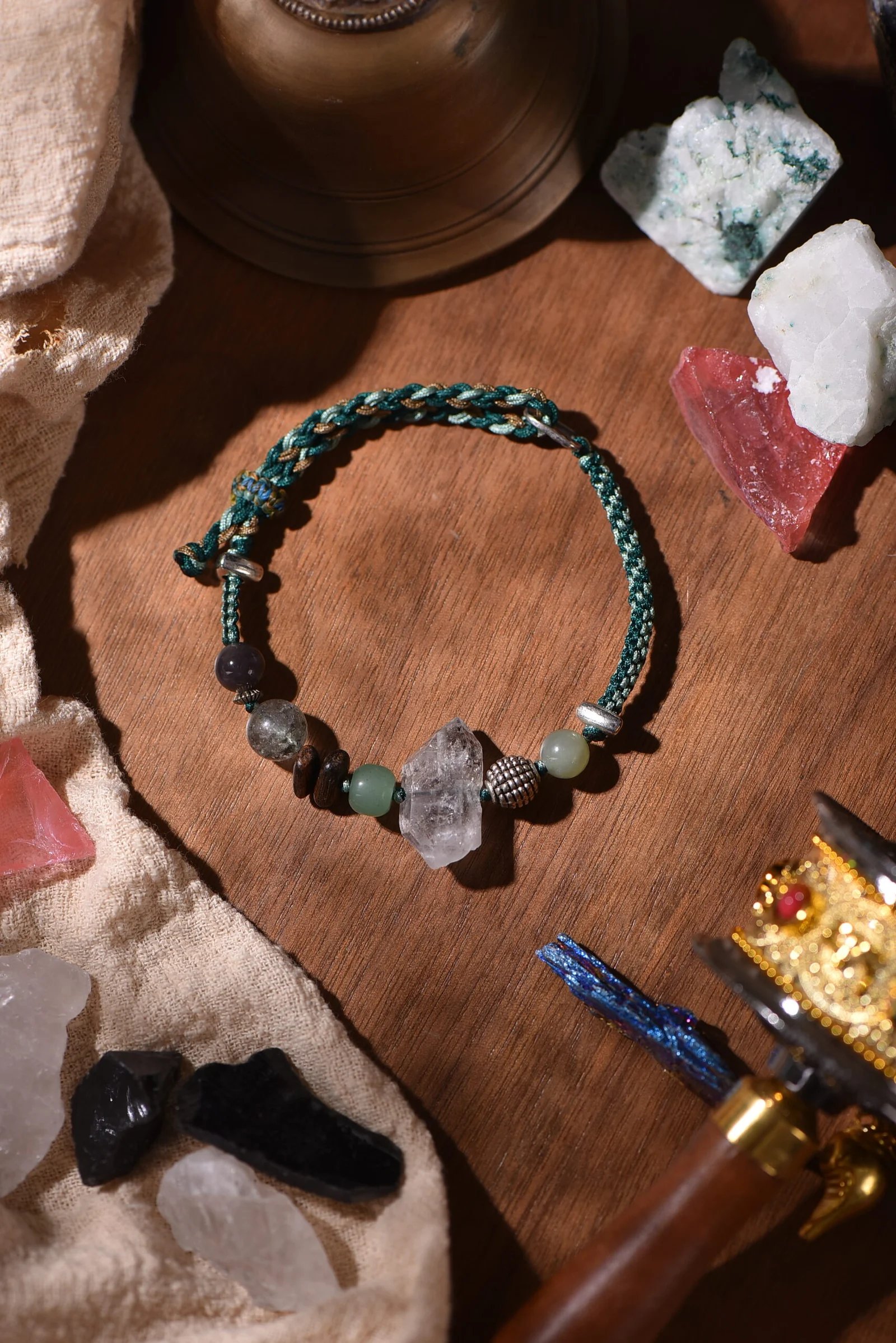
The natural stones we source — moss agate, tiger’s eye, aventurine — arrive with layers no quarry can duplicate. Even two beads cut from the same rock will catch light differently because their internal maps diverge. A stone with more quartz catches the light cold and clear. One with more iron oxide warms it. When we hold a stone up to the window to choose its placement, we are not just looking at color. We are reading its history.
This means our Five Elements Wood bracelet in forest green and earth brown never looks exactly like its neighbor. The cords carry the same palette, but the tones settle in their own order. The stone at the center holds its own geography. When you wear it, you are wearing a specific moment in the life of a material. You are wearing the fact that nature made this stone before we ever touched it.
The Knot as Fingerprint
Macramé knots look simple from a distance. Up close, they are full of decisions. How tight? How many wraps? Which direction does the working cord travel? Does the artisan double back for security, or trust the single pass? Does the pattern mirror exactly, or does it wander by a millimeter? These choices pile up into a texture that is unmistakably individual.
We work primarily with square knots, lark’s head anchors, and twisted cord patterns. Each has a personality. The square knot is steady and flat. It sits close to the skin and creates a solid band. The twisted pattern adds movement. It catches light along its ridges and casts tiny shadows. When we combine them in a single bracelet, the ratio between knot types becomes another layer of variation. One bracelet might be two-thirds square knot, one-third twist. Its neighbor from the same session might split fifty-fifty.
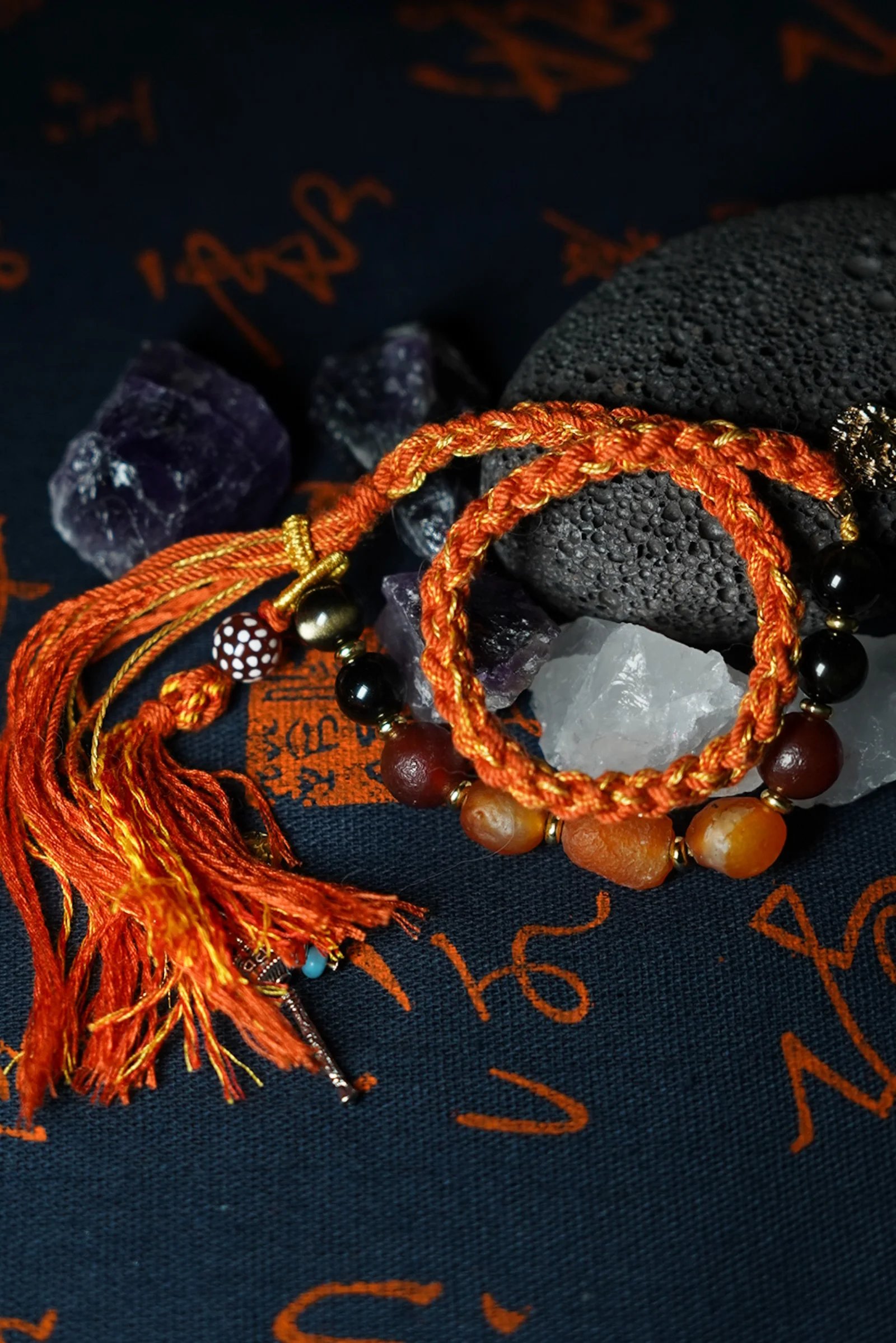
Our Leo Flame-Weaved bracelet in oxblood red and saffron gold uses the same knot family as our quieter earth-toned pieces, but the color density changes how the eye reads the structure. Red knots look bolder against skin. Gold thread catches window light and throws it back in small flashes. The same hand, the same technique, a completely different presence. It is not louder. It is just more direct.
Even within a single series, variation creeps in. A bracelet made in the morning, when hands are fresh, tends to carry tighter tension. One made in the evening, when muscles have settled into rhythm, often feels softer. Neither is better. Each is true to its own hour. That is the contract of handwoven work. You receive the piece as it came into being, not as it was engineered to be.
Which One Will Be Yours?
If you are drawn to the slow-made and the singular, browse our current collection. Each piece is already finished, already waiting. You do not need to commission anything. You only need to choose the one that speaks to you. No two are alike. No two will ever be.
Some people choose by color. They see a peony-pink thread against cream and know it belongs on their wrist. Others choose by weight. They pick up a bracelet with a heavier stone and feel the grounding pull of it. Still others choose by accident. They come looking for one thing and leave with something that caught their eye from the edge of the frame. However you find your piece, the story is yours. The bracelet is simply ready.
- Start with our forest-green and earth-brown handwoven bracelet for a palette rooted in soil and leaf.
- Or choose the oxblood-red and gold handwoven bracelet for something that carries heat and contrast.
- Explore the full handwoven bracelet collection to find the piece that fits your own unrepeatable story.
Nature, woven by hand. Color, woven into stories.
Want to see new pieces before they reach the shop? Join our email list for studio notes and first access.
