 Skip to content
✨ New Year Offer: Up to 20% off ·
Begin 2026 with something handmade ✨
✨ New Year Offer: Up to 20% off ·
Begin 2026 with something handmade ✨

Tibetan-Inspired Jewelry: Woven for Hard Mountain Light | TibetanTwist

Tibetan-Inspired Jewelry: Woven for Hard Mountain Light | TibetanTwist
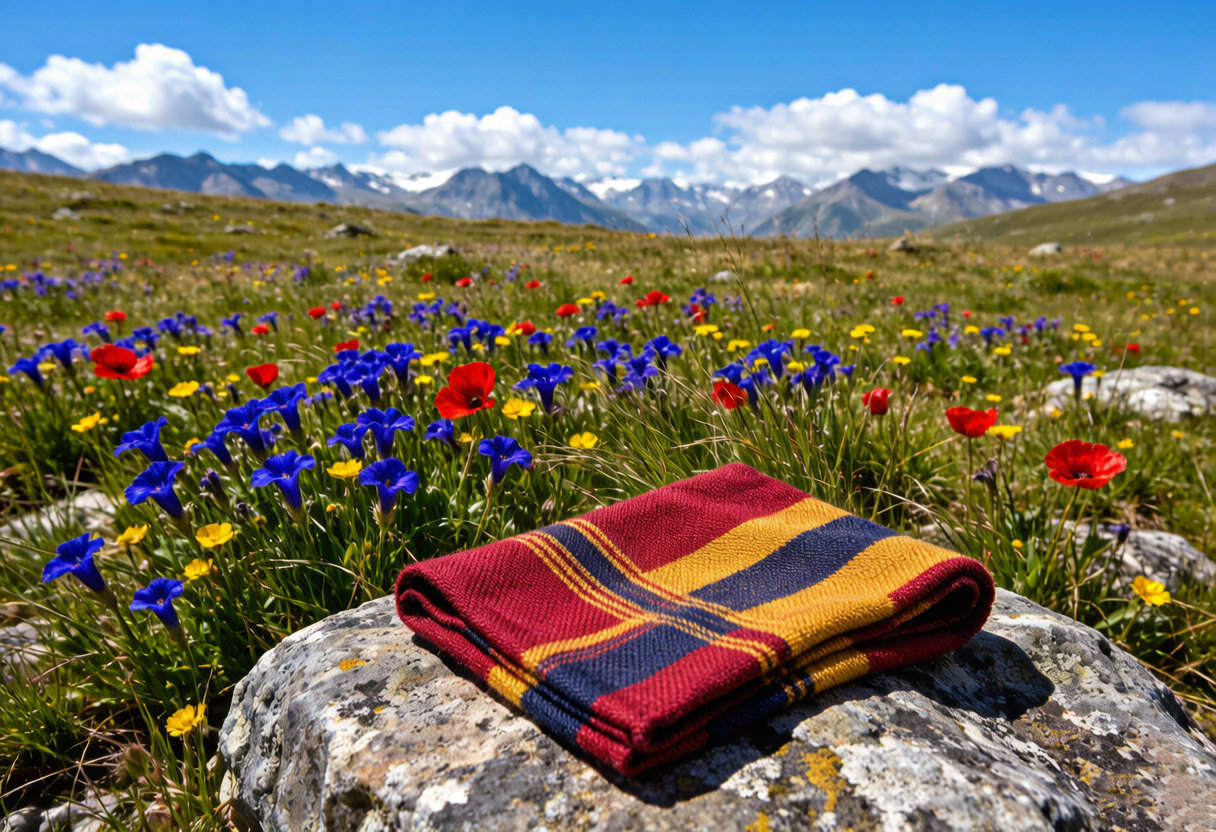
Up on the high plateau, the sun is not polite. Thin air lets the light arrive at full strength, snowfields throw it straight back, and shadows cut hard as knife edges. Yet the colors there refuse to fade — reds like dried lacquer, golds like late barley, blues pulled straight out of a deep alpine lake. That is the standard behind our Tibetan-inspired jewelry: color bold enough to read from across a valley, held in place by a knot tied by hand.
Color That Has to Survive the Light
At altitude, color has one job: it has to survive. Paint peels in that light. Wood turns grey within a season. Anything quiet is erased by glare before lunch.
What lasts is what is saturated. Door lintels painted oxblood red still read as oxblood at noon, at dusk, through dust, from the far side of a riverbed. Trim of saffron gold stays gold even when the sky behind it goes white. The plateau palette is not shy, because shyness literally disappears up there — distance thins a color, hard light flattens it, and only pure pigment pulls through. Generations of makers learned to mix loud on purpose, not as decoration but as a way of keeping things visible in a landscape that erases whisper tones.
We hold our own threads to the same test. When we choose cord for a Tibetan-inspired piece, we ask a plain question: if this strand were strung across a bright room, would it still read as itself? If it drifts grey, it does not make the cut. That is why our reds lean oxblood instead of candy pink, and why our blues come from deep water rather than pale morning sky. The pieces are built to hold their own in full sun, not just in a photo taken in soft window light.
The lesson travels well. A color that survives hard light also survives real life — a summer on a wrist, a winter in a drawer, a pocket, a suitcase, a washing-up bowl accident that turns out fine. We would rather spend an evening choosing between two deep reds than explain why a fashionable blush faded by August. Slow-made color should outlast the trend that brought you to it.
The Plateau Palette, Borrowed Piece by Piece
Every color in our Tibetan-inspired palette comes from something you can point at. No shade begins life on a screen.
Oxblood red — the shade of lacquered door panels and the deep maroon of woven sashes. It is a red with brown in its bones: warmer than fire-truck red, older-looking than cherry, and it deepens rather than shouts as the afternoon goes on.
Saffron gold — late-summer barley fields a week before harvest, and brass fittings catching the last hour of sun. On the wrist it reads warm rather than glittery: the color of grain, honey and well-used tools.
Deep lake blue — the impossible shade high lakes turn in late afternoon, when the water stops reflecting and starts glowing from underneath. Our monsoon sky blue sits in the same family, one breath lighter — the color of the hour after rain has just left.
Cloud white and yak-horn cream — the rests between the notes. Without them, the loud colors never get their turn; with them, even a single red strand looks deliberate.
Stone and glass do the same work as thread. Deep glass beads throw back more light than matte cord, so we use them the way a painter uses a glaze — small points of shine that keep the earth tones from going flat.
You can see the whole range knotted together in our Tibetan-inspired multi-use charm — carved yak bone, deep glass beads and cord in earth tones, made to move between a bag, a keyring and a wrist. See the multi-use charm here. For the same palette in metal, our hand-cast brass bag and car charm carries it in a quieter register: warm brass, soft edges, made to hang where the light can find it. See the brass charm here.
Why Bold Color Needs Quiet Structure
Loud thread shows everything. With a pale cord, a crooked knot hides in the haze; with oxblood red, every crossover sits in plain sight. So bold palettes demand better structure — and structure is where the slow work lives.
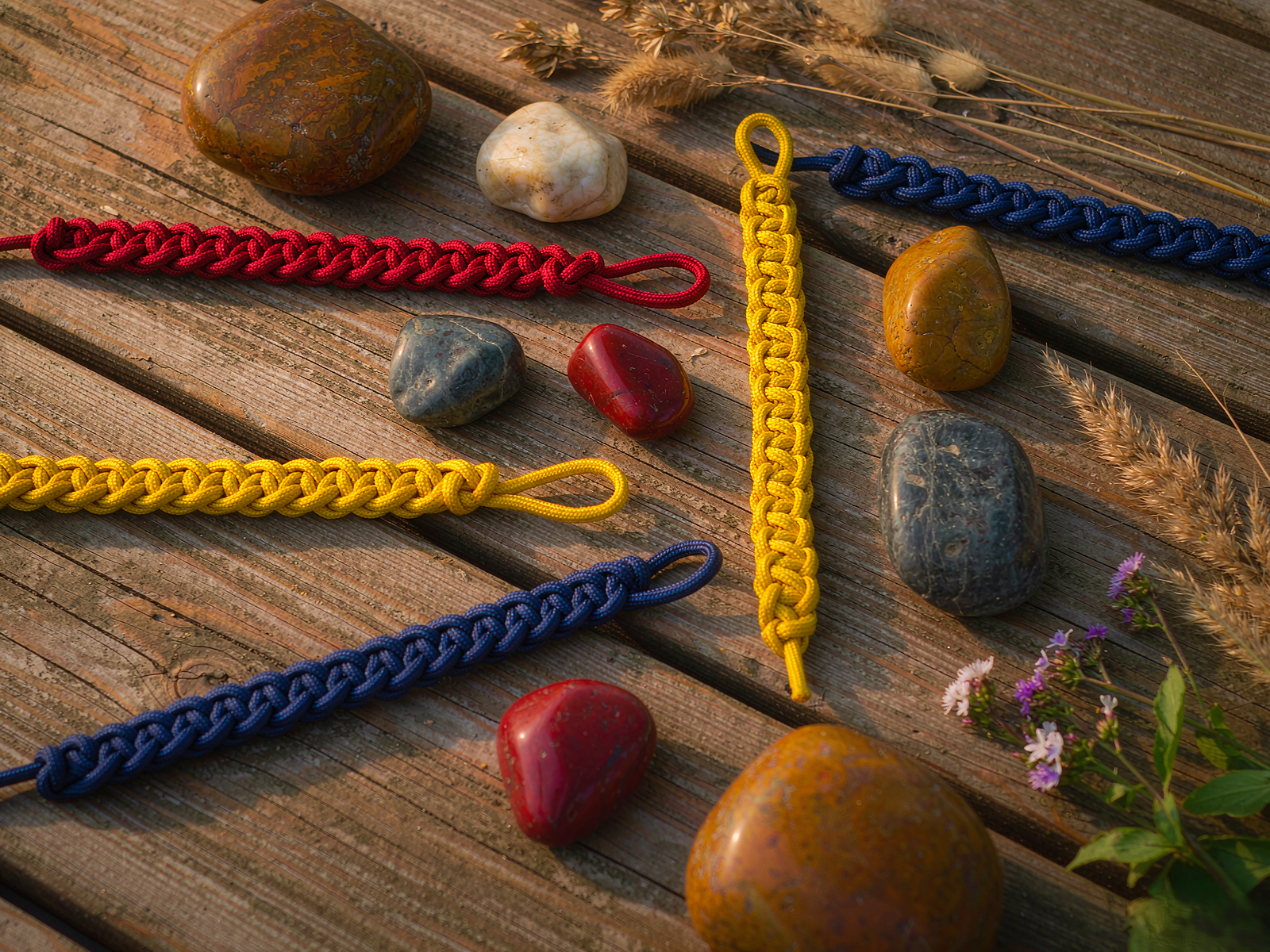
We knot in waxed cord, the quiet workhorse of waxed cord jewelry. It grips. It holds tension. It keeps a stripe pattern straight through years of daily wear. Each knot is pulled to the same snugness so the color reads evenly from one end of a piece to the other, and the wax keeps the cord from going soft or fuzzy the way untreated thread does. Look closely at a finished band and you will see the grid: rows of small, even knots, stacked like bricks in a wall.
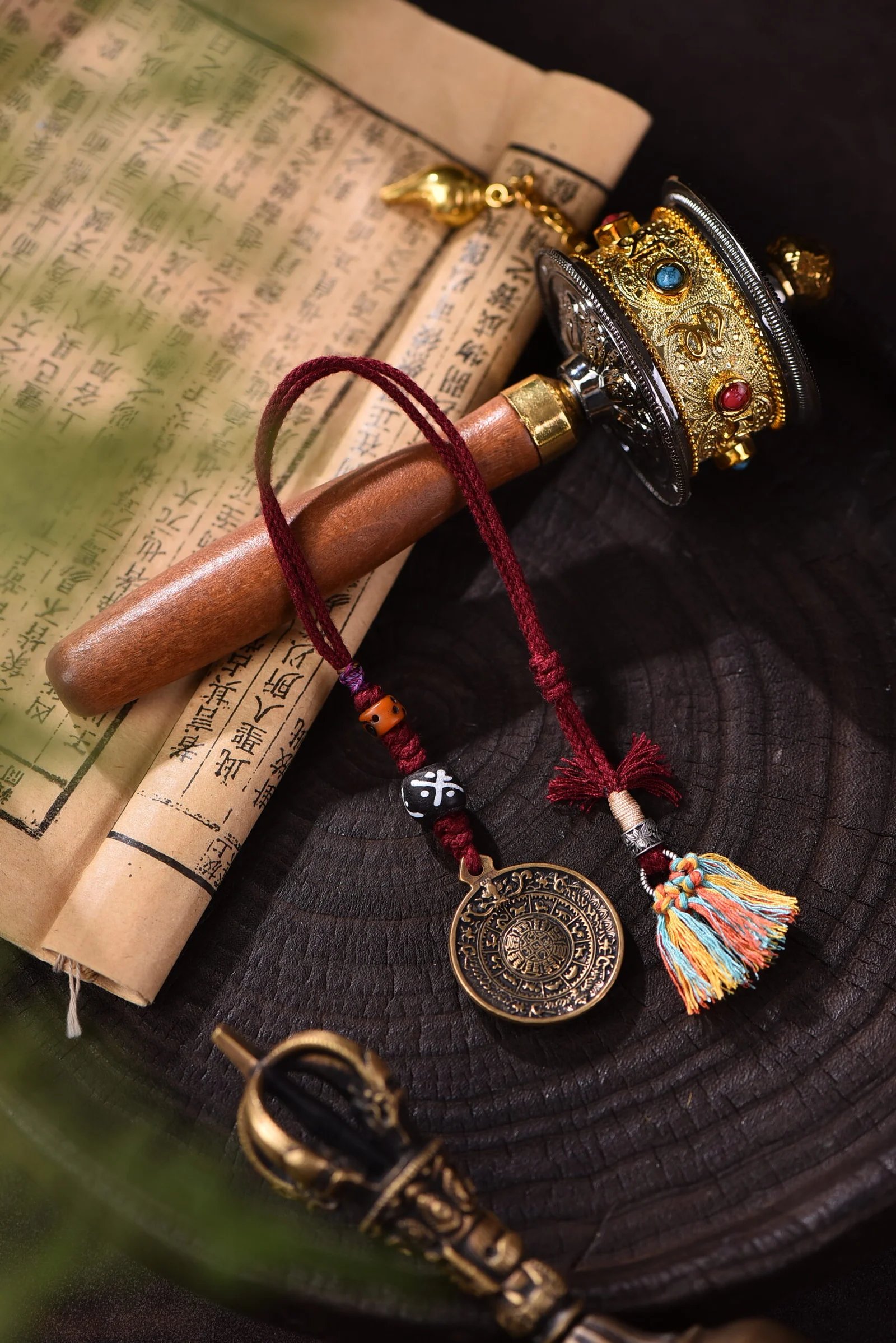
A hand-turned prayer wheel repeats one motion thousands of times, and that repetition is what gives the object its finish. Knotting is our version of the same patience: same twist, same pull, thousands of times over, until the color sits straight and a bundle of thread becomes a thing you can wear. No two come out identical — the small differences in tension are the fingerprint of the day each piece was made. That is not a flaw in the process; it is the process. Made by hand, one at a time.
There is a clock in it, too. A single-strand band takes an evening; a wide, multi-strand piece takes days, and the wax must be worked in as we go so the tension stays honest from first knot to last. Rush a bold palette and the unevenness shows at ten paces. Take the slow road and the piece reads even from across a room — which, if the plateau taught us anything, is the distance that matters.
How to Wear Plateau Color at Sea Level
Plateau color is loud on purpose, so the trick to wearing it every day is to give it room.
Start with one saturated strand against quiet cloth — cream linen, washed denim, a grey wool coat. A single oxblood-red bracelet against a cream sleeve does more than three competing colors ever could. If you want a second strand, go quieter rather than louder: our saffron-and-gold handwoven bracelet, knotted in orange and gold thread, sits happily beside blue denim and a plain white tee. See the saffron-gold bracelet here. On warmer days, a deep blue-and-cream band keeps the same idea but cools the whole palette down.
It is also an easy color story to give. Oxblood for the friend whose winter coat is black; saffron gold for the one who lives in denim; deep lake blue for the swimmer or the lake-house dreamer on your list. A small brass charm on the wrapping string finishes the parcel without a bow.
Two quick questions to find your shade. First: which plateau color do you already own in a scarf, a mug or a book cover? That is usually the one you will actually wear. Second: do you want the piece to open your outfit — go oxblood or saffron gold — or to settle it? In that case deep lake blue does the job. And because every piece is one of a kind, the exact knots in front of you will not come again; when a piece feels right, it is right.
If you are still choosing, browse the rest of the palette and the stories behind it in our Tibetan culture journal, where each color gets its own chapter. Which one is yours — oxblood, saffron gold, or deep lake blue?
Nature, woven by hand. Color, woven into stories.
Join our email list for new palettes, studio notes, and first access to seasonal drops.
