 Skip to content
✨ New Year Offer: Up to 20% off ·
Begin 2026 with something handmade ✨
✨ New Year Offer: Up to 20% off ·
Begin 2026 with something handmade ✨

Pressed Flowers, Woven Color: Bringing the Garden Indoors — TibetanTwist


Pressed Flowers, Woven Color: Bringing the Garden Indoors — TibetanTwist
Some flowers keep going long after the stem has gone. A pressed marigold between the pages of an old notebook, a piece of fern flattened under a stack of poetry books — the color stays honest for years, slow and quiet, like a small garden held between two hands. At TibetanTwist, we make botanical jewelry the same way. We press the colors of real gardens into our hands, knot by knot, and we bring them indoors as handwoven pieces you can carry through every season.
The Old Habit of Keeping a Garden
For as long as people have grown flowers, they have also saved them. A grandmother pressing roses between the pages of a hymnal. A child slipping a daisy between wax paper to bring to school. A hiker tucking a single pine needle into the back pocket of a field journal. The habit has its own quiet logic: gardens end, but pressed color does not have to. A pine needle held in a book still smells like the year it was picked. A peony petal, dried and tucked into a corner of a drawer, can change the smell of the whole drawer for a season.
We think about this a lot in the studio. A garden is a generous place, but it is also a temporary one. The same marigold that opens in July is gone by August. The same fern that looks like late-spring fireworks in May is a brown whisper by October. The flowers we love are the flowers we lose. Pressed botanicals are how we keep what would otherwise disappear.
It is also a slow practice. Pressing flowers is not a fast craft. You set a petal between two sheets of paper, rest a heavy book on top, leave it alone for three or four weeks. When you finally come back, the petal has flattened into the color it always wanted to be — softer, more even, less shadow. The flower becomes a color object. It can travel without wilting. It can sit in a drawer without rotting. It can outlive the season that produced it.
This is one of the reasons we started making botanical jewelry. A handwoven bracelet is a small, portable garden. It carries color from one place to another. It moves with you through kitchens and train stations and slow Sunday afternoons. It holds the same color a pressed petal holds — the color of a specific moment, slowed down, brought indoors, kept close.
From Pressed Petal to Woven Thread
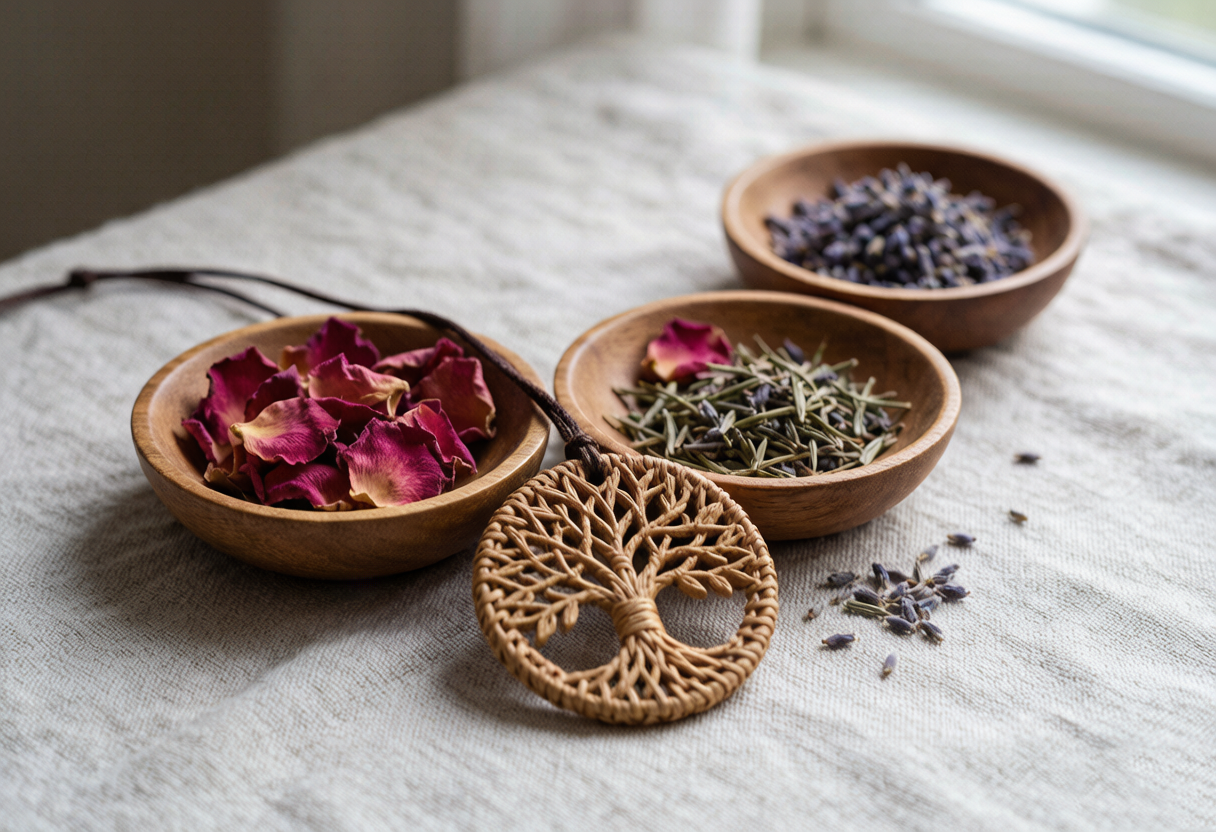
The translation from garden to thread is slow and deliberate. We do not pull colors out of a digital screen and call them botanical. We hold actual petals against actual spools of waxed cord and ask which thread catches the same light.
A peony petal, for instance, has at least three colors in it — deep coral at the base, blush pink in the middle, cream at the outer edge. We try to match all three at once, which is harder than it sounds. Some afternoons, our hands are stained with peony juice by the time we find the right combination. The waxed cord has a soft, matte finish that absorbs dye in a way synthetic threads cannot. It takes a garden color and makes it wearable.
A pressed fern is harder. Fern greens shift between the bright yellow-green of new fronds and the deep blue-green of older ones, with all kinds of olive and sage in between. We keep two or three thread spools in front of a single fern frond before we choose. Pine branches are gentler, but the green is darker than it looks — a wet-pine green, almost black in shadow, almost mint in the sun. A pine needle against a forest-floor shadow becomes a study in slow color.
The slow part is also the part we trust. When we sit at the worktable with a petal, a sprig, or a single leaf, we are not after an exact copy of that color. We are after the way that color feels in a hand, on a wrist, after a long day. Botanical jewelry is not a botanical illustration. It is a mood carried in waxed cord, one knot at a time.
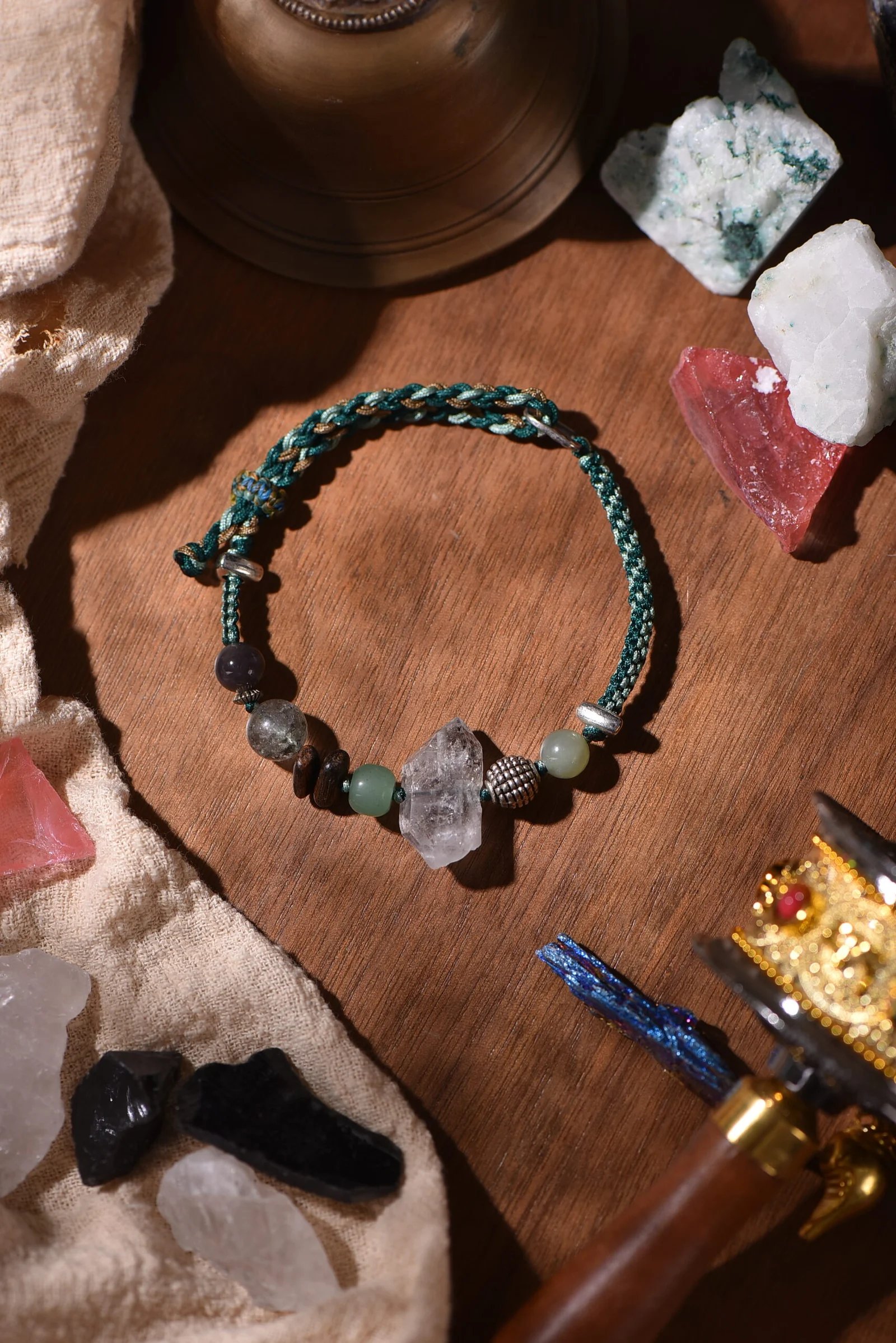
Our pine-green-and-earth-brown handwoven bracelet began this way. The first thread we pulled was the wrong green — too bright, too spring, more like a lime than a forest. We set it aside. The second was the wrong brown — too orange, too much like a chocolate wrapper, too loud for any forest we had ever walked through. The third, finally, was the color of a forest after a slow rain: a deep, mossy green paired with a quiet brown that would have made the forest floor itself nod in agreement.
That bracelet has become one of our most returned-to pieces. It works because the color is honest. It does not shout. It suggests.
A Garden You Carry Against Your Skin
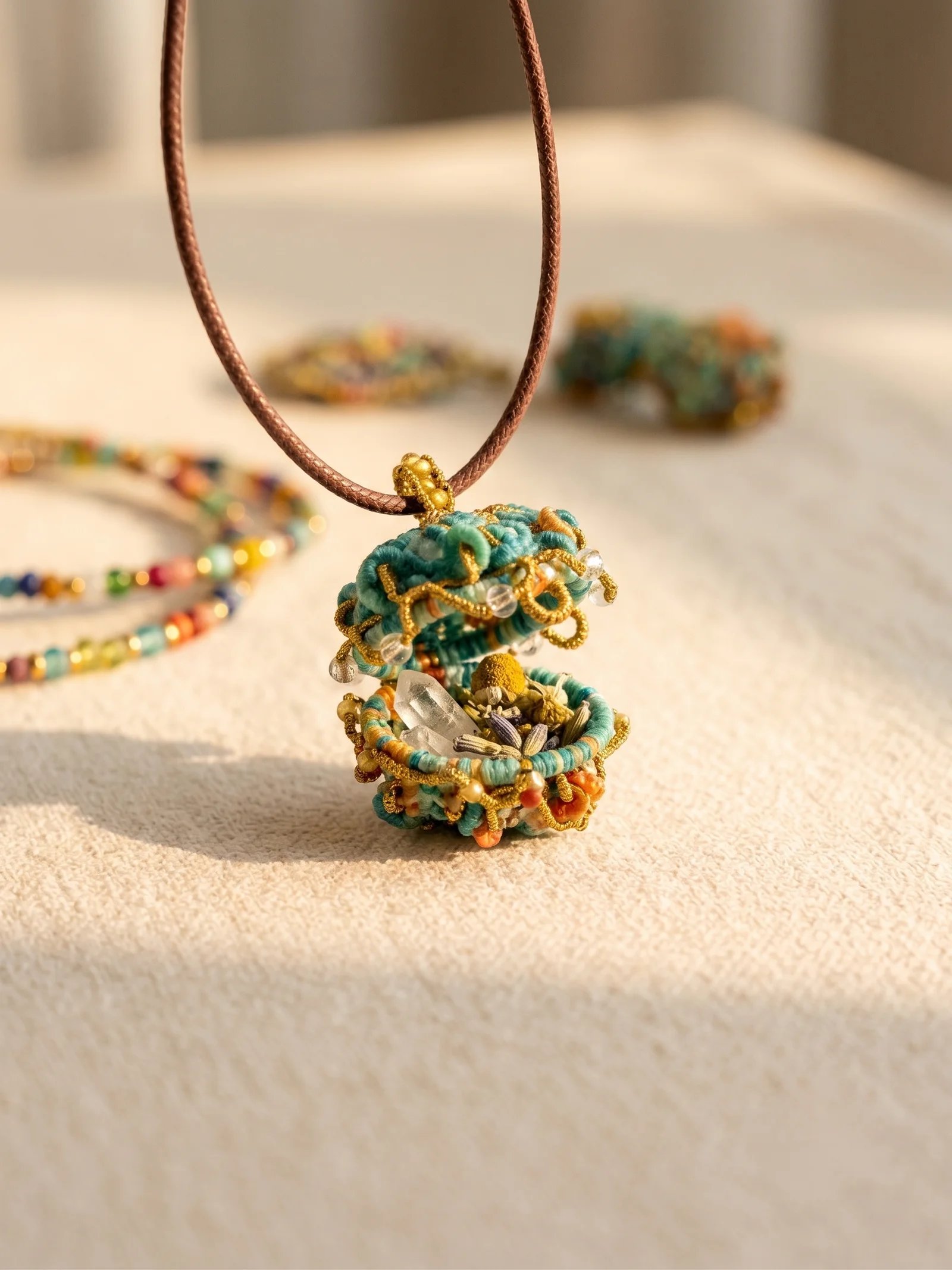
There is a particular kind of botanical jewelry that goes one step further than a single color. An openable woven pendant can hold a small piece of the garden inside it — a pressed petal, a single lavender sprig, a tiny leaf no bigger than a fingernail, a feather from a slow afternoon. The garden does not just sit on the wrist or at the collarbone; it lives there, inside the piece, in a quiet way.
We knot these for slow rituals. A wedding morning. A first home. The first winter of a garden that has just been planted. The pieces we make for these moments are not louder than our regular botanical jewelry. They are quieter, because the inside of the pendant is doing some of the work. The wearer adds what is missing — a memory, a flower, a phrase from a poem they read the year they turned twenty.
Our handwoven lotus pendant is one such piece. The lotus is the kind of flower that opens and closes every single day, depending on where the light is. It is also a flower that keeps its color even after it has dried. We knot the pendant around that idea: a small garden that opens when you choose, closes when you set it down, and keeps its color through both.
If you have ever pressed a flower between the pages of a favorite book and forgotten about it until a year later, you already understand the appeal. The garden goes where you go, and it stays the way it was.
How to Bring a Garden Indoors
If you want botanical jewelry that feels like a specific garden rather than a generic idea, here is the slow way we recommend choosing it.
First, pick the season you remember most clearly. Spring blossom asks for soft pinks and pale sage. Summer bloom asks for coral, monsoon sky blue, sunflower gold. Autumn seed pods ask for ochre, deep moss, the brown of fallen leaves. Winter bark asks for pine green, mushroom cream, the grey of lichen on stone. The right botanical jewelry will rhyme with that season, even without your having to explain it.
Second, pick the color your hands reach for when nobody is watching. We keep a small wooden tray of thread samples in the studio for exactly this reason. A color you reach for without thinking is a color you will still want a year from now. It will be the color you wear on a slow afternoon, the color you reach for when something needs to feel like itself.
Third, decide whether you want the garden on the outside of the piece or inside it. A bracelet carries color along the wrist, where it is easy to see. A necklace carries it near the collarbone, where it is more private. A small woven pendant can carry a piece of the garden itself, tucked inside until you choose to open it.
For the soft-spring palette, start with our pine-green-and-earth-brown handwoven bracelet. For the grounded autumn palette, see our forest-green-and-deep-brown handwoven bracelet. For a piece that can hold a small pressed petal or a single sprig of lavender inside it, look at our lotus handwoven pendant. Or browse the full handwoven bracelets to find the garden you remember most.
Nature, woven by hand. Color, woven into stories.
Get the next pressed-flower color story in your inbox — gardens we are knotting next, new botanical palettes, slow notes from the worktable. Join the TibetanTwist letters.
