 Skip to content
✨ New Year Offer: Up to 20% off ·
Begin 2026 with something handmade ✨
✨ New Year Offer: Up to 20% off ·
Begin 2026 with something handmade ✨

Handwoven Jewelry: The Studio Hours You Never See | TibetanTwist

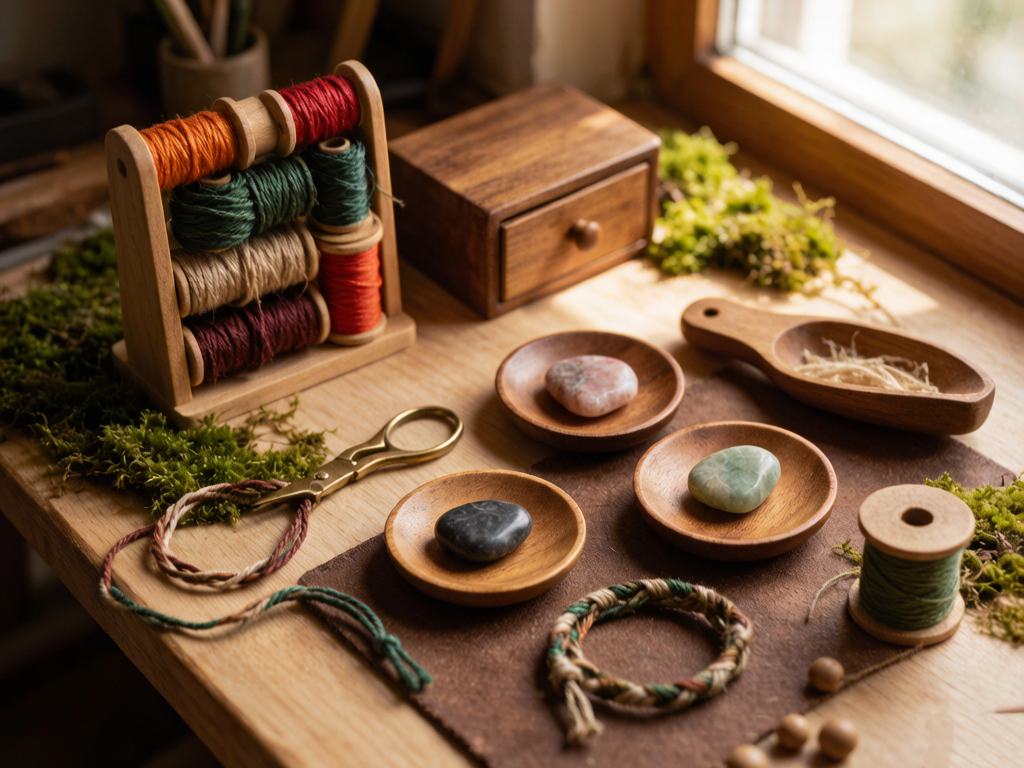
Before the first cord of the day is cut, the studio has already been at work for an hour. Steam curls off the kettle by the window. Morning light lands on the spool shelf — coral, pine green, oxblood red, cream, monsoon sky blue. And underneath it all sits a list of small jobs that never appear in a finished bracelet: winding, waxing, cutting, sorting, checking. We want to show you those jobs, because handwoven jewelry is not made out of knotting alone. It is made out of the hours you never see.
Before the First Knot: The Quiet Prep Hours
People sometimes picture a handwoven jewelry studio as one uninterrupted day of tying knots. Knotting is the heart of our day, but it is rarely more than half of it. The other half is preparation, and it starts before the light is fully in. Waxed cord arrives on bulky spools that fight you at every pull, so the first job is winding it down onto small bobbins that behave in the hand. Then each length is drawn slowly between two fingers — feeling for spots where the wax coat sits too thick, for fibers that have gone rough, for anything that would show up later as a stubborn, uneven knot.
After the cord comes the bench itself. Brass scissors get their edge checked. The wooden dishes of beads and stones are refilled and sorted by shade. The day’s palette candidates — yesterday’s garden cuttings, a few river stones still damp from the creek, a shell with a storm-grey lip — are gathered onto one tray, so that no knot ever has to stop mid-rhythm to go looking for material. Cooks call this mise en place; we just call it the boring hour. We protect it, because a knot can only be as honest as the cord that feeds it. If a length was cut short or the wax sat wrong, no amount of careful knotting will hide it later.
Prep also gives the week its shape. Early in the week we wind the everyday shades — creams, greens, the blues everyone reaches for. Midweek belongs to longer lengths, because the dual-tone pieces use up thread by the yard. And one afternoon is always set aside for small stock-taking: testing a new cord batch for wax feel, sorting beads back into their dishes, noting which spools are running low. None of it is glamorous. All of it is the reason the knotting hours flow.
There is a reason we are showing you this part. Most of what a studio does never becomes a product photo. The winding, the trimming, the sweeping of cord clippings into a jar — none of it photographs well, and all of it ends up in the piece you wear. We think trust starts here: with work that is done whether or not anyone is watching, for a piece that will be worn whether or not anyone asks how it was made.
The Morning Color Check: Real Things Beside Real Thread
Once the thread is ready, color takes over the table. We do not choose palettes on a screen, and we do not mix them from a chart. We lay real things beside real thread until the match feels true: a peony petal pressed flat in a book, pine needles shaken loose from a sweater cuff after the walk up the hill, the dusty pink inside a broken shell. Every candidate palette has to pass one test — it must trace back to a real scene. If we cannot say where a color came from, it goes back on the shelf, no matter how pretty it looked on the spool.
This morning’s tray held a wheat-field combination: thread pulled to pale gold, a cream that matches the inside of the petals, and a warm brown the exact shade of turned soil at the field’s edge. Knotted side by side, they became one of our favorite single-strand pieces — our gold, cream and earth-brown bracelet — a palette you can read at a glance: end of summer, warm field, last light.
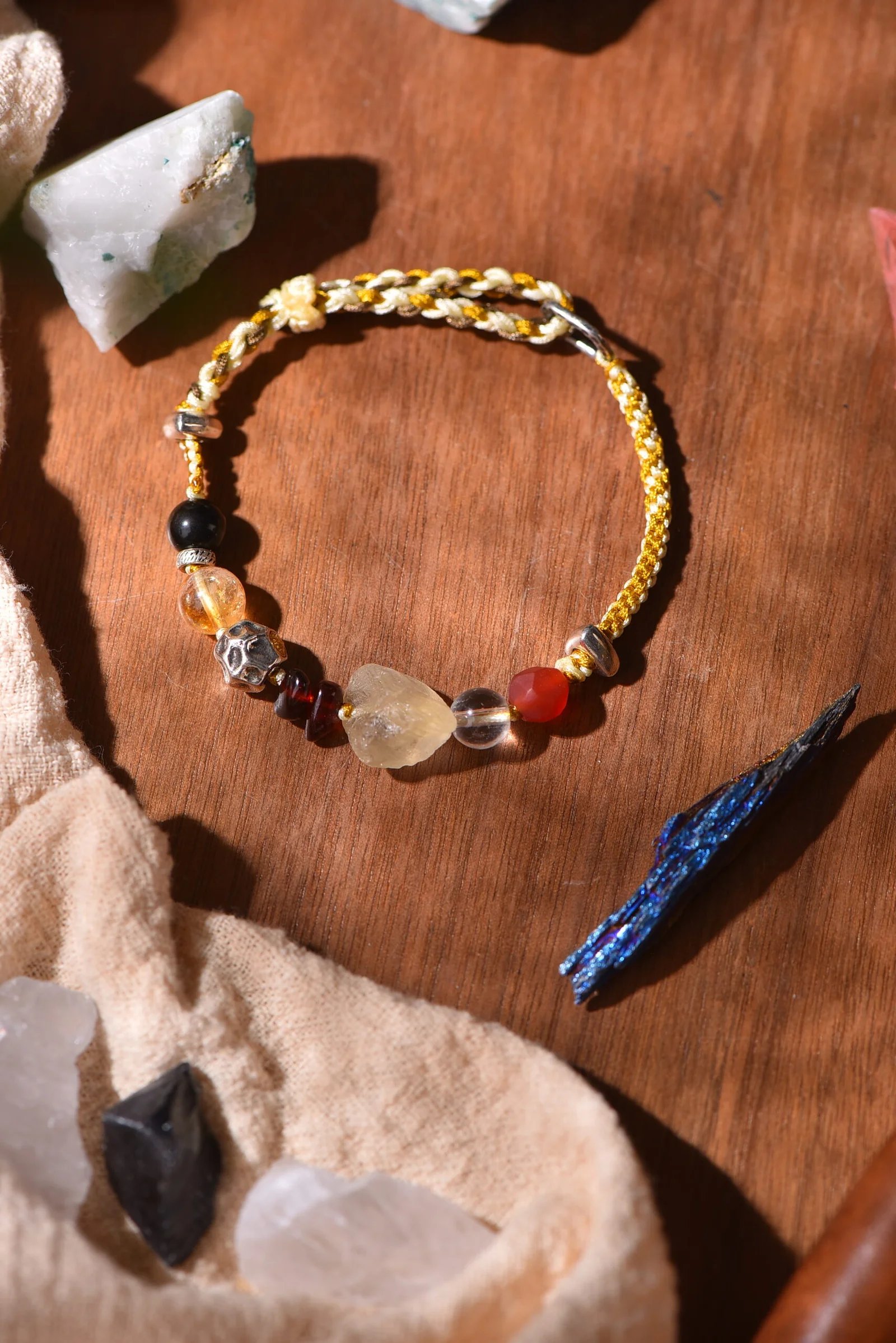
The color check is also where we catch ourselves. Some mornings a combination looks right in the tray and wrong in the cord — the greens fight each other, or the gold goes brassy indoors. When that happens, we unknot and start again, and the failed test goes into the sketchbook with a note: not this pairing, not this week. A studio that never discards a palette is a studio that is not looking closely enough.
True Light Only: Checking and Photographing Every Piece
By late afternoon, the day’s pieces come off the drying rack one at a time for the last hour of the process. Each is turned slowly against the window light — looking for knots that sat uneven, color transitions that jump, ends that did not seal flat against the cord. Hands find what eyes miss; you would be surprised how much a fingertip can catch. Anything questionable is unknotted and redone. Anything unfixable goes to the remnant jar, where the cord waits to become smaller work. Nothing is wasted, and nothing questionable ships. The drying rack earns its keep here too: a piece that has rested overnight tells the truth about its tension, so anything knotted late in the day waits until morning for its check.
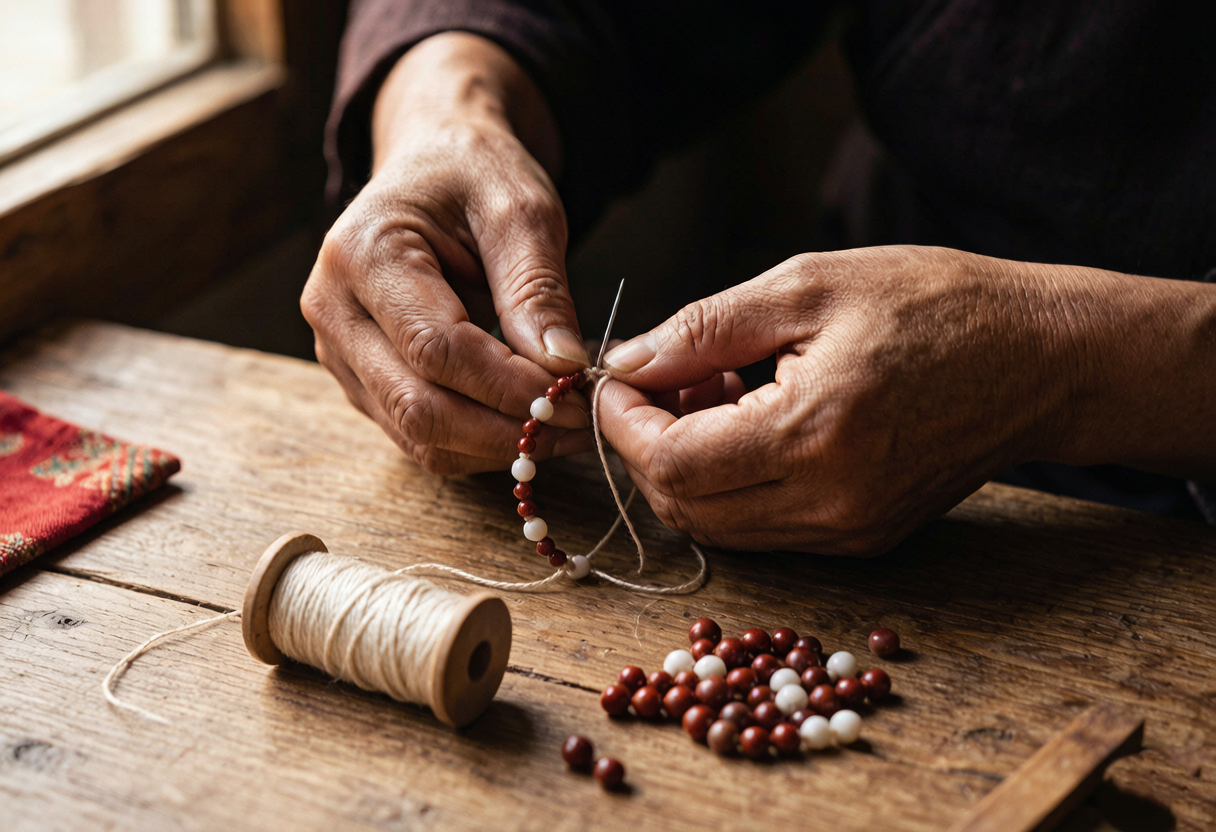
Photographs happen in the same hour, by the same window, in the same light you would wear the piece in. No filters, no color push, no studio tricks. The coral you see on screen is the coral the cord actually is; the indigo is the indigo of the deep half of a monsoon sky. If a photo cannot tell the truth about a color, we reshoot it on a clearer day rather than adjust it. Waxed cord even changes a little with the seasons — deeper in winter, brighter in high summer — and we would rather you meet the honest version of a palette than a perfected one.
How to Choose From What the Day Makes
If this tour has you wanting to hold a piece, here is the best part: you do not need to explain anything first. Every piece we make is already here — knotted, checked, photographed — and choosing one is as simple as choosing from the collections. A few ways in:
Start with a place you know. The palette that snags you is usually the landscape you already carry. If end-of-summer fields are your place, the gold, cream and earth-brown single-strand bracelet is a near match. If your place is weather — big grey skies with one bright tear in them — the monsoon-sky-and-indigo dual-tone knotted bracelet wears a whole afternoon of it on one wrist.
Decide how loud you want the piece to be. A single-strand bracelet in two or three related shades is quiet and everyday; it goes with linen sleeves and muddy boots. A many-shade piece like our herbal bracelet in layered greens, corals and creams is knotted side by side like a flower border, for days when you want the color to speak first.
Read the signs of hands. Look closely at any handwoven piece and you will find tiny shifts in tension, a pattern that breathes instead of repeating like wallpaper, ends sealed flat one at a time. These are not flaws. This is what one of a kind looks like up close — no two pieces alike, because no two days at the bench are alike.
You can read more studio notes like this one in our Craft & Process journal, or go straight to the pieces themselves. And if you would like the workbench to come to you, subscribe to the studio letter below — one short letter a week, written between knots.
Nature, woven by hand. Color, woven into stories.
