 Skip to content
✨ New Year Offer: Up to 20% off ·
Begin 2026 with something handmade ✨
✨ New Year Offer: Up to 20% off ·
Begin 2026 with something handmade ✨

Botanical Jewelry: Four Garden Sketches to Wear | TibetanTwist


Botanical Jewelry: Four Garden Sketches to Wear — TibetanTwist
Before I knot a bracelet, I draw the plant in my mind. Not a careful botanical illustration — more like a quick sketch: the way a peony folds into itself, the way a pine needle catches light, the way a winter twig refuses to be bare. Botanical jewelry, for us, starts with looking closely at something that grew. Then we translate that looking into thread. Each piece is a wearable garden sketch: color pulled from a real plant, knots arranged like stems, a finished shape that still remembers the living thing it came from.
We keep a color notebook, but instead of paper we use waxed cord. Instead of pencils we use knots. The pages are the four sketches that return to us every year: a bloom opening, a branch in full green, a stick that will not surrender to the cold. These are not literal copies of nature. They are interpretations — the moment a plant teaches you something about color, and you decide to wear that lesson.
We work in four sketches. Each one is a different way to read the garden.
Sketch 1 — Peony: The Soft Geometry of a Bloom
A peony is not simply pink. Open one fully and you will find cream at the center, a faint coral wash near the petals’ edge, and a cool green sepal holding the whole bloom together. When I translate that into a handwoven bracelet, I do not copy the flower. I copy the way the colors sit next to each other. A peony-pink thread beside a moss-green thread. A cream knot that interrupts the pink the way the center of the bloom interrupts its petals.
The knot pattern matters here. A tight square knot becomes the sepal: small, holding, slightly sharp against the softer threads around it. A looser twist becomes the petal: open, yielding, moving when the wrist moves. When you wear the piece, the knots shift and settle the way a peony shifts and settles in a vase over the course of a week. It is never the same shape twice, and that is the point.
This is why our botanical pieces look different from printed floral jewelry. There is no literal rose charm, no enamel petal. The peony becomes a palette. The wearer carries the bloom’s color logic without carrying a picture of the bloom. On early spring mornings, I reach for a cream-and-terracotta handwoven bracelet — the one that starts with peony logic and ends in knots. It pairs with a cotton shirt in undyed oatmeal or a linen dress the color of dry grass. The pink does not shout; it reads like a flower that has just opened and has not yet decided whether to be bold or shy.
The peony sketch is the quietest of the four. It does not demand attention across a room. It asks to be noticed up close, the way you notice a flower when you bend toward it. That is the scale we design for: wrist distance, coffee-cup distance, the distance at which someone leans in and says, I have never seen that color before.
Sketch 2 — Pine: Reading Green in Layers
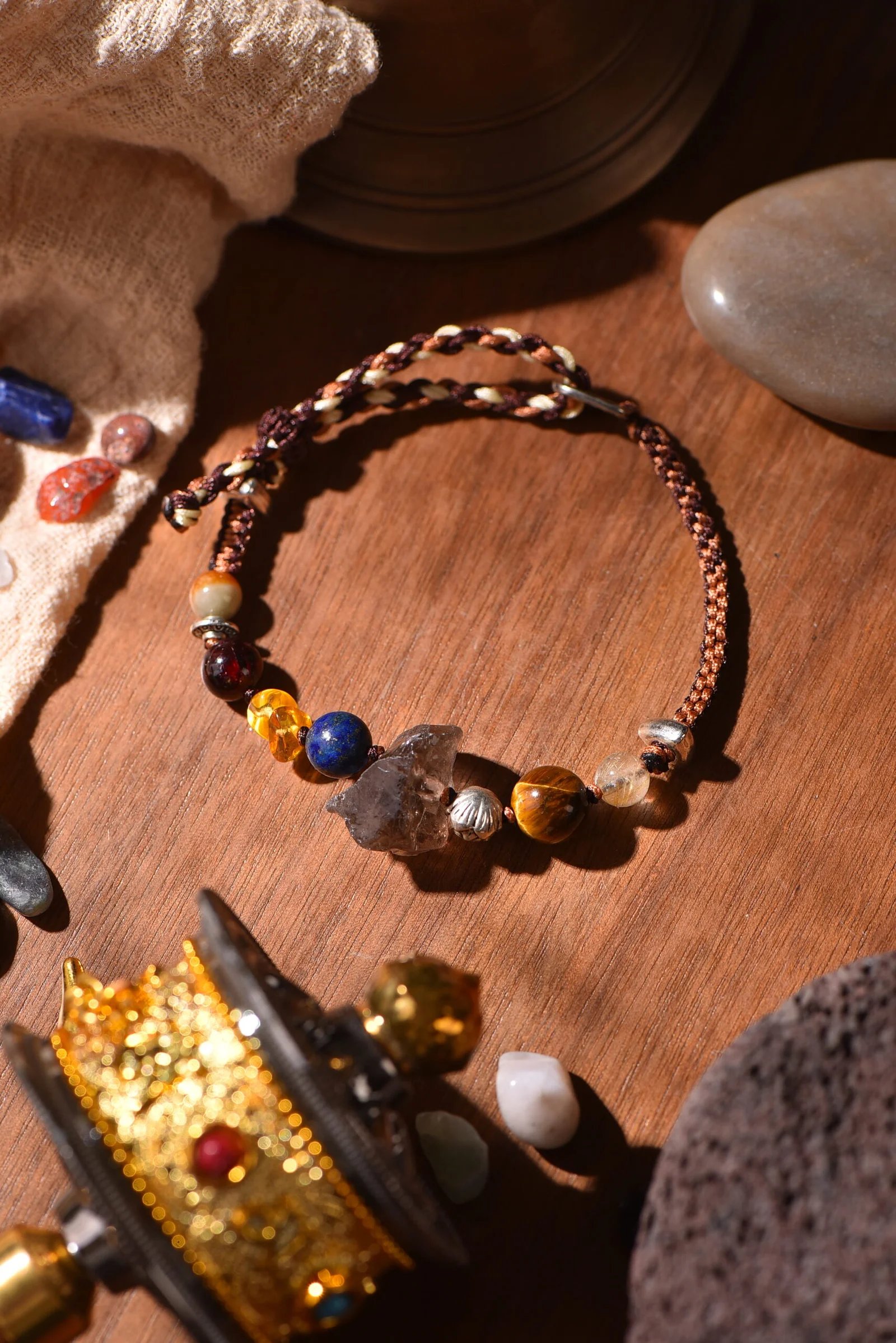
If you have ever held a pine branch under afternoon light, you know green is never one color. The outer needles are dusty sage. The inner needles are deep forest. The youngest tips catch the light as almost-yellow. Drawing that, I stop trying to choose a single green. I use three. Maybe four. The knot pattern itself becomes the layering: a base thread in deep pine green, a crossing thread in pale sage, a tiny accent in warm cream to mimic the light.
Pine is the sketch that taught us restraint. You do not need every color in the garden to make a statement. You need the right greens, spaced apart by hand so the eye travels through them the way light travels through needles. This approach shows up in our pine-green-and-earth-brown handwoven bracelet — a piece that reads like late summer shade, something you would wear while walking under old trees. It looks at home beside raw denim, beside a wool cardigan in oatmeal, beside any outfit that has already spent time outside.
What I love about the pine sketch is how it behaves across seasons. In July, the green feels cool against sun-warmed skin. In November, the same green feels like the last living thing in a field of brown. The knots darken slightly with wear, the way pine bark darkens after rain. The bracelet does not try to stay new. It tries to stay true to the plant it came from.
Sketch 3 — Winter Twig: What Grows When Nothing Blooms
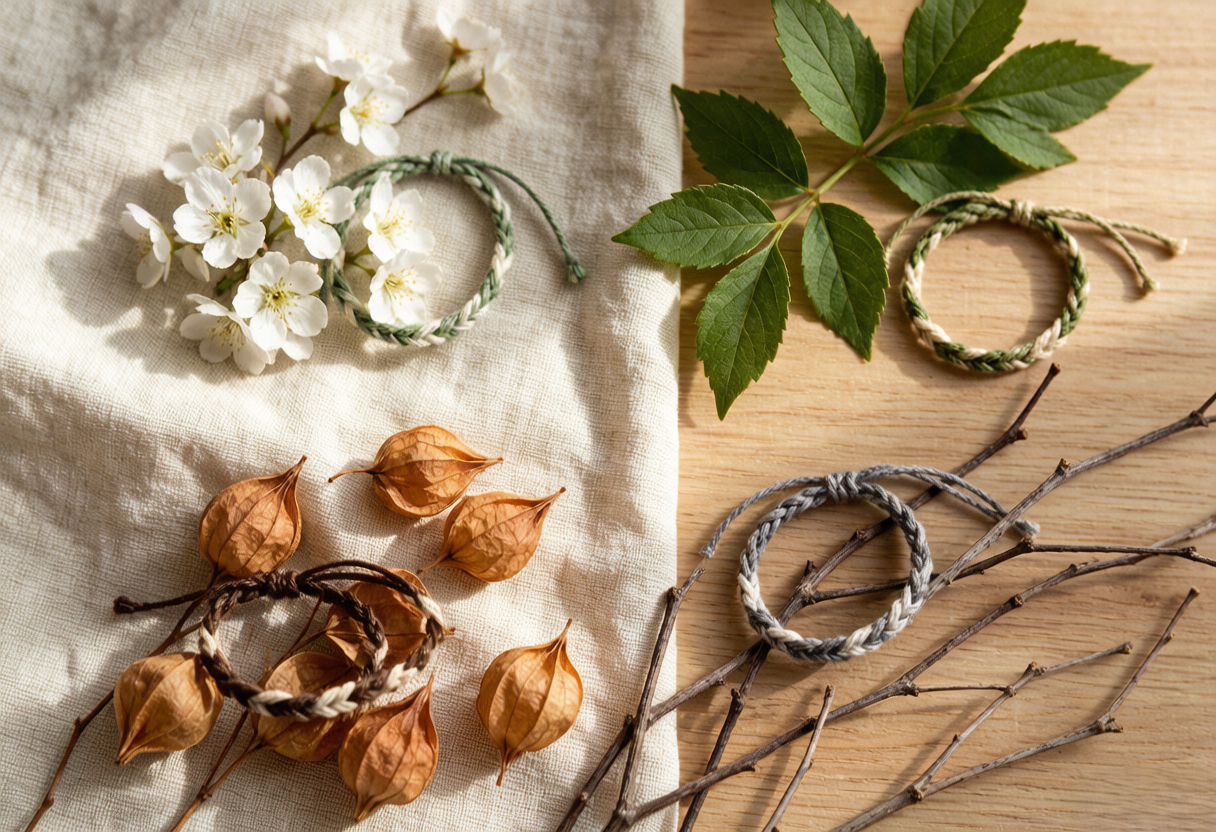
The winter garden is not empty. It is honest. Sticks become architecture. Seed pods become punctuation. A single red berry against grey bark is more arresting than a field of flowers because you notice it more slowly. Our third sketch starts there: not with abundance, but with what remains.
Winter botanical jewelry uses fewer threads and stronger contrast. Oxblood red against cream. Deep brown against pale grey. A single knot repeated like a row of buds. The result is a handwoven bracelet that feels like the end of the year — quiet, structured, slightly weathered. I wear ours with heavy knits and leather boots, letting the cord peek out from a glove cuff or a coat sleeve. It is the season when jewelry does not decorate an outfit; it anchors it.
The waxed cord we use was chosen for moments like this. It holds its shape in dry air and damp air alike. It does not mind being tucked under a coat for hours and then exposed to the cold. A winter piece has to be patient. It spends much of the day hidden, then reveals itself for a few seconds when you reach for a door handle or pay for coffee. Those small reveal moments are the whole reason for the sketch. Winter does not give you color all at once. It gives it in flashes.
Which Garden Sketch Will You Wear?
I do not think of botanical jewelry as a trend. I think of it as a way to keep paying attention. The garden keeps changing. So does the light. So do the colors we want against our skin. A peony sketch for the soft beginning of things. A pine sketch for layered, steady green. A winter twig sketch for the quiet architecture of the colder months. Each one is a different question the garden asks, and each bracelet is a small, knotted answer.
If you are drawn to soft pinks and early-season color, our cream-and-terracotta handwoven bracelet carries the warm base of peony logic into thread. For layered greens that read like shade under pines, the pine-green-and-earth-brown handwoven bracelet is the one I reach for on slow walks. Browse our full botanical-inspired bracelet collection to find the sketch that belongs to your season.
Choose the sketch that matches the season you are in, or the season you wish you were in. Either way, you are wearing something that began with a plant, was drawn by hand, and ended up on your wrist.
Nature, woven by hand. Color, woven into stories.
Join our email list for early access to new garden palettes and seasonal collections.
