 Skip to content
✨ New Year Offer: Up to 20% off ·
Begin 2026 with something handmade ✨
✨ New Year Offer: Up to 20% off ·
Begin 2026 with something handmade ✨

Botanical Jewelry: What the Flower Press Teaches About Color | TibetanTwist

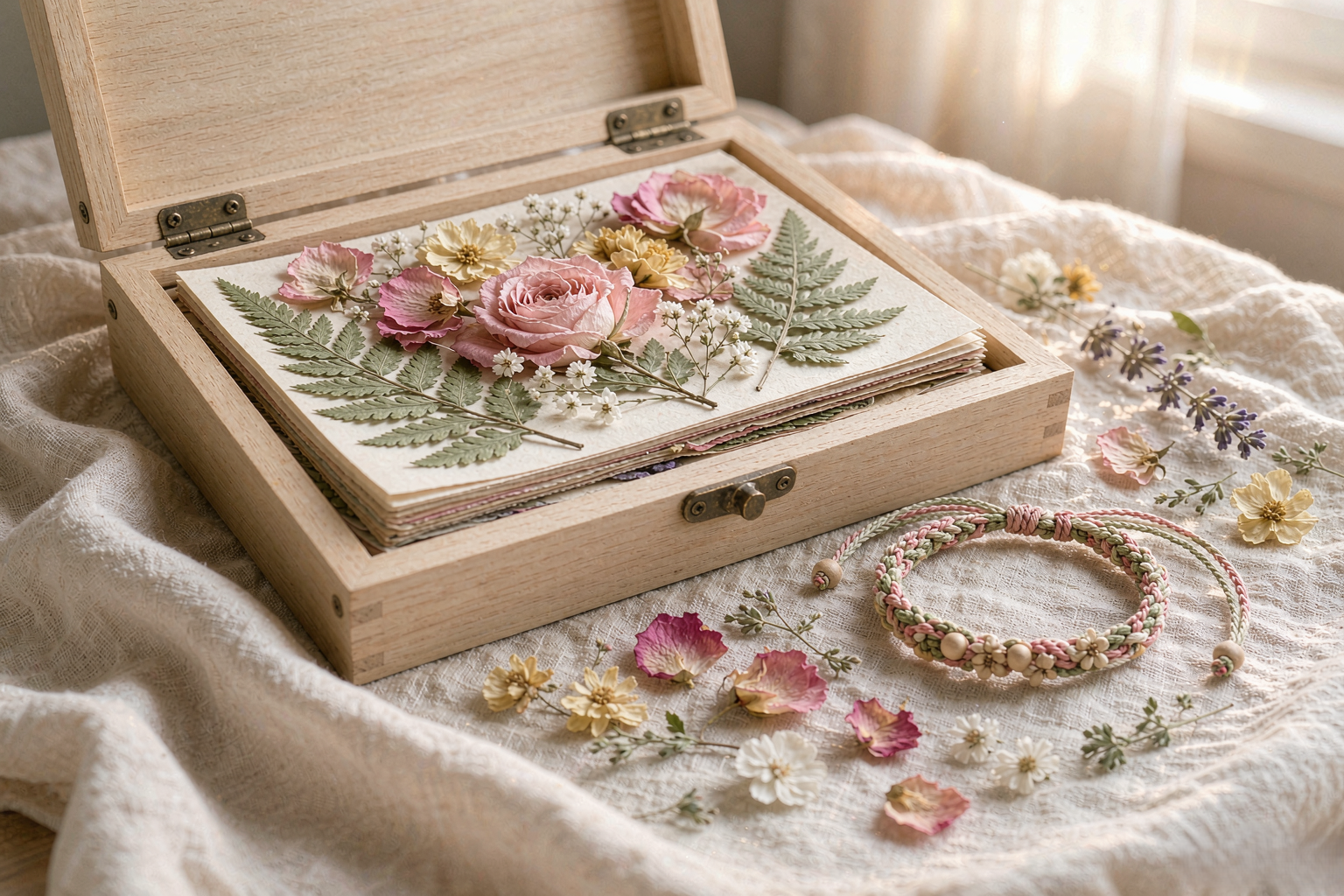
On the shelf above our worktable sits a wooden flower press — two oak boards, four brass screws, and a garden flattened into thin, honest color between them. We open it the way other people open cookbooks: for reference, for memory, for the quiet pleasure of seeing a season held still. Autumn is press season here — the year’s last color, saved on purpose. Every handwoven piece we knot begins in that same spirit. Botanical jewelry, for us, is simply color given enough time to become itself.
Two Slow Tools: the Press and the Knot
A flower press works with pressure, paper, and weeks. Water leaves the petal; pigment stays. What survives is a quieter version of the flower — no glare, no dew, no wind — just the color itself, thin as a wash of paint and far more lasting than the bloom it came from. A knotted bracelet works the same way from the other side of the workbench: tension instead of pressure, waxed cord instead of paper, hours instead of weeks.
The wax locks dye deep into the thread; the knots lock the palette into shape. Neither tool can be hurried, and both forgive everything except impatience. A knot tied in haste shows its haste for years, the same way a petal pressed carelessly keeps its wrinkle. Turn the screws a quarter turn at a time; tie the cord a knot at a time. The slowness is not the price of the color. The slowness is where the color comes from.
This is why the press sits in the studio at all. It is not decoration. When we need to know what a peony pink really looks like — not the garden version that shifts with every hour of light, but the pigment underneath — we open a page and lay our thread beside it. The press is our color library. The cord is how we lend that color out into the world.
Reading a Pressed Page Like a Color Card
Open an old press and you open a diary written in pigment. The marigold page says July. The fern page says the last warm week of October. The oak-leaf page says a brown afternoon neither of us remembered until we saw its color again. Some pages are twenty years old and the color has not moved. That stubbornness is the lesson: honest color does not need to shout to be remembered. A pressed page is also the fairest judge we know — it cannot be styled, lit, or edited. It is just what that plant was, flattened to the truth.
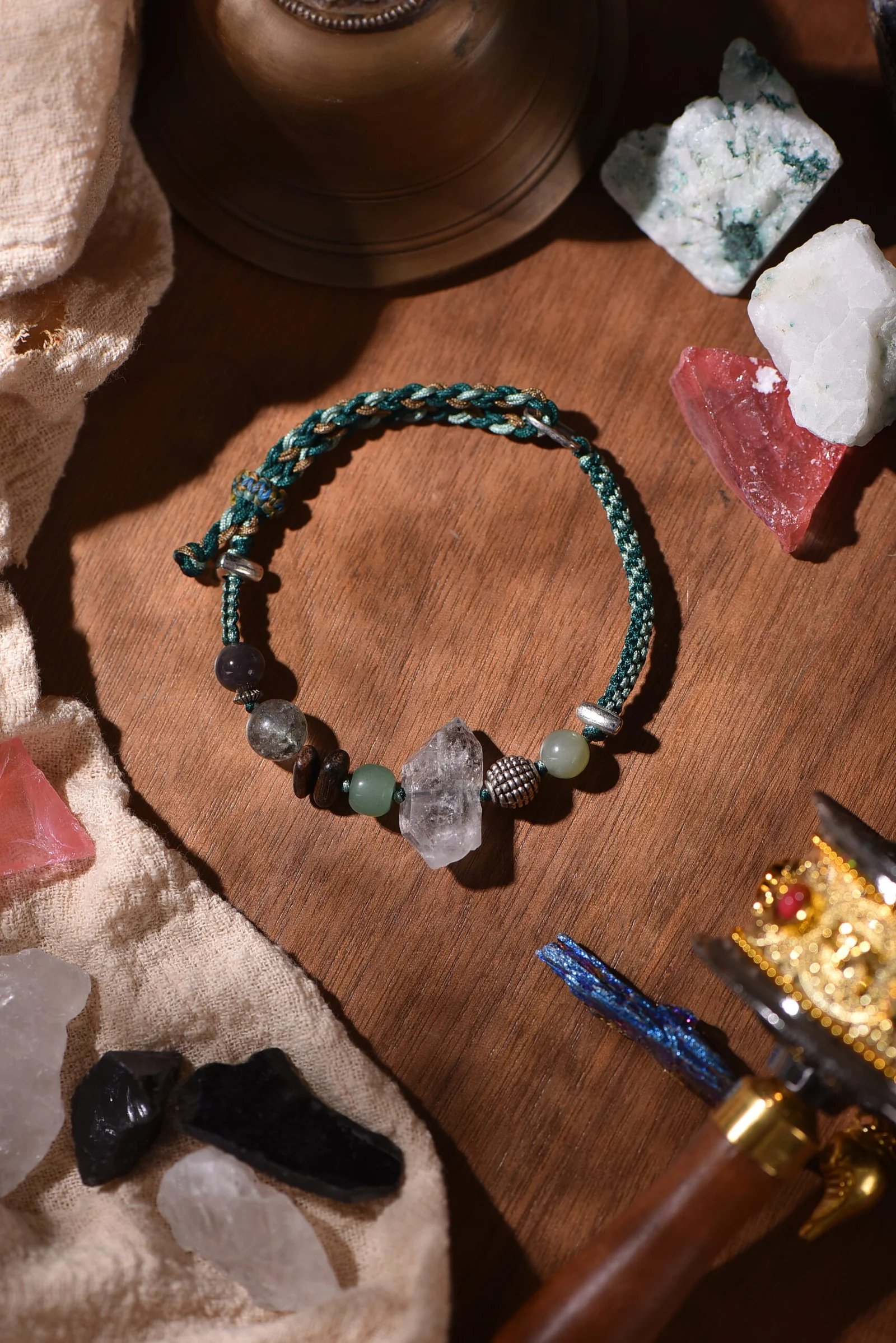
Before we knot a new piece, we lay waxed cord directly on the page. A pressed frond teaches faster than a fresh one, because pressing strips a leaf down to its two or three true greens — the bright, almost yellow green where the sun used to land, and the deep, cool green that lived in its own shade. Both belong on the wrist, so both go into the strand. Our fern-green-and-earth-brown handwoven bracelet came straight out of one such page: the green of a streamside fern, the brown of the oak leaf pressed beside it, two plants from one afternoon.
Deeper palettes come from deeper pages. The reference for our forest-green-and-deep-brown knotted bracelet was a winter press — pine needles gone dark, one last fern, bark gathered on a walk that ended earlier than planned. Worn side by side, the two pieces read like the same book opened to different months. That, to us, is what botanical jewelry does best: it keeps a season open long after the garden has closed.
A Garden That Lives Indoors
Pressed pages live in books and drawers. The wearing version lives on wrists and collarbones, and that is the whole point: color that travels with you once the season outside has shut its doors. It is the difference between a garden you visit and a garden you keep. We knot our palettes so they can be carried through kitchens, train stations, and slow Sunday afternoons without asking anything of the weather.
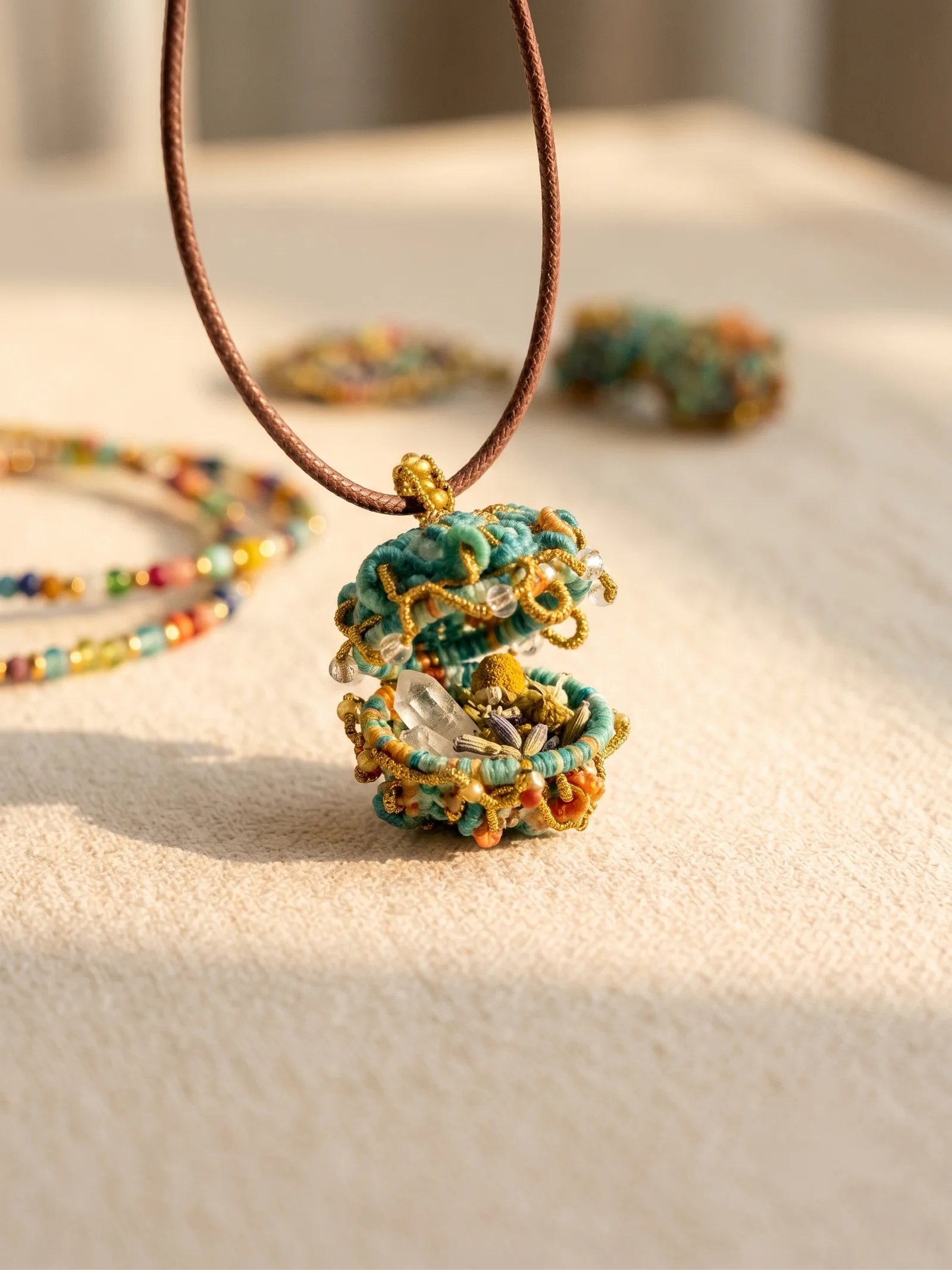
Visitors to the studio often ask why a jewelry table needs a stack of pressed leaves. The honest answer is that we do not design palettes from memory. Memory flatters color; a pressed page does not. The closest thing to wearing the press itself is an openable pendant — a small chamber, woven shut, that opens when you choose and keeps what you give it: one dried petal, a leaf no bigger than a fingernail, the first violet of the year. Our handwoven lotus keepsake pendant was knotted around that idea. The lotus opens and closes with the light every day of its life, and it holds its color long after it dries — a flower that spent its whole life practicing for the press.
Every piece we knot is made by hand, one at a time, and no two are alike. You choose from the palettes that already exist on the shelf — we think that is half the slow pleasure of it. A piece becomes yours the way a pressed page becomes yours: by what you tuck inside it, and by the days you give it after that.
Start a Small Pressed-Color Habit
You do not need an oak press to begin. You need a walk, two sheets of paper, and one heavy book.
First, pick one leaf or one petal on your next walk — a ginkgo leaf in its yellow week, a rose petal past its best day, a fern from the shaded side of the path. Lay it between the sheets, close the book, and leave it alone for three weeks. Pressing is mostly the art of not peeking. When the wait is over, the color underneath will be quieter and truer than anything you could mix.
Second, notice the colors your hands already return to while the book does its slow work — the mug you reach for first, the scarf that lives on the same hook all winter. That hue, not the one you admire in shop windows, is the one you will still want to wear next year.
Third, when the page finally opens, choose the piece that rhymes with it. A pressed fern asks for our fern-green-and-earth-brown handwoven bracelet. A dark winter page asks for the forest-green-and-deep-brown knotted one. A single perfect petal asks for a room of its own — the lotus keepsake pendant opens and closes for exactly that. And if you would rather wander first, the garden color notes in our Botanical Journal are a good place to start.
One more habit worth borrowing from the press: date every page. A pressed leaf is a letter from one specific week — the week the light changed, the week the first cold arrived. Write the date small in a corner of the paper. Years from now, the page will tell you not only what grew, but when.
If you press one thing this season, press two: one for the book, one for the wrist. In three weeks you will have a page for the shelf and a palette to match it — and the color you keep will be the color of one specific afternoon, yours. Which one is yours?
Nature, woven by hand. Color, woven into stories.
Want new palettes and studio notes in your inbox? Join the TibetanTwist newsletter.
