 Skip to content
✨ New Year Offer: Up to 20% off ·
Begin 2026 with something handmade ✨
✨ New Year Offer: Up to 20% off ·
Begin 2026 with something handmade ✨

Behind the Knots: A Day in Our Handwoven Studio


Morning light slides across the workbench, catching the edges of waxed cord spools — coral, pine green, oxblood red, cream, saffron gold. The studio smells faintly of beeswax and dried lavender from a bouquet that has been hanging by the window since spring. Somewhere in the middle of the table, half-finished bracelets wait in a row, their patterns paused mid-knot. This is where every TibetanTwist piece begins: not on a screen, not in a spreadsheet, but in our hands, one knot at a time.
Morning — Choosing the Day’s Palette
Before a single knot is tied, we spend the first hour of every day with color. Not on a screen — with real things. A peony from the garden. A pine branch from the walk to the studio. A storm sky photographed on the way in, the clouds stacked in layers of grey and blue. We lay these next to our waxed cord spools and let the morning light tell us which palette wants to be knotted today.
Color, for us, is never a hex code on a screen. It is a memory of something real — the exact pink of a peony petal just before it falls, the green of pine needles after rain, the blue-grey of a monsoon sky pressed flat against the hills. When we choose threads for a handwoven bracelet, we are choosing which slice of the outdoors to carry on a wrist.
This is why our studio table is always a mess of botanicals and cord. Dried flowers sit beside spools of oxblood and moss. River stones nestle against brass scissors. A jar of forget-me-nots from last week’s walk holds court next to a tray of coral and cream threads. The mess is not chaos — it is our color library, and every morning we open it like a book and read the pages.
Today the book says green. We pull three spools: a deep pine, a pale sage, and a brown that leans toward terracotta. These will become a Wood-element bracelet, and the palette comes straight from the branch of new leaves we found on the path this morning.
Midday — The Rhythm of Knotting
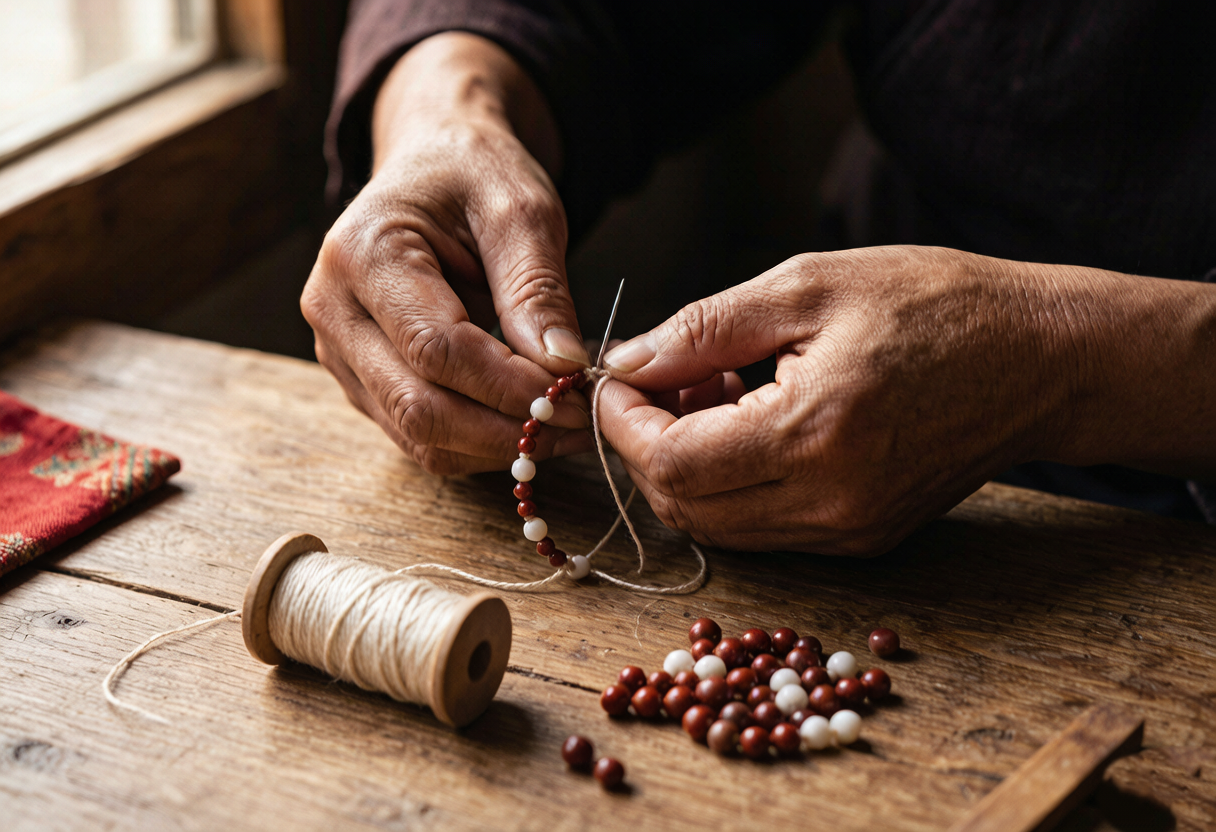
By eleven, the studio goes quiet. The choosing is done. Now comes the part that gives this brand its name: the twisting, the knotting, the slow building of pattern, one cross at a time.
Waxed cord has a particular feel between the fingers — slightly tacky, warm from the hand, firm enough to hold a knot but soft enough to drape against skin. We pull a length of pine green, anchor it to the workbench with a brass clip, and begin. Over, under, pull tight. Over, under, pull tight. The same motion, hundreds of times, until a pattern emerges from repetition.
People sometimes ask how long it takes to knot one bracelet. The honest answer is: longer than you think. A single-strand piece in a straightforward pattern might take a full afternoon of focused work. A multi-color piece with color changes — where we switch from pine green to cream to oxblood mid-row, splicing the cord and tucking the ends so the transition is invisible — can take two days. And an openable keepsake pendant, where the woven shell has to open and close around a tiny chamber, takes even longer. The cord has to be tight enough to hold its shape but flexible enough to hinge without fraying.
We do not rush this. The cord tells us when a knot is right — you can feel it seat into place, firm and even, the wax gripping just enough. A rushed knot looks rushed. A knot made with patience looks like it was always meant to be there, like it grew out of the thread itself. That is the difference between handwoven jewelry and everything else: you can see the time in it.
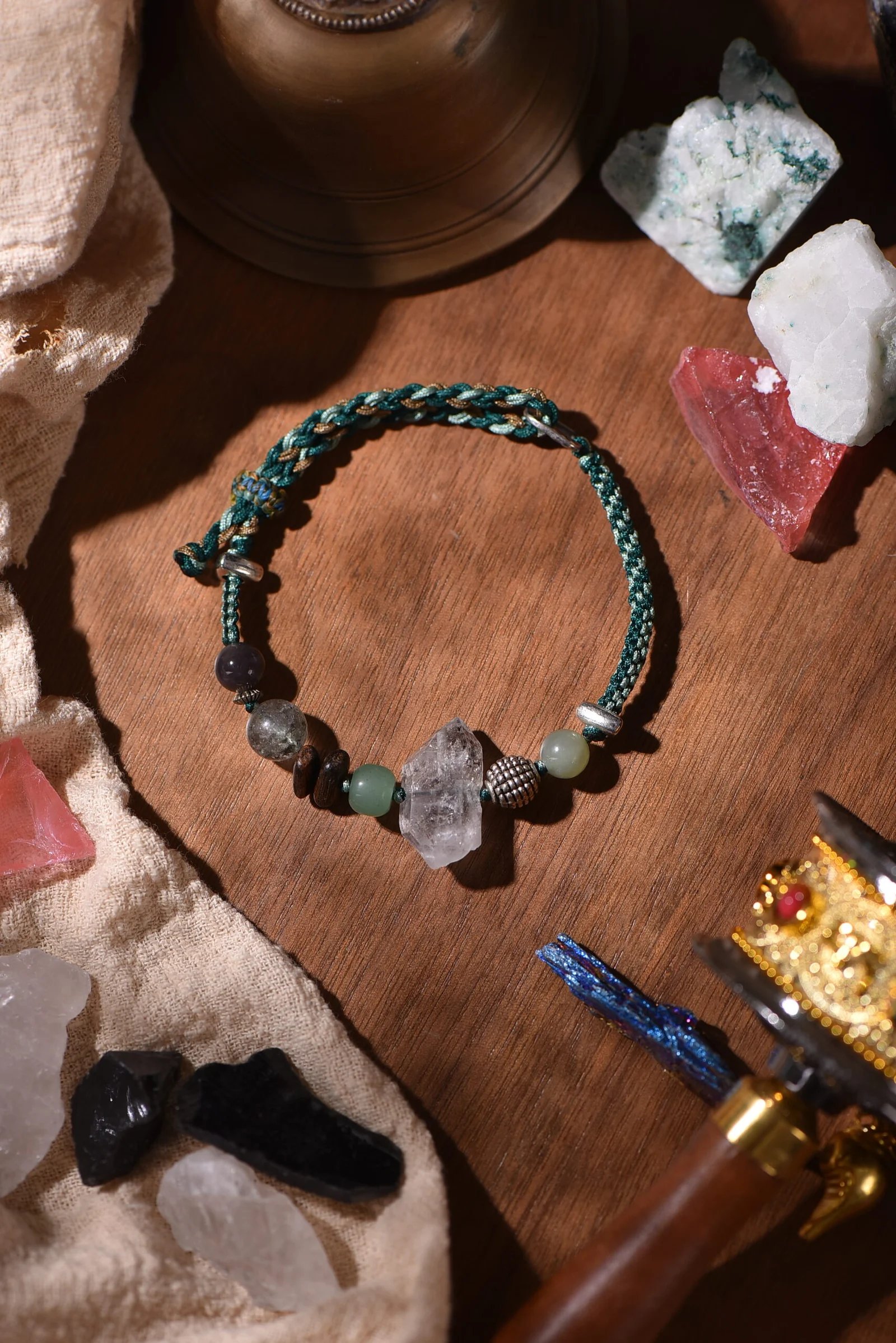
That green-and-brown piece on the bench right now is one of our Five Elements Wood bracelets — a single-strand design in pine green and earth brown that takes its palette from new growth in early spring. Every knot in it is pulled by hand, and no two come out exactly alike. That is not a line we put on a tag. It is simply what happens when a human hand ties four hundred knots in a row — the tension shifts, the cord warms, the pattern breathes.
Afternoon — When a Piece Comes Together
After lunch, the studio light shifts. The morning’s sharp angles soften into a warm amber glow that makes every color on the table look deeper and richer. This is when we finish pieces — adding the brass clasps, trimming the cord ends with a heated blade, pressing the final thread tip so it seals flat against the knot.
Finishing is its own craft. A bracelet that has been knotted beautifully can still look unfinished if the clasp sits crooked or the cord end frays. We check every piece against the window light, turning it slowly, looking for any knot that sat uneven or any color transition that jumps. If something is off, we unknot and redo it. If it cannot be fixed, the piece goes in the remnant jar — we save the cord for smaller work, and nothing is wasted.
Some afternoons are also for the more intricate pieces — the ones that cannot be rushed even by our standards. Our keepsake pendants are woven around a tiny chamber that opens, holding whatever small thing you want to keep close — a pressed flower, a snippet of cord, a folded note with no writing on it. The weaving on these has to be precise enough to hinge and close, and loose enough to open without the cord fraying at the seam. It is the kind of work that demands a clear head and steady hands, which is why we save it for the afternoon, when the phone stops ringing and the only sound is the scrape of cord against cord.
Which Piece Will You Wear First?
By late afternoon, the day’s pieces are on the drying rack. A row of bracelets in pine green and cream. A keepsake pendant in oxblood red. A few experimental color combinations — coral and indigo, saffron and moss — that we are testing for the next season. The studio smells of beeswax and warm cord. Outside, the garden is going gold.
If you are new to handwoven jewelry, here is how we suggest choosing your first piece:
Start with color, not complexity. Pick the palette that reminds you of a place — a garden, a sky, a walk in the woods. The bracelets collection is a good place to browse; each piece is photographed in natural light so you can see the true colors without a filter.
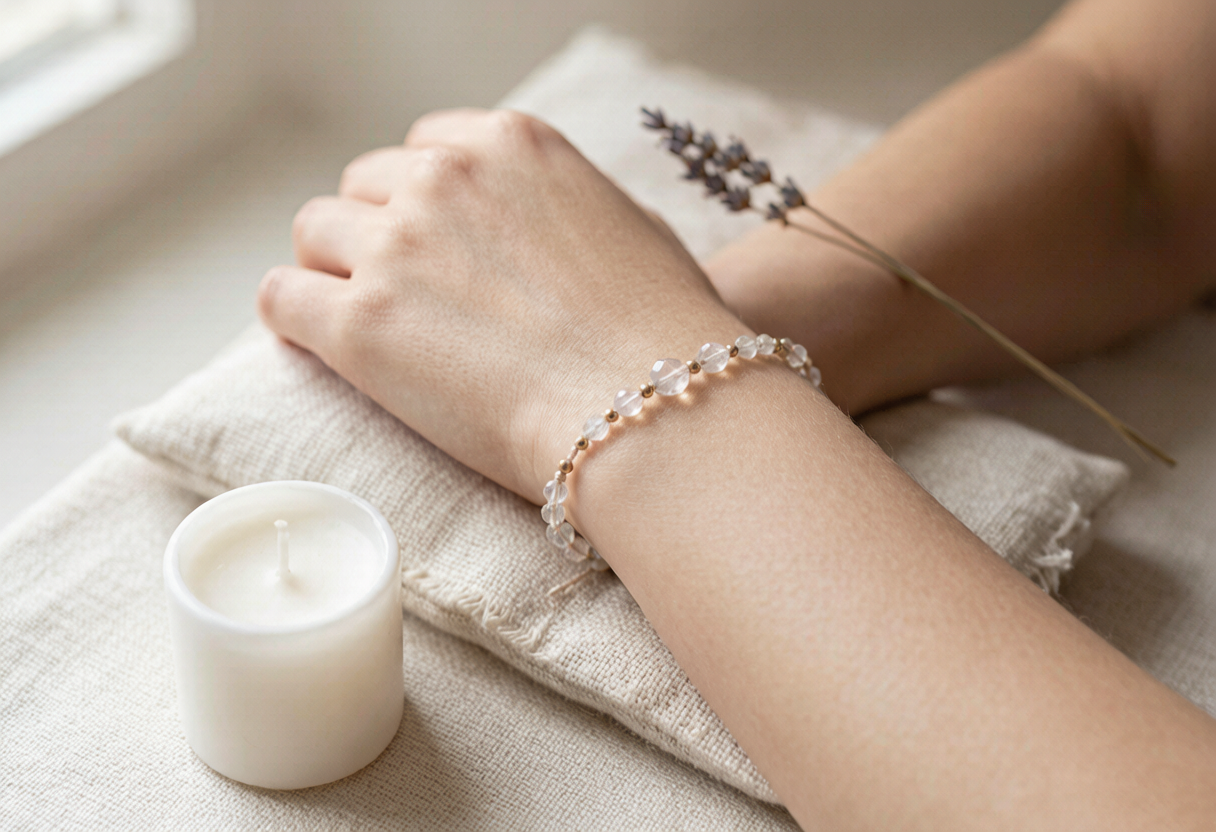
Think about how you wear it. A single-strand bracelet in two colors is quiet and everyday — it goes with linen, denim, a cotton sleeve. A multi-color piece or a keepsake pendant is more of a statement — something you wear when you want the piece to be the first thing someone notices.
Let the cord do the work. Waxed cord is lightweight, skin-friendly, and breaks in beautifully. It softens over time without losing its shape. You do not need to baby it. Wear it in the garden, wear it in the rain, let it age. The color deepens. The knots settle into each other. It becomes yours in a way that a factory-made piece never does.
If you already know your palette, try our orange-and-gold handwoven bracelet — a warm, bold piece that carries sunset colors into everyday wear. Or start with something green and grounded, like the Five Elements Wood bracelet above. Either way, you are wearing something made by hand, one knot at a time, in a small studio where the cord smells of beeswax and the light is always changing.
Nature, woven by hand. Color, woven into stories.
Want more from the studio? Join our mailing list for new pieces, color stories, and behind-the-scenes notes from the workbench.
