 Skip to content
✨ New Year Offer: Up to 20% off ·
Begin 2026 with something handmade ✨
✨ New Year Offer: Up to 20% off ·
Begin 2026 with something handmade ✨

Keepsake Jewelry: The Pendulum of Scent


Somewhere in the middle of the afternoon, a dried rose is put back into a handwoven chamber the size of a walnut, and the room changes. Not because the flower is loud, and not because anyone stops what they are doing. It is a line of scent that crosses the air the way a thread crosses a loom: thin, deliberate, and impossible to ignore once your eyes have found it.
That is the whole argument for a keepsake piece over a bottle. A bottle holds everything at once, sealed and even. A woven chamber holds a little, releases a little, and takes in something new when the first thing has gone quiet. It behaves less like a product and more like a small room with a door.
This is the third time we have written about this side of our work, so let us start somewhere new: not with the history of botanical scenting, and not with a list of what fits inside. Let us start with the air on both sides of the door.
Where the Scent Goes: Inside the Thread
When someone writes to us about a piece that has softened, they usually think the petals have given up. Most of the time the petals are still working. What has changed is the air around them, and how much of that air the thread is willing to hold.
Waxed cord is not a neutral material. The thread we knot carries a thin coat of beeswax, applied while it is warm, and that coat does two jobs we did not expect in our first year. It makes the cord grippy enough that a knot stays where we put it. And it holds the smallest trace of whatever has been near it — the oils of a dried petal, the dusty green of a crushed leaf, the faint sweetness of a seed husk. Not much. Just enough that a wearer tilting the pendant close to their face notices something before they see anything.
The weave matters as much as the coat. A tight, even knot wall closes the sides of the chamber and lets the scent out mostly through the top opening. A looser wall lets the whole surface breathe, so the scent leaves faster and softer, spread across the day instead of arriving all at once. Neither is better. They are two different temperaments, and we build both.
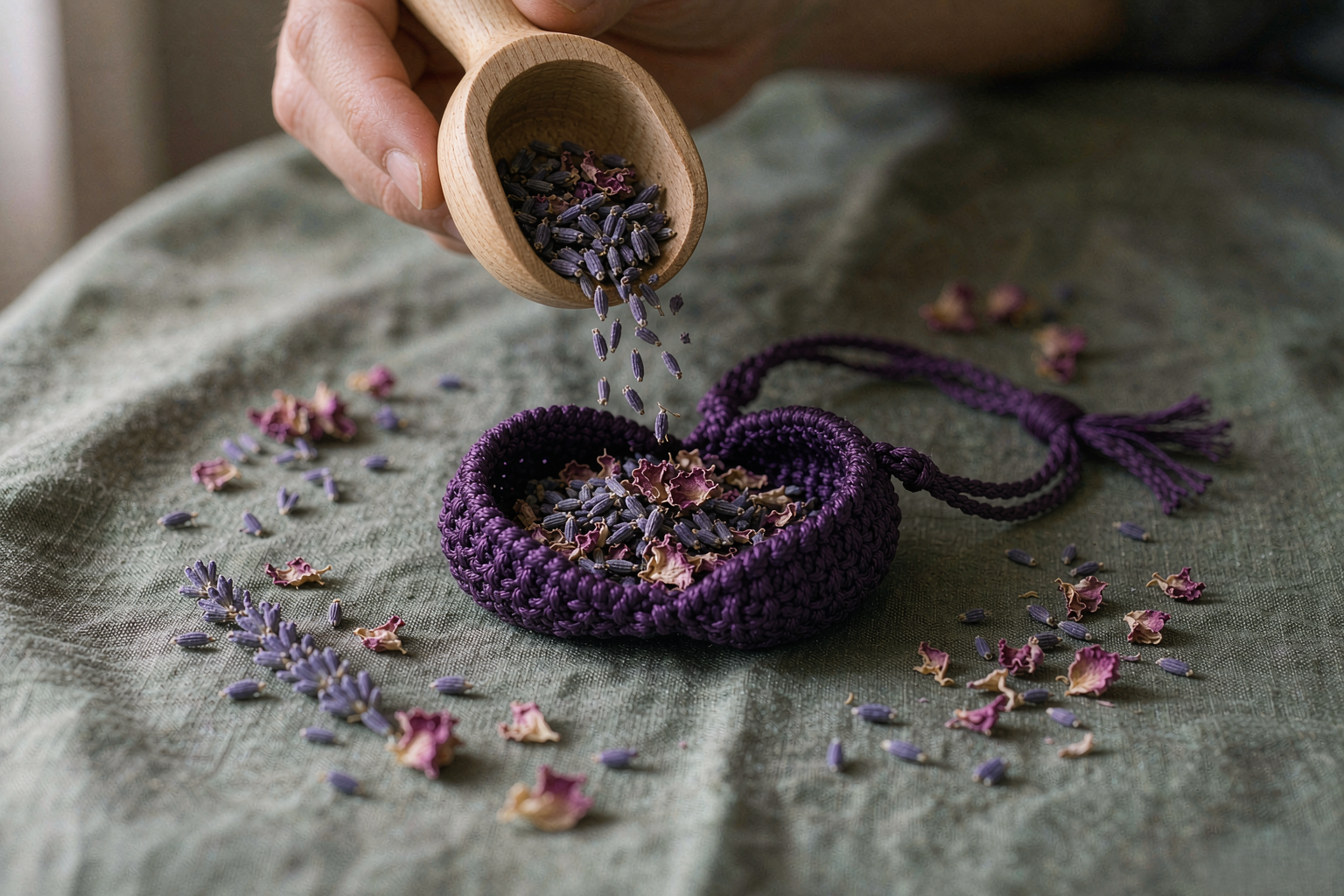
The Scent of a Keepsake: Three Lives in One Chamber
A piece made of real botanicals will pass through three distinct lives, and knowing them is the difference between disappointment and affection.
The green life. In the first two or three weeks, the plant is still finishing its drying. Lavender keeps a bright, almost sharp edge. Rose is strongest for a few days and then draws back. Mint smells like a stem snapped in a warm hand. This is the loudest period and, for many people, the least comfortable one — it can read as too much. Give it time.
The dry life. After a month, the scent settles into something flatter and closer to the material itself: hay, paper, warm dust, a cupboard where someone once kept dried flowers. Some people love this phase more than the first. It is the smell of a book that has been read, not a sample in a shop.
The quiet life. Eventually the chamber holds what a stone holds — the memory of a smell rather than the smell. This is not a failure. It is the reason the chamber opens. One spoon, one new petal, and the third life becomes a fourth.
We test a small set of botanicals every season, and the ones that survive well are rarely the fragrant ones with the most oil. Strong oils fade fastest, because they have the furthest to fall. The quiet ones — dried grass, a seed cone, cedar shaving, the pale inner husk of a garlic-flower bud — enter slowly and leave as slowly, which is closer to the way a garden actually smells.
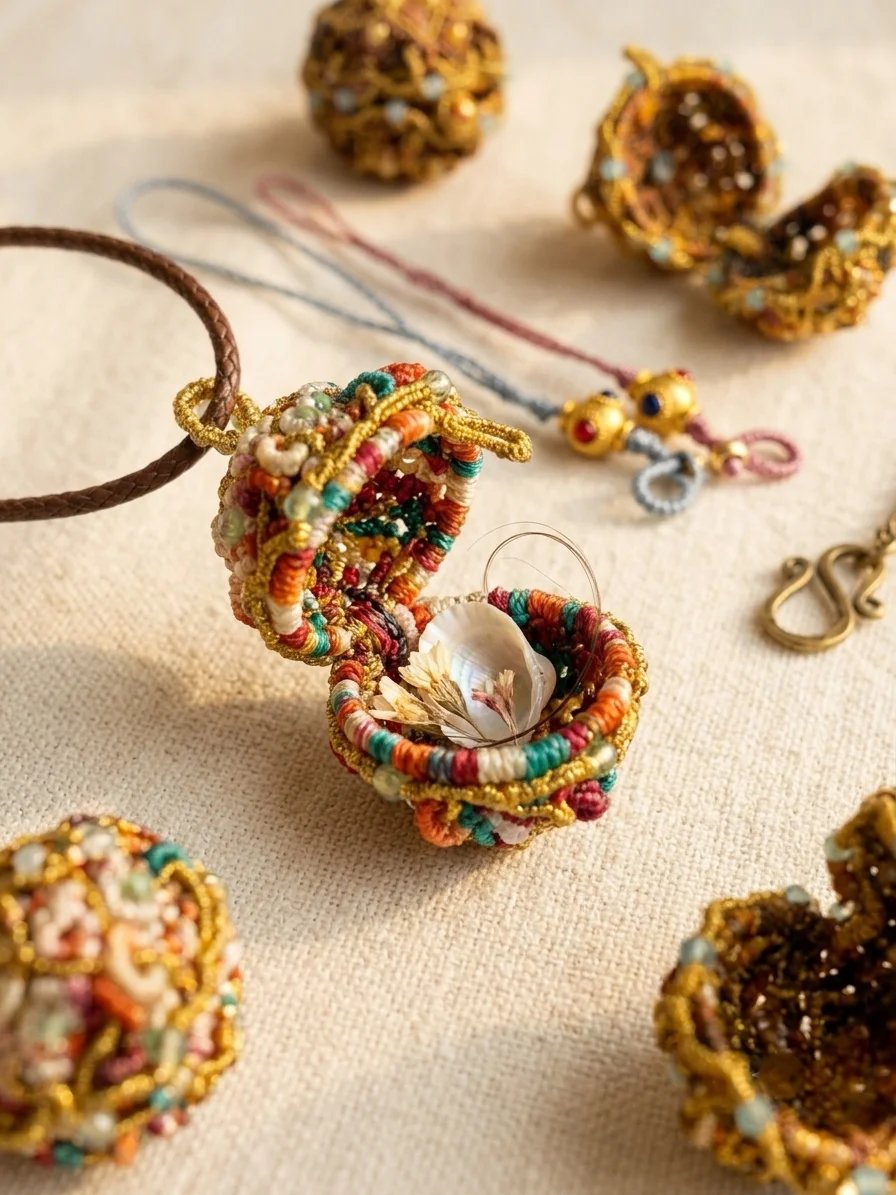
A Little Room, and What It Changes
Here is a thing we did not expect when we began knotting these chambers: the object changes how the wearer handles scent, and the handling changes what scent is for.
A bottle teaches you to spray at a distance and forget. A woven chamber teaches you learn to open, look, choose, and close — four small actions that take about a minute and resist being rushed. The piece hangs less than a hand’s span from the face. What sits inside has been picked up with fingers. There is no spray, no mist, no cloud to walk through.
That minute is the whole design. We size the opening so a fingertip fits but a scoop does not. We leave the hinge loose so the lid falls open with gravity and closes with a click. We knot a short cord on one side, long enough to find in the dark, short enough that the piece never taps against a collarbone when walking.
And we build the chamber to be looked into. The inside wall is finished — not a rough, unconsidered back. When the lid opens and the light comes in, the weave is the first thing seen, and the petals sit on it like a small worn floor. Two minutes of work that no one sees when it is closed, and everything when it is open.
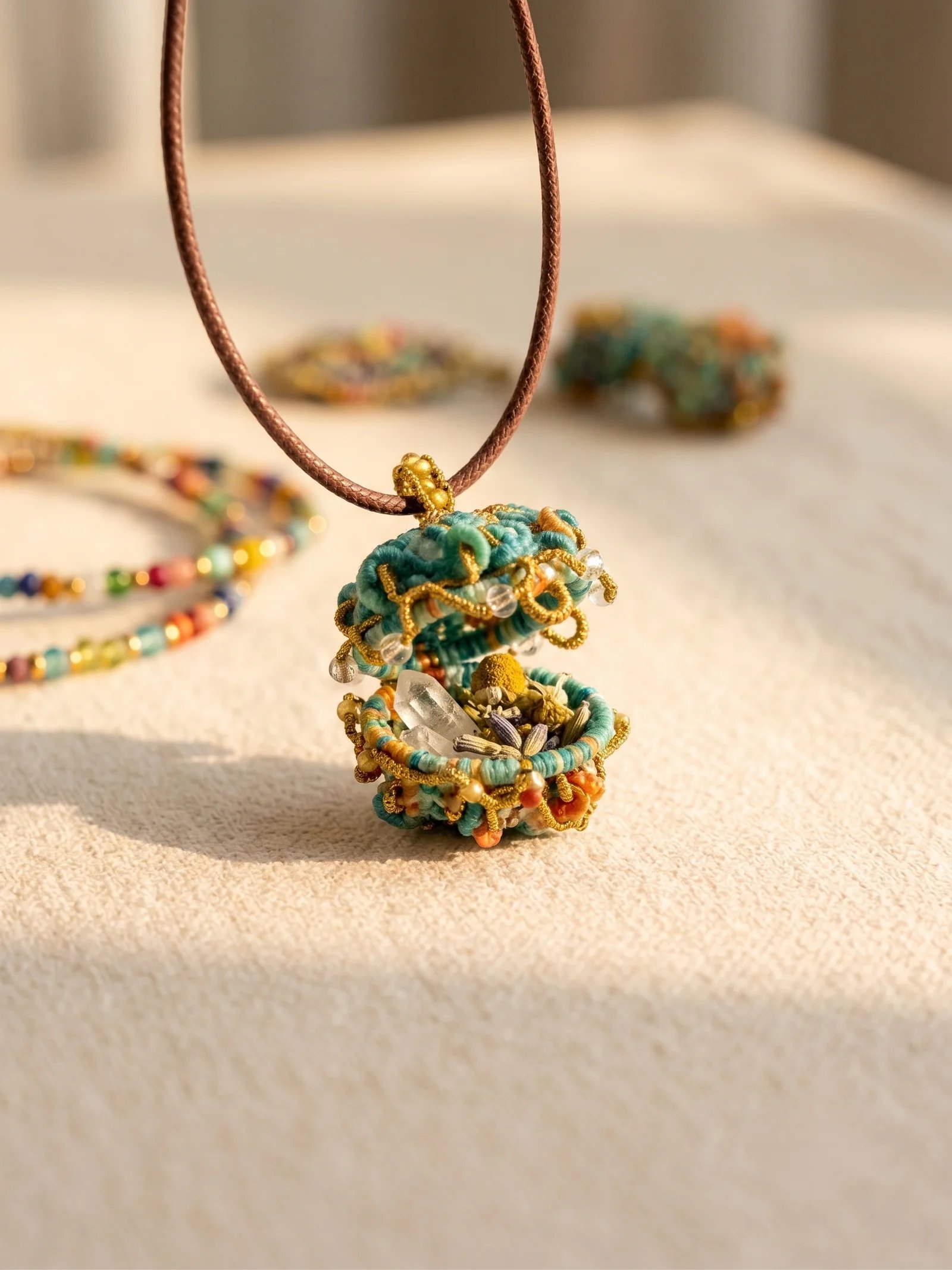
How to Refill the Chamber, Season by Season
Refilling is the part where most people stop, usually because they are afraid of breaking something. Nothing here breaks. The piece is cord and thread; it bends before it fails.
Our own sequence, for anyone who wants to follow it:
Open the chamber with two fingers on the rim, never by the hinge. Tip it over a dish and let the old contents fall out on their own. Do not pull; dried petals catch in the weave and pulling loosens the knot wall.
Wipe the inside with a dry cloth, once, no pressing. If you want to clear the old scent faster, leave the chamber open overnight on a windowsill out of direct sun. Air does more than water ever will.
Fill no more than two-thirds. A full chamber presses the botanicals flat and holds nothing. Two-thirds leaves air to move, and moving air is the whole mechanism.
Close it, wear it for an hour, and then decide. The first hour is always too strong. The second day is the truth.
If you are choosing from our current pieces, three that we build for this purpose:
- A teal-and-coral handwoven keepsake pendant with a gold thread running through the wall and a clear quartz resting on top of the botanicals — the roomiest chamber we knot, and the one that changes the most with the seasons. See the teal and coral keepsake.
- A cream-and-blush handwoven keepsake box charm, pale as a linen press, finer in the wall than the teal piece — best for one quiet botanical and a single stone. See the cream and blush keepsake.
- A rose-and-sage handwoven herbal bracelet, where the botanicals sit woven into the band itself instead of a chamber — for anyone who wants a scent that stays put and never needs opening. See the purple and black herbal piece.
If you would rather read before you choose, our keepsake and memory journal collects everything we have written about what these chambers hold, and the woven keepsakes page lists the pieces that are finished and waiting.
One last note on the air. A scent you carry is not a scent you apply. It does not announce itself in a room and it does not need to. It waits in a small woven room, half a hand from your face, and speaks only when you choose to lean in. There is a certain honesty in that — a garden that gives you one petal at a time.
Nature, woven by hand. Color, woven into stories.
If you would like our next chapter on what these chambers hold to arrive in your inbox — one quiet letter, now and then, straight from the workbench — join our newsletter below.
