 Skip to content
✨ New Year Offer: Up to 20% off ·
Begin 2026 with something handmade ✨
✨ New Year Offer: Up to 20% off ·
Begin 2026 with something handmade ✨

Handwoven Jewelry: The Daily Practice | TibetanTwist

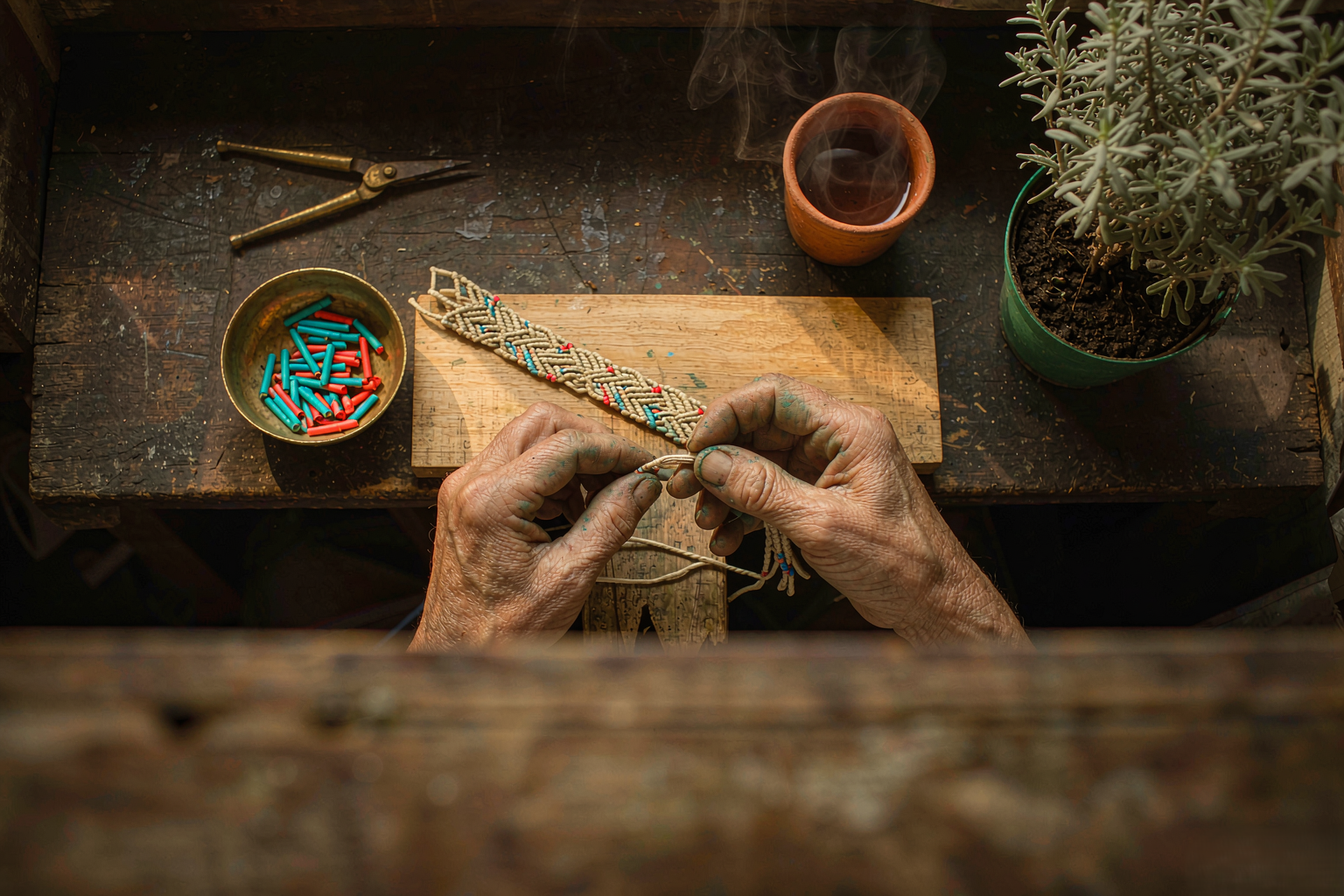
Some mornings the studio smells of wax and cold tea. The window is still fogged. I sit down, pull a spool of oxblood cord closer, and begin again — the same four knots, the same small tension, the two hundredth or the two thousandth time.
That is the part of handmade handwoven jewelry nobody photographs. We talk about the finished piece because it is easy to look at. But the finished piece is only the last hour of a practice that happens every day, whether anyone is watching or not.
Knot, Rest, Unpick: The Practice Behind Handwoven Jewelry
At TibetanTwist, the workday does not start with a design. It starts with a practice.
Each of us keeps a practice cord — a scrap about the length of a forearm that never becomes jewelry. We knot it for ten minutes before we touch a real strand. The point is not to make something. The point is to arrive. Hands that have just been holding a phone or a cup of tea are not hands that can tie evenly, and the practice cord brings them back.
The same progression happens on that cord every single day. We call it knot, rest, unpick. First the knot: whatever the hands can manage that morning. Then the rest: the cord goes into a drawer with a note about what felt wrong. Then the unpick: the next day we undo the worst section and knot it again, and the difference tells us what changed — our grip, our patience, the weather, whether we slept.
Nobody is talented at this at eight in the morning. We are simply not allowed to skip the practice cord, and after a few hundred mornings the knots stop being decisions. They become rhythm. That is all craft really is: a small thing repeated until the hand stops asking permission.
Cord Prep: What Happens Before the First Knot
If the practice cord is the ritual, cord prep is the quiet craft nobody thinks to ask about. It is also where most of the day goes.
Waxed cord does not arrive ready. A new spool is stiff and slightly glossy, and the wax sits unevenly from the factory roll. We unwind it, check for a flat spot or a soft section, and run it through the fingers twice to spread the coating. Then it rests. Cord that has rested holds tension better than cord pulled straight from the spool.
Color is the other half of prep, and it is the slowest part of the morning. We put the candidate strands next to a real botanical — a dried sprig, a pressed petal, a single leaf — rather than next to each other. Two greens can agree beautifully on a table and still disagree against the thing that inspired them.
There is a small notebook on the bench for this, and it is not tidy. Pages hold a loop of pine green taped beside a leaf, another loop in monsoon sky blue beside nothing at all, only a note about the rain that day. When a palette finally reads right, the piece takes about a day to knot. The preparation took a week.

Knotting is where color and time finally meet. A knot is not decoration laid on top of a material; it is the material rearranged until it holds light differently.
Each knot has its own character. Some sit flat and almost vanish, letting the cord do the talking. Others stack into a small ridge that catches daylight on one side and shadow on the other — the same oxblood red reads brighter in one knot and deeper in the next. When we plan a piece, we are not choosing colors so much as choosing where the colors will be seen from.
Time enters through tension. Pull a cord a fraction tighter than its neighbor and the weave narrows slightly for the next row; the color bands compress and the pattern tightens the way a breath does. Over a full bracelet, those small shifts build a texture that is completely unique to that one piece — no two alike, and not because we try, but because hands are not machines. On a good afternoon the wrist band comes out a millimeter and a half different from the one before it, and that difference is the whole reason it exists.
A Day of Practice, From Bench to Box
The day has a shape, and it never changes.
Mornings belong to preparation: practice cord, cord inspection, a first real look at the palette in natural light while the sun is still low and honest. Midday belongs to knotting, when the room is warm enough that cord goes supple. Late afternoon is for finishing — pulling the short ends, trimming each tail to the same length by eye rather than by ruler. Then the slow look, holding the piece at arm’s length in the doorway where light comes in sideways. If a color band is bullying its neighbors, it comes apart. It happens more often than we admit.
The evening box is small and plain. Inside goes the piece, a handwritten note about the cord lots used and the day it was knotted, and nothing else. We stack the day boxes near the door and they wait for the walk to the drop point, which is our favorite part — a small, ordinary walk that turns an object in a workshop into something on its way to a wrist.

Which Piece Fits Your Own Daily Practice
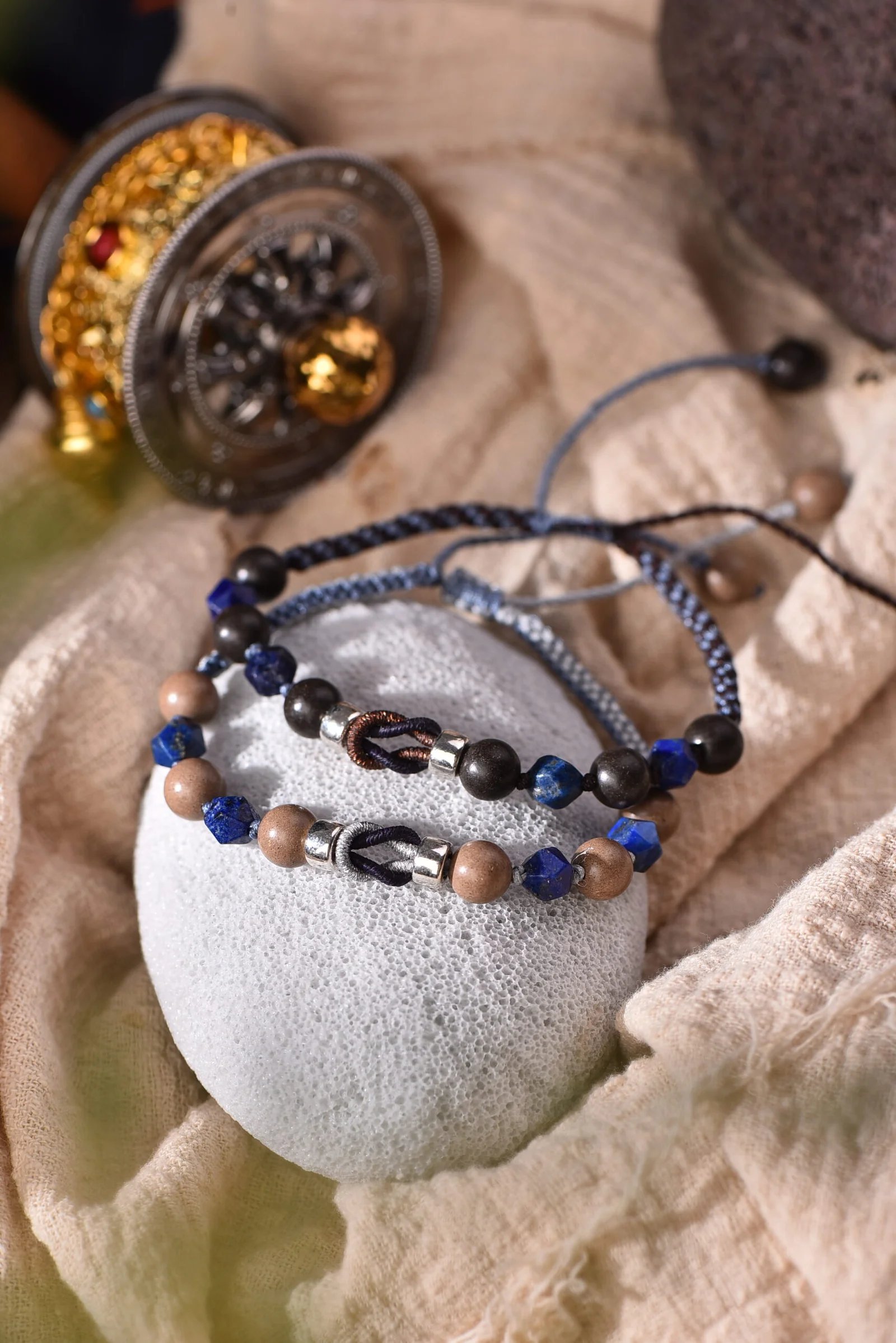
If you wear bamboo and linen, a cord in bark brown and pine green will feel like it was always in your closet. If your everyday is denim and white cotton, a handwoven bracelet in monsoon sky blue and indigo has enough lift to be noticed without asking for attention. And if you prefer quieter, warmer tones, our cream, gold and terracotta single strand sits easily against a bare wrist all year.
Wear the piece the way we make it: daily. Take it off for salt water and long showers — the wax can handle rain, not the sea — and let the cord darken slowly where it touches your wrist. That mark is not wear. It is the record of a practice, yours and ours overlapping.
You can explore the full range of handwoven bracelets and keepsakes or read more about how every piece is finished in our craft and process journal. Each piece is made by hand, one at a time, and choosing from the existing collections is the only way we work.
Nature, woven by hand. Color, woven into stories.
If you would like to see what the bench looked like this week, subscribe to our newsletter — one letter, sent slowly, with a knot, a color, and the small difference a day makes.
