 Skip to content
✨ New Year Offer: Up to 20% off ·
Begin 2026 with something handmade ✨
✨ New Year Offer: Up to 20% off ·
Begin 2026 with something handmade ✨

Why Waxed Cord Beats Chain: Material Behind the Knot


Every TibetanTwist bracelet starts with a question that has nothing to do with color: what should the cord be? Before we pick a palette or plan a pattern, we choose the one material every knot will live inside. We have tried the alternatives — and we keep coming back to waxed cord. This is the argument behind that choice, and why it shapes every piece of handwoven jewelry that leaves our studio.
Why Not Chain, Leather, or Elastic?
Walk through any jewelry counter and you will meet three common carriers: metal chain, leather, and elastic. Each one does a job. None of them does our job.
Chain is rigid by design. It holds a pendant beautifully, but it has no grip — a knot tied in chain is a decoration, not a structure. If we wove our color bands in chain, we would need clasps, solder, and findings to do the holding. That moves the craft from hands to hardware, and it makes a piece that cannot flex with your wrist.
Leather has warmth and age to it, and we respect it. But leather is a hide, not a thread. It comes in a narrow range of tones — browns, blacks, tans — and it resists dye in ways cotton never does. Our palettes are the point: peony pink, pine green, monsoon sky blue, oxblood red. Leather cannot carry a garden. Waxed cotton can.
Elastic is the quiet tempter. It makes one-size bracelets effortless. But elastic is a factory shortcut with a short memory: it stretches white, yellows with sweat, and eventually snaps. A knotted bracelet should not expire. When you tie a piece in waxed cord, the structure lives in the knots themselves, so nothing is waiting to break.
Waxed cord wins because it is the only material here that is both a structure and a canvas. It grips itself so knots hold without glue. It takes dye deeply, so color reads like the thing it came from. And it stays soft against skin, so a bracelet can be worn daily instead of saved for occasions.

You can see that dual role in our oxblood-and-cream infinity knot bracelet. Two cords, two tones, one knot that holds them together — no clasp, no solder, just waxed cotton doing both jobs at once.
Thin Cord or Wide Braid: Thickness Is a Design Decision
Once you have chosen cord, the next question is width. We stock everything from a slender single strand to a broad woven band, and the choice is never random. Thickness decides how a piece sits, how it stacks, and how much color it can carry.
A single thin strand reads like a line of ink. It sits close to the wrist, slips under sleeves, and layers without bulk. It is the cord equivalent of a fine pen stroke — quiet on its own, striking in company. Our pine-green and bark-brown single strand is exactly that: one slim waxed cord, knotted through with small stops of color, made to be worn alone or stacked two and three deep.
A wide braid does the opposite. It turns color into a field instead of a line. When we weave a broad band, the palette needs more internal contrast, because there is room for the eye to wander across it. Thickness also changes the knots: on wide cord, each knot is a visible event; on thin cord, they dissolve into texture.
We decide width on real wrists, not on paper. A band that looks perfect on the bench can sit too proud on a small wrist, and a slim strand can disappear under a watch. So every new width spends a day on our own arms — typing, cooking, carrying — before it earns a place in the collection. If it annoys us by evening, it never reaches you.
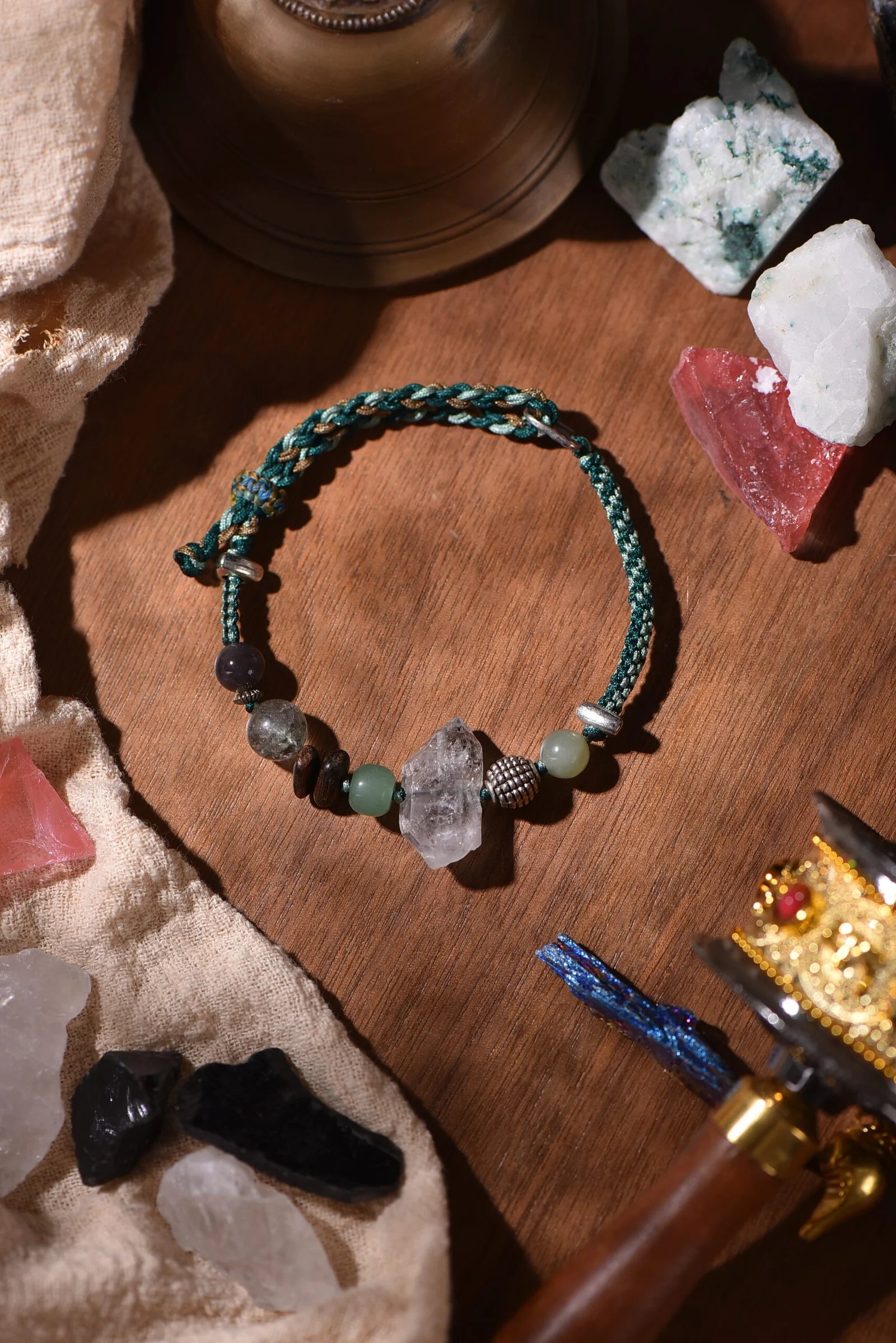
There is a third variable people rarely notice: ply. A cord of many fine threads behaves differently from a cord of few thick ones. More plies mean more grip inside a knot, which is why we reach for high-ply cord on pieces where two directions of strand meet. Fewer plies mean a softer bend, which suits slim stacking pieces. None of this shows on a product photo, but you feel it the moment you tie one on.
One Size That Fits: The Adjustable Knot
Here is a practical question we get almost weekly: how does a knotted bracelet fit wrists it has never met? The answer is one of the oldest techniques in our craft — the sliding knot.
At the open end of most of our pieces, two cords pass through a small woven loop. Pull them apart and the loop tightens; slide them together and it opens. No clasp to fumble, no links to count, no sizing chart to consult. The same bracelet fits a seven-year-old and her grandmother, which makes these pieces easy to gift and easy to share.
An adjustable knot also ages well. Chain bracelets live or die by a single spring ring; when it fails, the piece is finished. A sliding knot has no moving parts. If it loosens over months of wear, you pull it snug again — the cord re-grips itself, and the bracelet carries on. That repairability is not an accident. It is what happens when the structure of a piece lives in knots instead of findings.
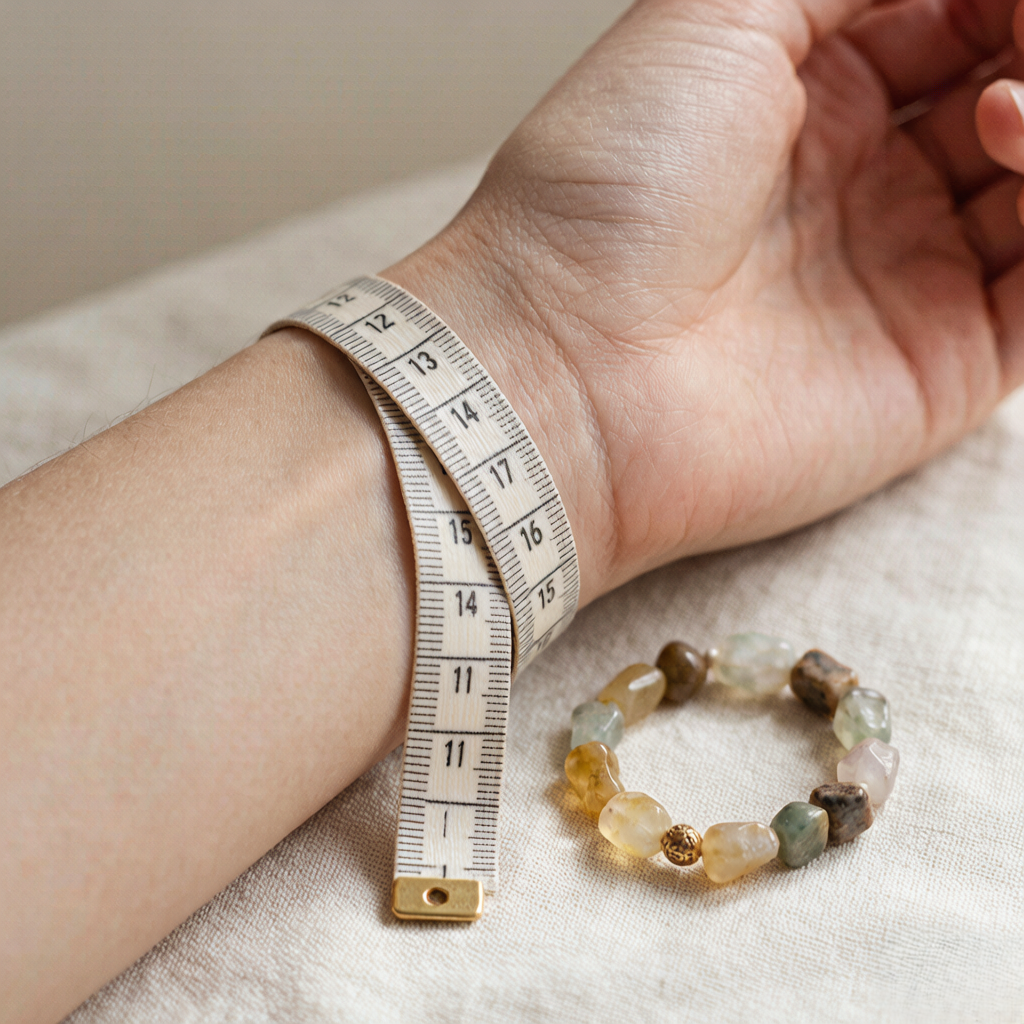
If you like a closer fit, wrap a strip of paper around your wrist and mark where it meets. That single number is all you need — slide the knot to match, and the bracelet sits exactly where you want it, snug for stacking or loose for a warm afternoon.
Which Cord Feels Like Yours?
Every piece we make is knotted by hand, one at a time, so no two are alike — and the cord is why. It is the reason a bracelet can carry garden color, hold its knots for years, and fit a wrist we have never measured. Browse the full range in our bracelets collection, or read more about how we work in our craft and process notes. If a sunny woven band is more your pace, the yellow-and-monsoon-blue woven bracelet carries the same waxed-cord logic in a wider braid.
Pick the palette that sounds like your kind of weather, and let the cord do the quiet work of holding it.
Nature, woven by hand. Color, woven into stories.
Want more from the studio — new palettes, knot notes, and pieces fresh off the bench? Join our newsletter and we will write to you when something is worth seeing.
