 Skip to content
✨ New Year Offer: Up to 20% off ·
Begin 2026 with something handmade ✨
✨ New Year Offer: Up to 20% off ·
Begin 2026 with something handmade ✨

Five Elements Jewelry: The Scheme of Control | TibetanTwist

Five Elements Jewelry: The Scheme of Control, Woven | TibetanTwist
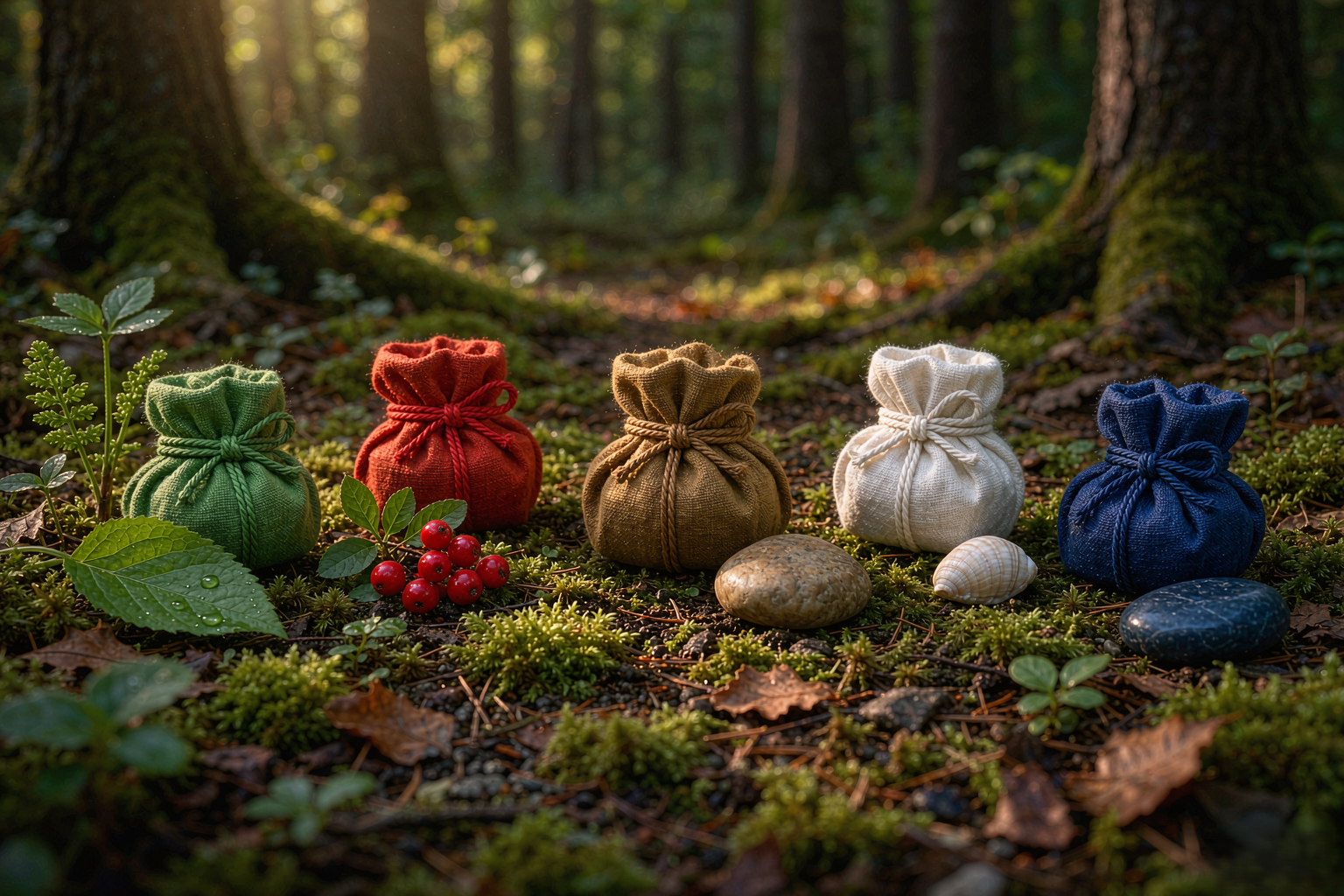
In the old Chinese books the five elements are not a mood board. Wood, Fire, Earth, Metal, Water are arranged in two different orders, and the whole system turns on the difference between them. One order says: this creates the next. The other says: this restrains it. Both were drawn to manage a landscape — a field, a river, an oven, a forest — long before anyone thought to wear them.
Five Elements Jewelry is what happened when we took those two orders and asked a simpler question: what happens if you knot them? A bracelet is a very small landscape. It has a beginning, a middle and an end, and colors that either feed each other or hold each other back. Here is how the weavers of the scheme of control changed the way we sit at the bench.
The Scheme of Control: Wood Breaks Earth, Earth Stops Water
Every element shares one word with the one beside it. Wood breaks earth, because roots split soil. Earth stops water, because a bank ends a current. Water quenches fire. Fire melts metal. Metal cuts wood. That is the restrained sequence, and it closes on itself in five steps.
The other order is easier to love. Water feeds wood. Wood feeds fire. Fire leaves ash, which is earth. Earth yields metal. Metal, cooled, gathers water. Creation runs in a ring, and every element is somebody’s parent.
What surprised us is how physical both orders are. Neither is a metaphor. Put a green strand beside a red one and the red gets louder — that is wood feeding fire, visible on a wrist. Put that same green beside a river blue and it settles instead, retracting by half a shade. The knot does not know anything about cosmology. It only knows that some hues push and some hues hold.
Weavers understood this first. Tibetan and Chinese textiles both build pattern in passes, and every pass has a job: one color lays down the ground, one cuts across it, one rests. A sash is a diagram of restraint. Read it as a chart, not a pattern, and the logic is right there in the weave.
There is a second lesson in those cloths, and it took us a while to notice it. A good sash never repeats the same width of color twice. The bands widen and narrow, and the eye reads that rhythm as movement. Our wrists work the same way. A bracelet that gives equal space to five colors looks like a sample card; a bracelet that gives one color a wide pass and another a single thread looks like it was chosen by a person. Restraint, in cloth and in jewelry, is mostly a matter of proportion rather than subtraction.
Reading a Wrist the Way We Read a Piece of Cloth
Once the sequence is in your head, a wrist stops looking like an accessory and starts looking like a small system.
Start with the color that is doing the most work. On most wrists that is the deepest hue — oxblood, indigo, pine. Call it the center, because everything else has to answer to it. If nothing answers, the piece reads as one heavy note held too long.
Then ask what that center needs. If it needs to be held back, add its restrained partner: indigo beside oxblood, cream beside deep ochre. If it needs to be opened up, add the element that feeds it: pine beside oxide red, pale gold beside river blue.
And if you cannot decide, look at where the colors meet. In a hand-knotted piece the answer is usually already there — the transition is where the tension changes, and where the weaver made a decision. Knots do not lie about weight. A strand that is being restrained is pulled tighter than one that is simply along for the ride, and you can feel the difference under a fingertip long before you can name it.
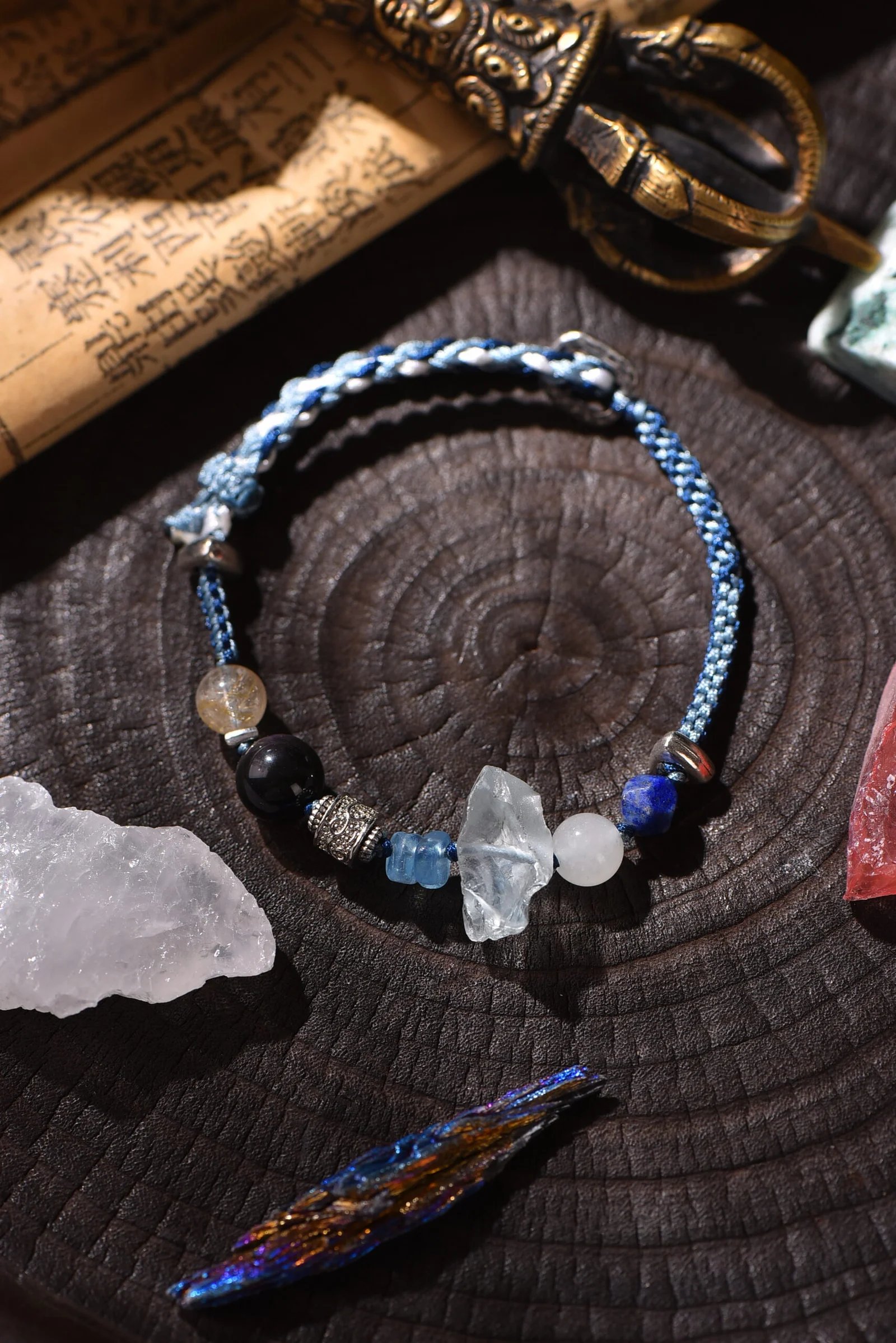
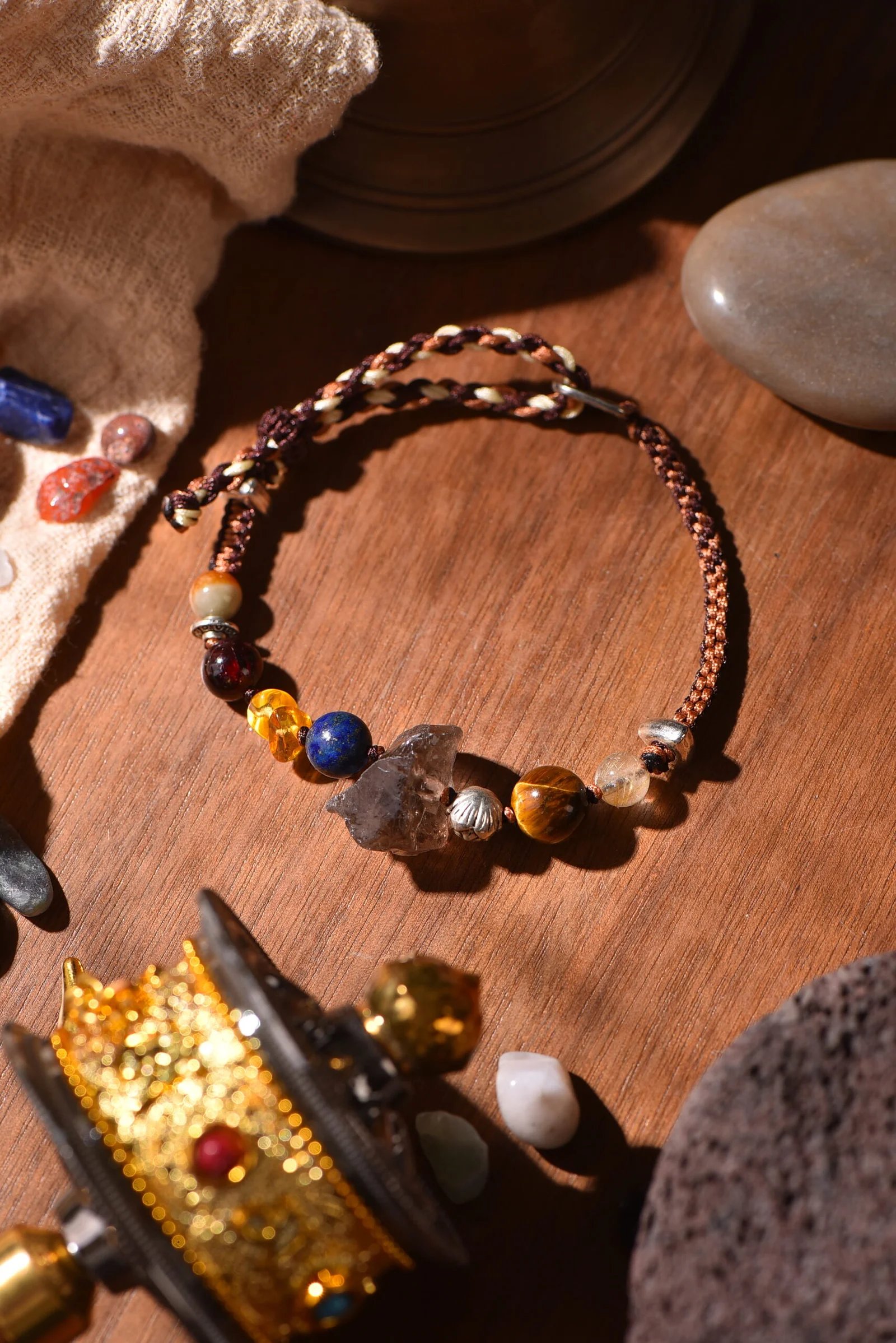
Our river-blue and white woven bracelet is a study in restraint: the blue never touches a warm hue, and the white does all the holding. Its opposite is our terracotta, cream and earth-brown piece, where three warm colors succeed each other and the cream is the only thing stopping the shoulder from tipping.
What the Five Terrains Look Like Woven
We keep the whole scheme in a notebook, one page per element, and each page is a place rather than an idea.
Wood is a spring branch with the bark still on: pine green carrying, bark brown holding. It feeds fire and it breaks earth, which is why green next to red goes bright and green next to ochre goes quiet.
Fire is a hearth at dusk: oxide red with white ash. It feeds earth and it melts metal, so a red strand will always make a gold one look hotter than it is.
Earth is a turned field after rain: terracotta, ochre, a little cream. It feeds metal and it stops water, which is the most useful rule on the page — if your blues feel adrift, put one brown thread at the edge of the blue and the piece suddenly sits down.
Metal is a pale stone at midday: cream, bone, a thread of old gold. It cuts wood and it gathers water, which is why a single cream strand can lighten a whole green bracelet without adding a second bright color.
Water is a river under cloud: indigo with a white edge. It quenches fire and it feeds wood, so blue beside red is fighting and blue beside pine is a riverbank.
Our pale-gold, cream and brown handwoven bracelet is the one we lend to people who are unsure. Metal is the quietest page in the notebook and the easiest to wear beside anything else — it cuts, and cutting is often what a crowded wrist needs.
How to Choose: Three Questions Before You Order
You do not need to memorize any of this. Three questions will get you to the right page.
What is the loudest thing you own? If it is a deep red scarf or an indigo coat, note it. That is your center, and your bracelet should either answer it or restrain it, never ignore it.
What do you want the wrist to do? Hold a color steady, or open it up. A restrained pairing keeps a look quiet and deliberate. A feeding pairing gives it a little heat. Both are correct; they just do different jobs.
Which element would you walk through first? Field, forest, river, oven, or pale stone at noon. Most people answer this instantly and without reasoning, and the answer tends to match the palette they keep buying anyway.
Then let the colors do the smaller work. Fire red and earth ochre will warm a cool complexion; indigo and cream will steady a warm one. We usually suggest wearing a piece for a full minute by a window before deciding, because dusk is unkind to every palette and daylight never is.
Everything we make is knotted by hand, one at a time, so no two bracelets carry the same handover between colors — the restraint is designed, the small irregularities are not. You choose from the collections we have already finished; we would rather you hold the piece in your hand than imagine it.
Browse the full range in our Five Elements collection, and if the scheme makes you see an old piece of cloth or a familiar field differently, write and tell us which one at hello@tibetantwist.com.
Nature, woven by hand. Color, woven into stories.
Want more like this? Join the TibetanTwist letter — one palette and one studio story in your inbox each week, nothing else. Subscribe here.
