 Skip to content
✨ New Year Offer: Up to 20% off ·
Begin 2026 with something handmade ✨
✨ New Year Offer: Up to 20% off ·
Begin 2026 with something handmade ✨

Tibetan-Inspired Jewelry: Color on the Wind | TibetanTwist

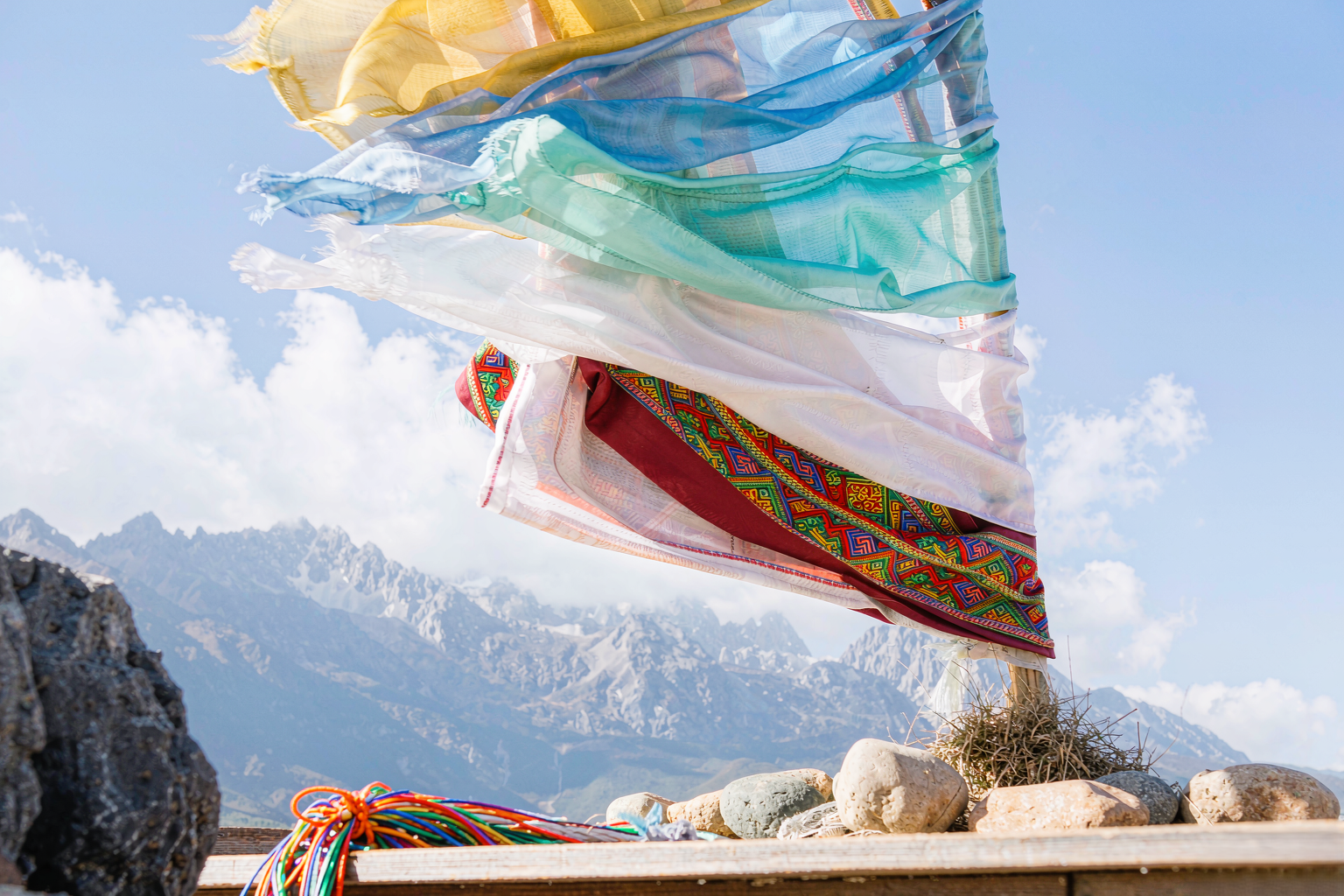
On the high plateau, color does not sit still. It lifts, snaps, blurs, and settles — then lifts again. A rope of cloth strips runs from one rooftop to the next, and every gust rearranges the order in which you see it. We have stood on those passes with cold fingers and watched a whole hillside change its palette every few seconds. That movement is the first lesson of Tibetan-inspired jewelry: color is not a block you look at. It is something the air reads for you.
Five Colors, Held in One Order
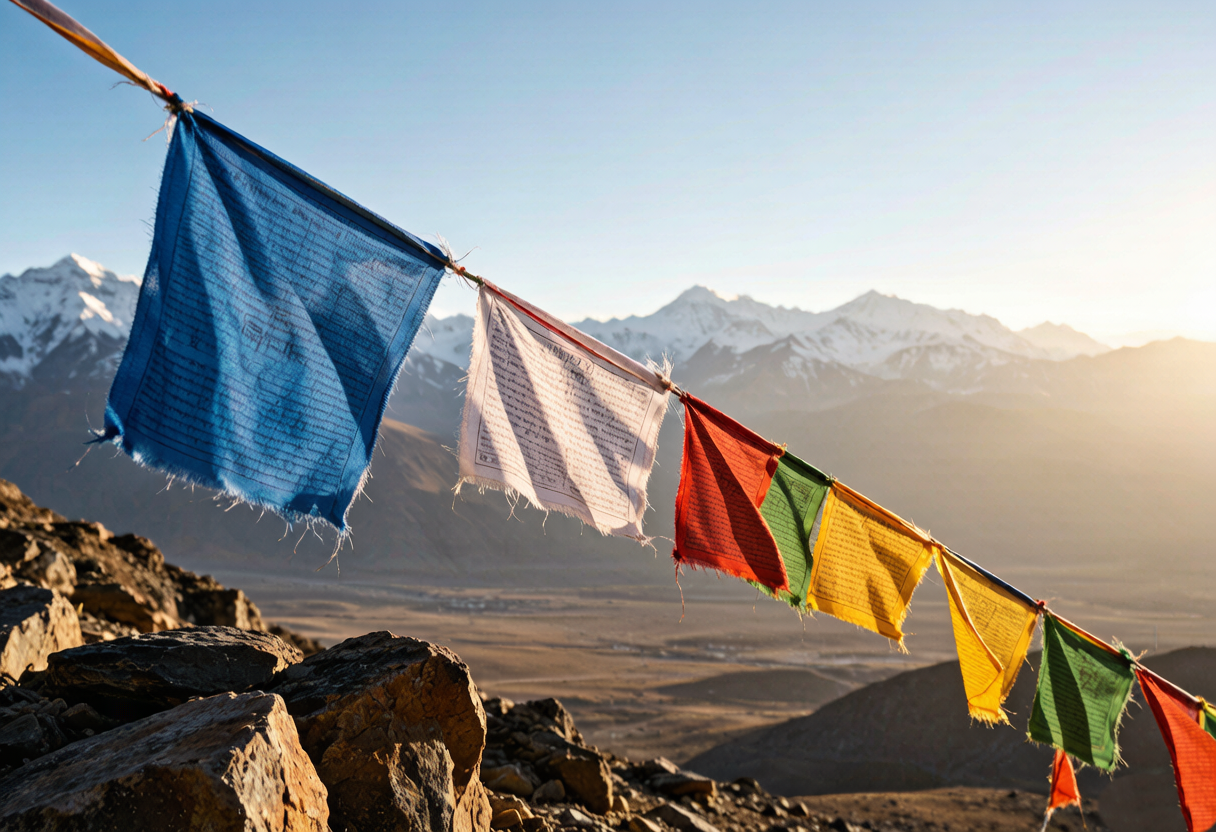
Look closely at a line of wind-set cloth strips and you will find a fixed sequence: sky blue, then white, then red, then green, then yellow. The order never changes, no matter how hard the gusts pull. On the plateau, people read that sequence as a ladder of landscape — blue for the sky overhead, white for the cloud, red for ember and sun, green for rivers and meadow, yellow for open earth.
We love this because it solves a problem every color lover eventually meets: five strong hues in one place usually argue. Here they do not. The order gives each color a job and a neighbor, and the argument becomes a sentence. Sky hands off to cloud, cloud hands off to ember, ember to river, river to soil.
When we translate that sequence into a handwoven bracelet, we keep the same discipline. Our blue-and-white single-strand piece is essentially the first two steps of that ladder — open sky, then cloud — knotted so they pass through each other instead of sitting side by side. Add a thread of oxblood, a green like wet meadow, or a warm cream-yellow, and you have the whole sentence on one wrist. The plateau gave us the order. Our hands just tie it down.
Why Color Has to Move
At four thousand meters, a still color disappears. The light is hard, the distances are wide, and glare washes pale hues flat. So the plateau solves the problem with motion. Cloth strips flutter, edges fray into fringe, and every flicker re-announces each hue to the eye. From far away you do not see five separate colors — you see rhythm. Red pulses, green flashes, blue steadies everything in between.
There is a weaving lesson inside that. On the wrist, the same rule applies. A single flat band of strong color can look heavy; but when strong hues alternate in small measures — a knot of indigo, a bead of saffron-gold, a span of monsoon sky blue — the eye reads movement even when the hand is still. You get the flicker without the wind.
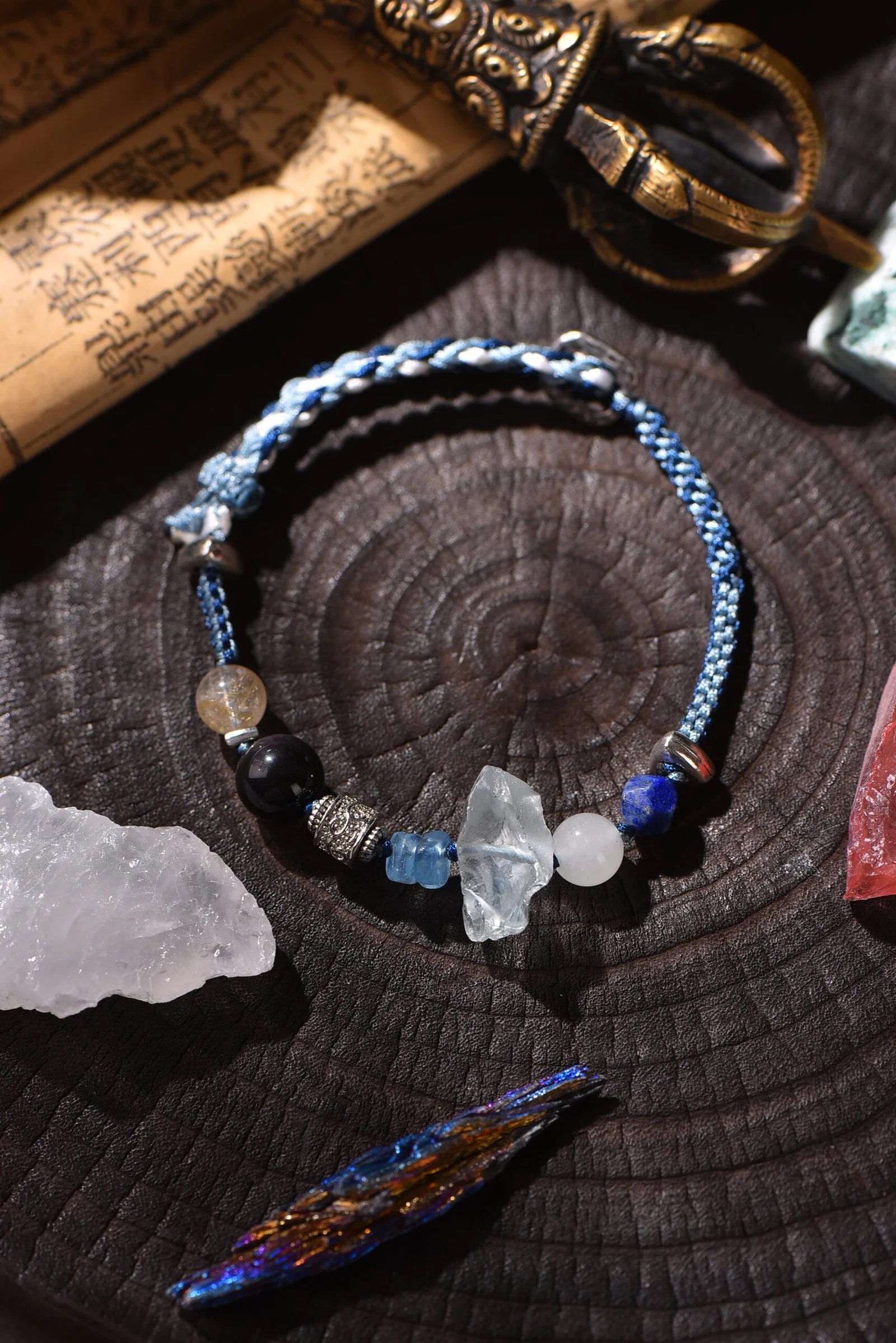
This is why we knot rather than glue. A knot has tension and release; beads sit in little pools of cord like light caught between gusts. Turn your wrist and the measures shift — red now beside cream, blue now beside brown — the way a hillside rearranges itself between two strides. No two of our pieces pass color hand to hand in exactly the same way, because each one is made by hand, one at a time.
The Quiet Side of a Loud Palette
The plateau palette is loud, but it never shouts alone. Notice what carries it: gray rope, weathered wood, dark stone, the deep brown of a doorframe. The loudest color system we know is always tied to something quiet. That contrast is the second lesson of Tibetan-inspired jewelry — bold hues need a still place to live.
In our studio, that still place is the cord. We wax it, twist it, and let it darken honestly with wear, so the bright measures sit against something that ages like the plateau itself — slowly, with visible time in it. The brights sing. The cord holds the tune. We also keep the measures uneven on purpose: one span of color runs long, the next runs short, because even rhythm reads as machine-made and these pieces are anything but.
It is the same when you wear it. A multi-hue woven piece settles beautifully over denim, oatmeal linen, or charcoal wool, the way cloth strips settle against gray rooftops. Let one quiet garment do the work of the rooftop, and the palette does the work of the wind.
For the boldest hue of all — that ember red between cloud and meadow — we sometimes reach for our saffron-and-gold handwoven bracelet, where warm orange runs through gold-flecked beads like late sun through dust. It is the loudest single note we make, and even it leans on quiet cord.
How to Wear the Wind’s Palette
You do not need five colors to borrow this system. Start where the ladder starts:
- One step of the ladder. Our blue-and-white knotted bracelet is sky and cloud only — the quietest possible plate of this palette, and the easiest to wear every day.
- Two neighbors together. Stack it with our terracotta-and-cream earth-tone piece, and you have sky over soil, with your wrist as the rope between them.
- One loud note against quiet cloth. If you prefer a single hue, wear ember or saffron-gold over charcoal or oatmeal, and let the contrast do what the rooftop does.
Our yak-bone and glass-bead Bagua charm carries the same plateau language in a smaller object — bone white, glass blue, a twist of cord — and can ride on a bag or keys when your wrists are already spoken for. Choose the piece that matches the weather you love, from the collections we already make; every one is knotted by hand, and no two are alike.
The plateau taught us that color is not something you own. It is something that passes through — and if you build it well, in order, on honest cord, it keeps announcing itself long after the gust has moved on.
Nature, woven by hand. Color, woven into stories.
Want more color notes from the studio? Browse more from our Tibetan Culture journal and join our newsletter — one quiet letter, when there is something worth showing.
