 Skip to content
✨ New Year Offer: Up to 20% off ·
Begin 2026 with something handmade ✨
✨ New Year Offer: Up to 20% off ·
Begin 2026 with something handmade ✨

Five Elements Jewelry: Match Your Element to a Stack | TibetanTwist

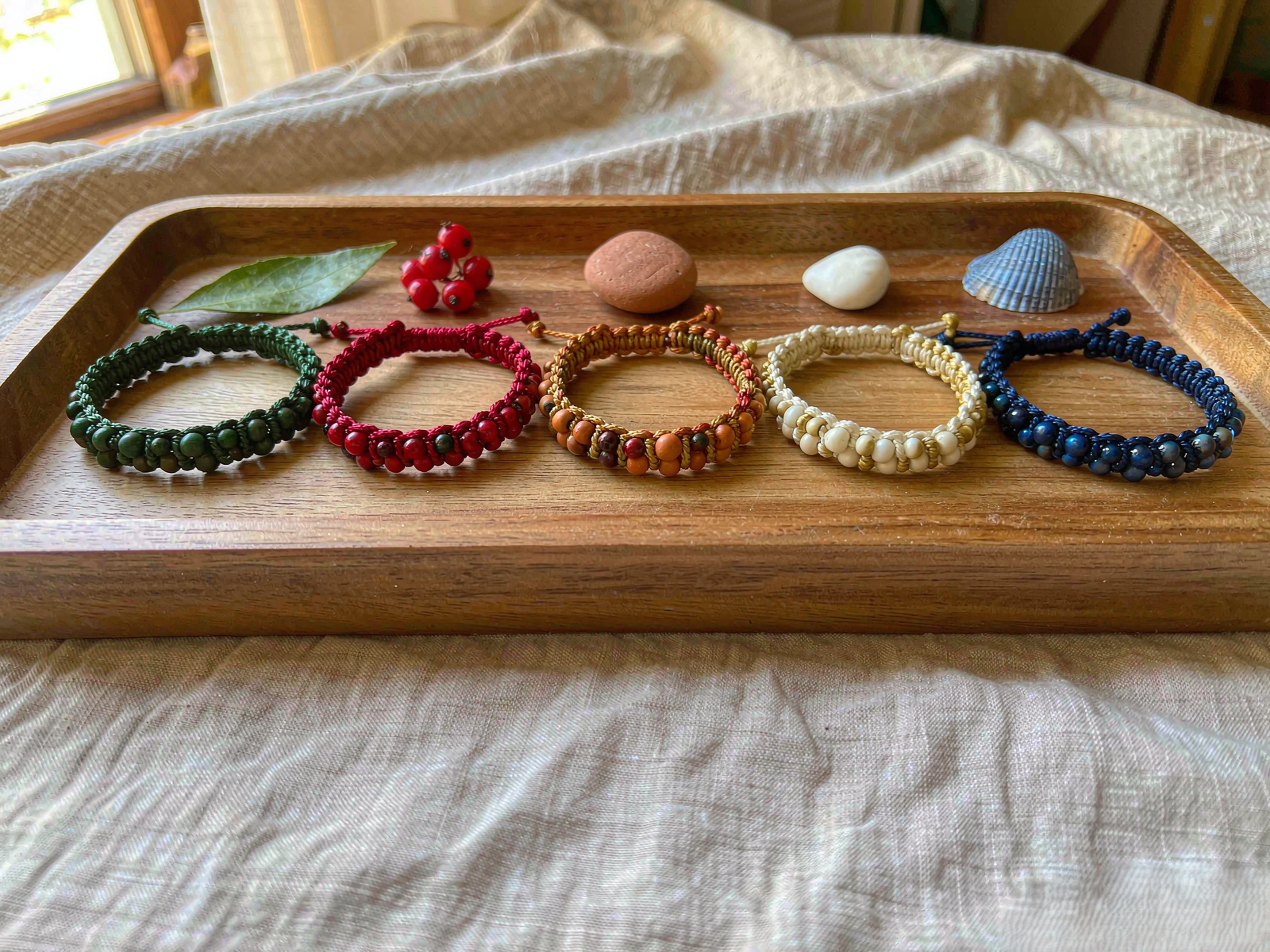
Most people do not stop at one Five Elements bracelet. They start with the palette that feels like home — the green of Wood, the red of Fire, the brown of Earth, the gold of Metal, or the blue of Water — and then they want another. The question changes from Which element is mine? to Which one belongs beside it? This is how we think about stacking Five Elements jewelry: not as a collection of meanings, but as a wrist story where one color leads and the others follow.
Your Element Is the Anchor, Not the Whole Story
Every stack needs a starting place. Pick the palette you would wear alone for a week without thinking about it. For some of us that is the fern-green-and-bark-brown of Wood, for others the river-blue-and-white of Water, for others the pale-gold-and-cream of Metal. That first piece is the anchor. It sets the temperature of everything that comes after it.
I always knot the anchor strand first. I choose the cord colors, I lay them against my own wrist to see how they read in real daylight, and I decide whether the piece wants to be quiet or loud. A quiet anchor — like our earth-brown-and-cream single-strand bracelet — leaves room for a brighter second piece. A loud anchor — like a deep-ember piece — needs a quieter neighbor so the wrist does not feel crowded. The anchor is not the whole story. It is simply the sentence that tells the other colors how to behave.
You can find your anchor without a chart. Open your closet and look at the colors you already own. If the warmest things you reach for are olive, cream, and terracotta, you are probably an Earth anchor. If your drawer is full of blue-grey, white linen, and pale denim, Water or Metal is likely your first language. If you own more than one forest-green thing, Wood is already speaking for you. The bracelet you buy should feel like the colors you have already chosen for yourself. Once you know your anchor, you stop shopping for bracelets the way you shop for trends. You start shopping for the color that already lives in your life.
The Neighbor Rule: Add the Element Beside Yours
In the Five Elements map, each element has two neighbors. Wood sits beside Fire and Water. Fire sits beside Wood and Earth. Earth sits beside Fire and Metal. Metal sits beside Earth and Water. Water sits beside Metal and Wood. We follow this same order when we stack.
Why? Because neighboring palettes share a thread. Wood green and Water blue both carry cool, wet notes. Earth terracotta and Fire ember red both carry warm, baked notes. Metal gold and Water white both carry bright, open notes. When you place neighbors together, the colors talk to each other instead of competing.
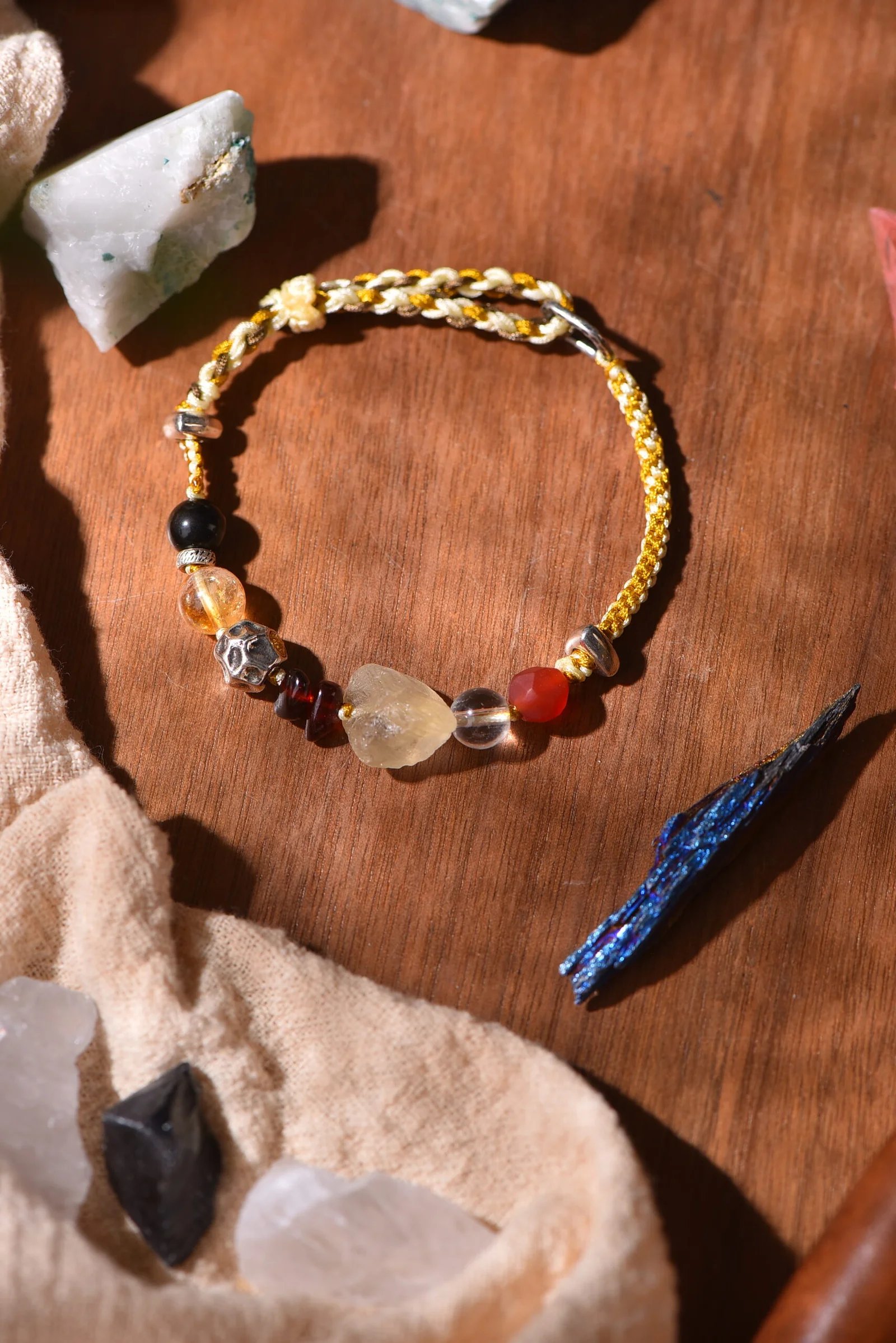
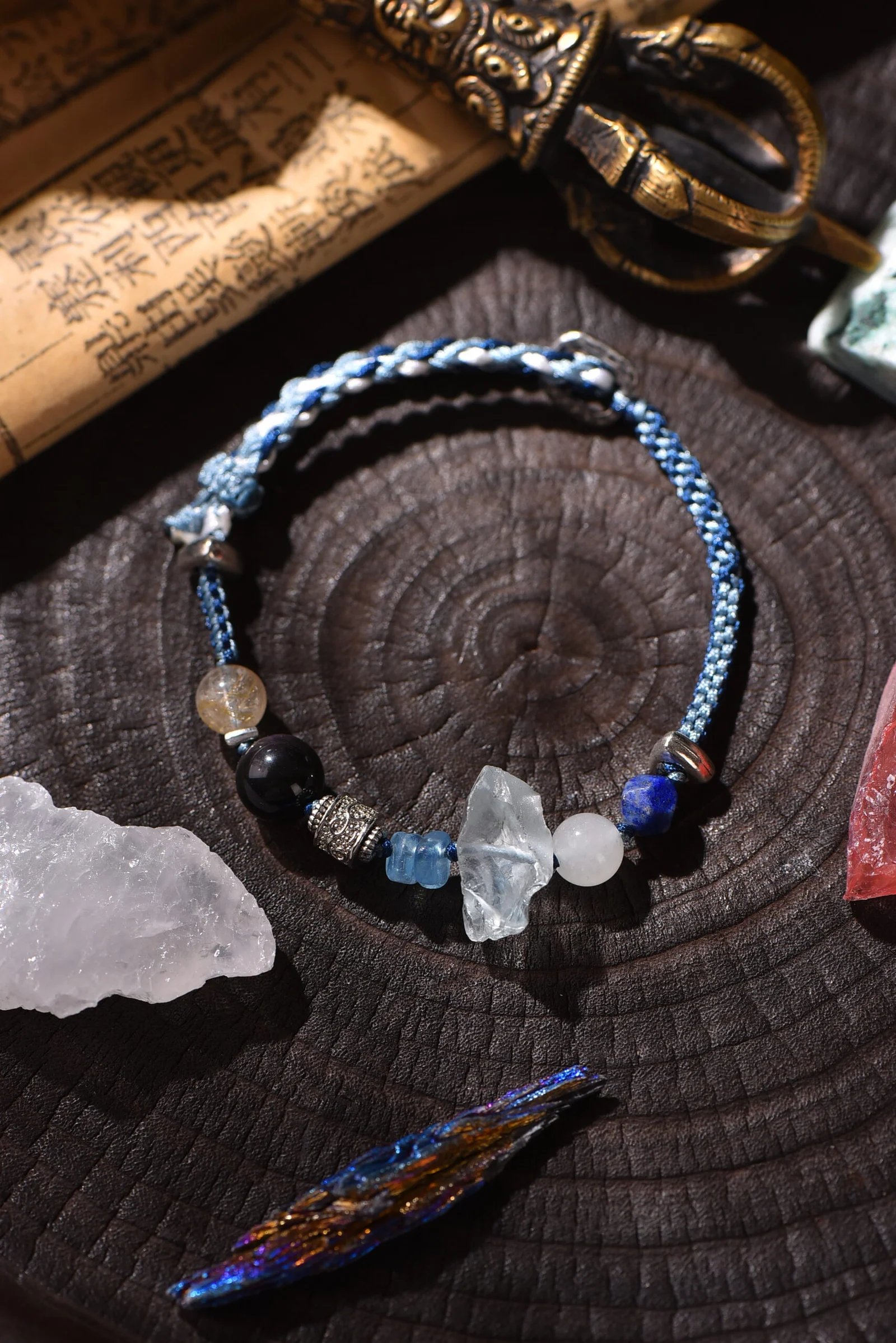
Our pale-gold-cream-and-brown handwoven bracelet is a natural neighbor to Water. The pale gold catches the same light as the white in our river-blue-and-white single-strand bracelet. Worn together, Metal and Water read as the bright side of a winter morning — frost on the riverbank, sun on pale stones. The stack does not need a third strand. Two colors, well chosen, are already a complete sentence.
The opposite pairs — Fire and Water, Wood and Metal, Earth and Water — can still work, but they need more space. A Fire strand beside a Water strand is a strong contrast. It can look intentional and graphic, but it also demands a simple outfit and a quiet third piece. Neighbors, on the other hand, forgive almost anything. They stack easily with watches, leather straps, or other bracelets because their colors already agree.
The One-Loud, One-Quiet Method
Three rules keep a stack from becoming noise. First, one piece leads. Second, the other pieces step back. Third, every strand must earn its place by adding a color the wrist did not already have.
A loud piece is usually the one with the strongest contrast: a red strand against cream skin, a deep-blue strand against a white shirt, a gold strand against a dark sleeve. A quiet piece is usually lower contrast: earth brown against skin, soft cream against a light sleeve, pale grey against grey. When you pair one loud with one quiet, each piece gets a turn to be seen.
If you want to add a third piece, make it the quietest of the three. A wrist with a loud Fire strand, a quiet Metal strand, and a whisper-quiet Earth strand has three clear layers without any shouting. This is why our single-strand bracelets work so well in stacks: the knot pattern is small, so the color does the talking, and the waxed cord keeps each color in its own lane. The cord also ages well, so a stack looks better after a month of daily wear than it did on the first day.
Skin tone plays a role, but not the way people think. A loud piece is not always the brightest color. It is the color that moves most against your own skin. On very pale skin, a deep-ember red shouts. On deeper skin, the same red might read as warm rather than loud, while a pale-gold strand might become the louder piece because it pulls ahead. I always test a stack in natural light, not under a lamp, because daylight tells the truth about contrast.
Which Stack Will You Wear?
Start with the element you already love. Then look at its two neighbors and choose the one whose landscape you also keep returning to. If your anchor is Water, try Metal for brightness or Wood for depth. If your anchor is Earth, try Fire for warmth or Metal for lift. If your anchor is Fire, try Wood for freshness or Earth for grounding. Wood anchors pair beautifully with Water for coolness or Fire for heat. Metal anchors sit well beside Earth for warmth or Water for a crisp, clean stack.
You do not need a reason beyond liking the pair. The Five Elements map is a guide, not a rule. We make each piece by hand, one at a time, so no two stacks are ever the same — and every palette is already waiting on the shelf. Browse our Five Elements journal to see all five side by side, then pick an anchor and one neighbor and wear them for a week.
If you are new to stacking, start with two. Two bracelets tell a clearer story than three. They leave negative space on the wrist, and they let each color breathe. After two weeks, you will know whether you want a third voice or whether the pair is already complete. The best stacks are often the smallest ones, because restraint is what makes color feel intentional.
If you want a stack that begins with cool light, try our pale-gold-cream-and-brown handwoven bracelet beside our river-blue-and-white single-strand bracelet. If you want something that begins with warm ground, try our terracotta-cream-and-earth-brown single-strand bracelet with any Fire or Metal neighbor. Let the first piece choose the second. The right stack is the one you forget you are wearing until someone asks about it.
And when you want the next palette before you have finished this one, our studio letters bring new stacking ideas and workbench notes by email. Join the TibetanTwist newsletter and stack it with us.
Nature, woven by hand. Color, woven into stories.
