 Skip to content
✨ New Year Offer: Up to 20% off ·
Begin 2026 with something handmade ✨
✨ New Year Offer: Up to 20% off ·
Begin 2026 with something handmade ✨

Handwoven Jewelry: The Knots That Hold Color | TibetanTwist

Handwoven Jewelry: The Knots That Hold Color — TibetanTwist
There is a moment when a single strand of waxed cord leaves your fingers and becomes something else. A twist here. A knot there. Then color settles into the weave like a garden after rain. That is where handwoven jewelry begins.
At TibetanTwist, we do not mold, cast, or machine-form our pieces. We knot them, one length of cord at a time, while the light moves across the worktable. The result is handwoven jewelry that carries the slight, honest variations of a human hand. No two are identical. No two should be.
The question we hear most often is simple: what makes handwoven jewelry different from everything else in a jewelry box? The answer is not one thing. It is the knot, the cord, the color, and the pace at which all three come together.
Why Handwoven Jewelry Has a Texture Machines Cannot Copy
A machine can repeat a pattern forever. It will make every loop the same size, every pull the same tension, every finish the same gloss. That consistency is useful for many things, but it is not what we want around a wrist.
Handwoven jewelry lives in the small differences. One knot sits a fraction tighter than its neighbor. A cord catches the light differently because of the angle at which it was pulled. These tiny irregularities are not flaws. They are the record of a pair of hands working slowly, paying attention to how the material feels rather than how a diagram says it should look.
We use waxed cord because it responds to touch. It keeps its shape without turning stiff. It softens as it is worn, taking on the warmth and movement of the person who wears it. Over days and weeks, a handwoven bracelet becomes less like an object you put on and more like something that has settled in with you.
The texture also changes with wear. A new piece has a clean, almost paper-like surface. After a few days, the wax begins to mellow. After a few weeks, the cord takes on a soft sheen that no factory coating can replicate because it comes from contact with skin, air, and light. That is the living part of handwoven jewelry. It does not stay exactly as it was on the day it was made. It grows with you.
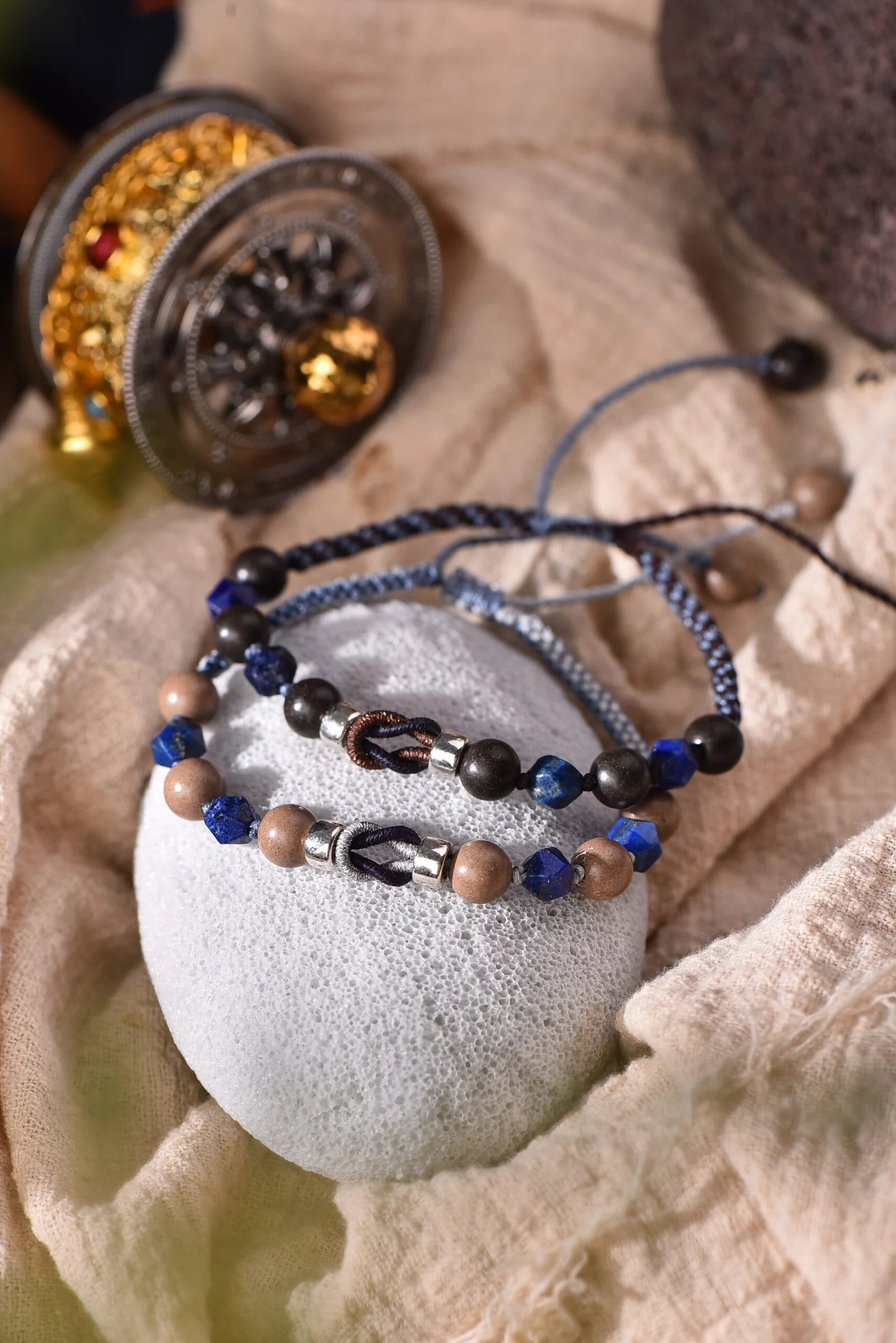
The piece above is one of our dual-tone woven bracelets. Look closely and you can see how the knot itself becomes the decoration. There is no need for extra hardware when the twist of the cord already holds the design. The knot is the pattern. The pattern is the story.
Color Comes From the World Outside, Not a Screen
Our palettes do not start on a color wheel. They start outside. We look at peony pink after the petals begin to open. We look at pine green in deep shade. We look at monsoon sky blue just before the rain breaks. Then we choose threads that echo those moments.
This is why handwoven jewelry can feel so immediate. A color is not just a color here. It is a reference to something real: oxblood red like late-season berries, sunflower yellow like dry grass in late summer, cream like unbleached linen left in the sun. Each piece carries a small piece of landscape.
We work in seasons. In spring, the table fills with soft pinks and fresh greens. In summer, the palette turns warmer: coral, amber, sunflower, sea glass. Autumn brings ochre, rust, sage, and dusk violet. Winter quiets everything down to charcoal, cream, forest green, and the pale blue of a frozen stream. When you choose a piece, you are not just choosing a color. You are choosing a season you want to keep close.
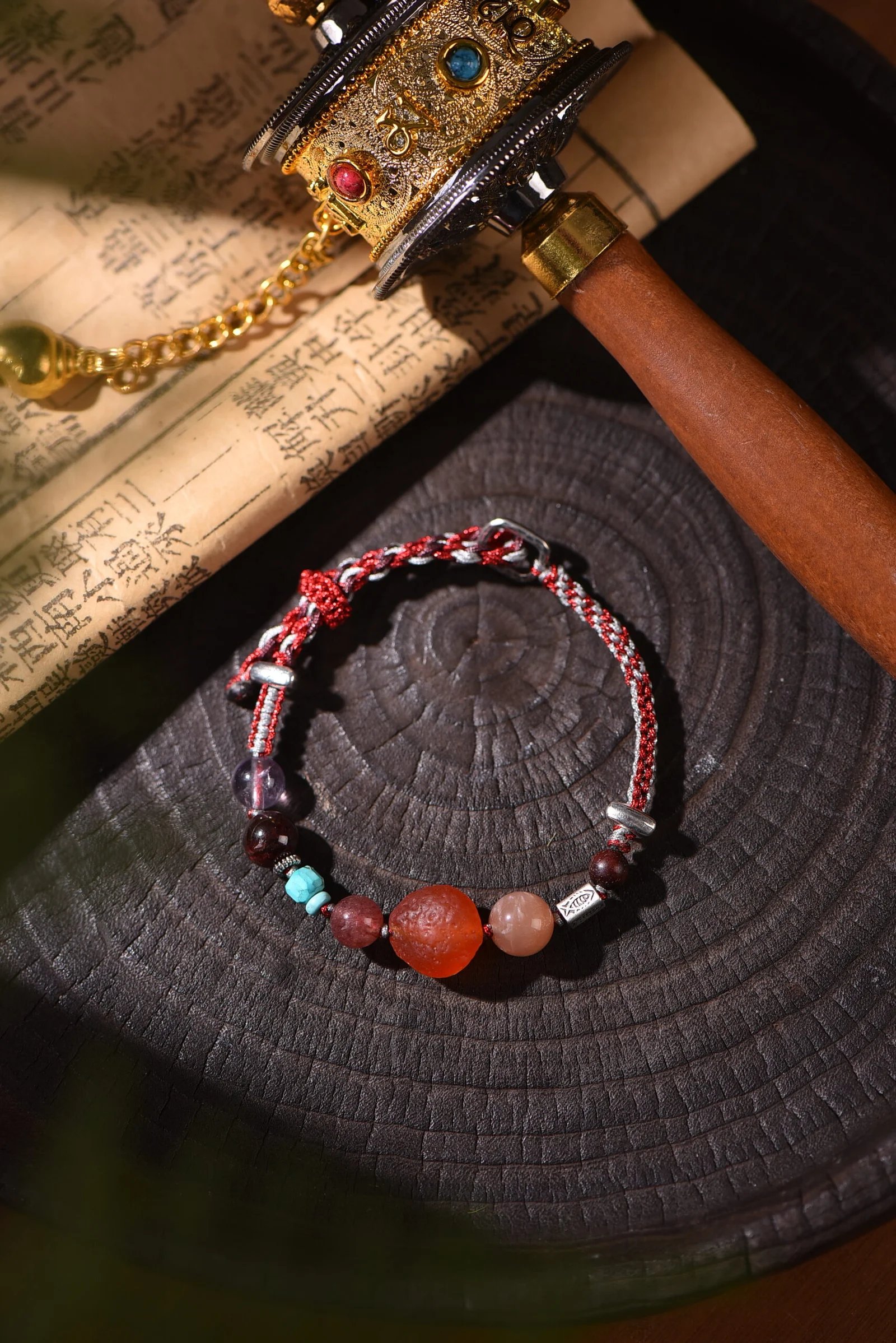
The red-and-white bracelet above came from watching how certain flowers hold their saturation even under harsh light. The contrast is bold, but it is not loud. It is the kind of color pairing you might find in a garden that has learned how to take care of itself.
Because we work with cord, we can layer color in ways that metal and stone alone cannot manage. One thread passes over another, and a third thread passes under both. The eye reads the colors together, not separately, and the result is a depth that flat surfaces rarely achieve. A handwoven bracelet can look different in morning light than it does at dusk because the threads shift and catch color from the air around them.
The Slow Knot: How One Piece Takes Shape
People often ask how long it takes to make one bracelet. The honest answer is: longer than it looks, and shorter than it feels. A simple design might take an hour from first knot to final trim. A more complex piece can take most of a morning. The real investment is not only in the time. It is in the decision-making that happens along the way.
We choose the cord color first, then the order of the knots, then the spacing. If something feels off, we undo it and begin again. There is no undo button in fiber work. There is only patience, and the willingness to start a section over if the tension is wrong.
Each knot is pulled by hand, and the pressure of that pull changes the shape of the piece. Pull too hard and the bracelet becomes stiff. Pull too softly and it loses structure. The right tension sits somewhere in the middle, and it is different for every cord, every color, every design. That is why experience matters. After thousands of knots, your hands learn to feel the right pull before your eyes can judge it.
The finishing is just as careful. Ends are trimmed, sealed, and tucked so they do not fray. closures are tested for ease and security. Then the piece is laid on the table and looked at from every angle, the way you would look at a photograph before signing the print.
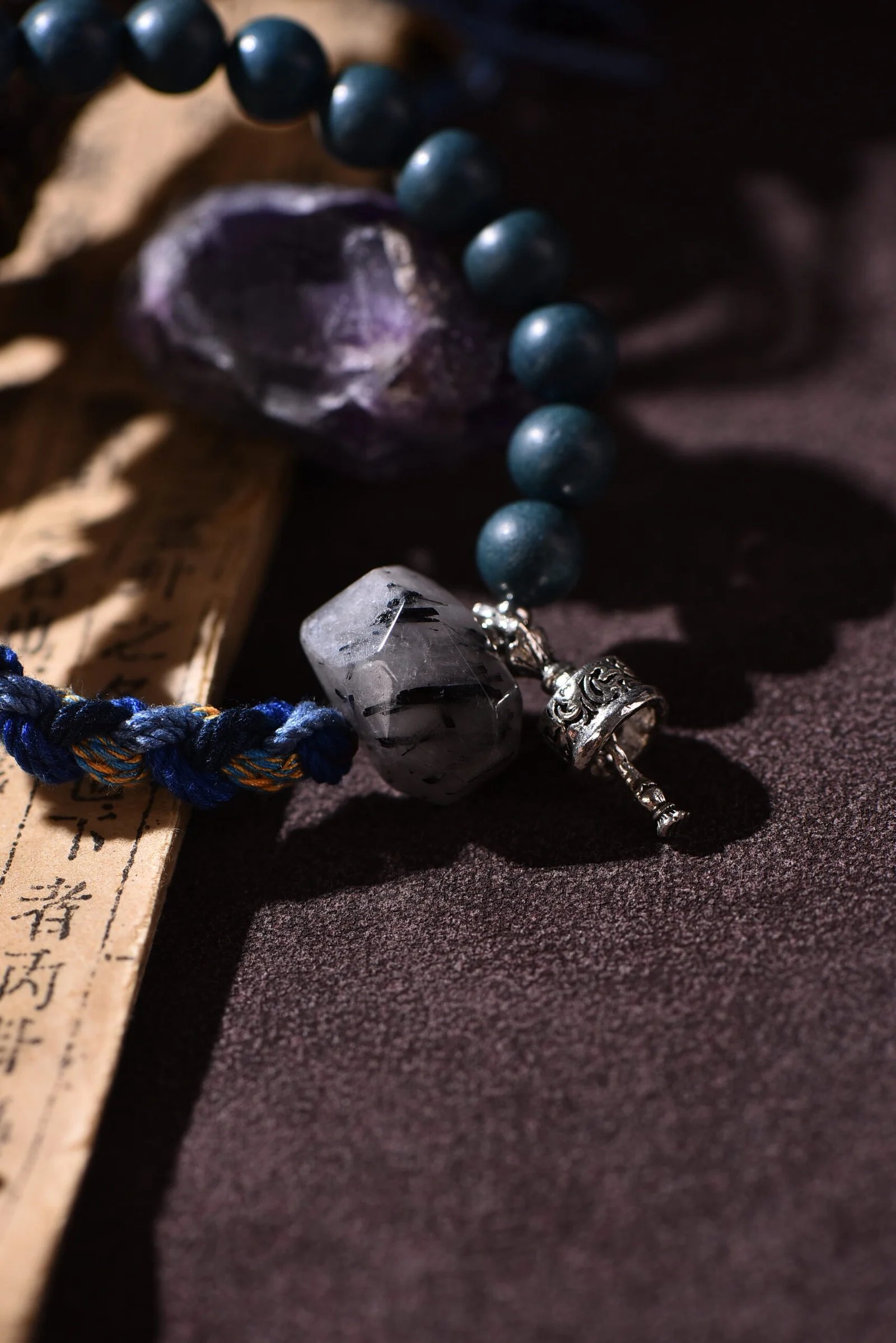
The green bracelet above is one of our botanical-inspired pieces. Every knot was tied while thinking about leaves, stems, and the way light filters through a canopy. That is the kind of attention we want each piece to carry. Made by hand, one at a time.
Which Handwoven Piece Is Yours?
If you are drawn to bold contrast, start with our red-and-white handwoven bracelet. It carries the heat of late-summer color without ever shouting. Wear it when you want one clean note of color against a simple sleeve.
If you prefer something that feels like a walk through green shade, the forest-green handwoven bracelet layers botanical tones in a way that settles quietly against the skin. It pairs naturally with linen, cotton, and anything else that breathes.
For something shared, the sky-blue handwoven couple bracelet holds its color in an infinity knot that keeps its shape through daily wear. The knot is small, but it carries the weight of repetition: the same knot, tied twice, for two wrists.
Browse the full bracelets collection to see how each color story takes form in cord and knot.
Nature, woven by hand. Color, woven into stories.
Want early access to new palettes and studio notes? Join the TibetanTwist newsletter below.
