 Skip to content
✨ New Year Offer: Up to 20% off ·
Begin 2026 with something handmade ✨
✨ New Year Offer: Up to 20% off ·
Begin 2026 with something handmade ✨

How to Choose Your First Handwoven Jewelry Piece


Buying your first piece of handwoven jewelry should feel like walking into a garden without a shopping list. You notice something first — a blue that looks like the sky before rain, a pink that matches the peonies by the fence — and your hand goes out before your head has time to argue. This guide is written for that moment, from the studio bench where every bracelet starts life as a length of waxed cord and a color somebody loved first.
We get a version of the same question every week: how do I choose, when everything is made one at a time and nothing can be repeated exactly? The honest answer is that you already know more than you think. You know which colors you stop for. You know whether you like things that sit close to the skin or things that announce themselves. The rest is just craft vocabulary, and that part is easy to learn.
Start With a Color, Not a Rule
There is no test to take and no chart to follow. Your eye has been collecting evidence for years. Look at what you already own and reach for — the sweater worn soft at the cuffs, the mug that always ends up in your hand, the flower bed you planted twice because the first one made you happy. The palette that repeats in your life without your permission is your palette.
Color comes first for a practical reason. A bracelet is small. It sits inside your own sightline all day, at the edge of every gesture, in every photograph of your hands. A color you genuinely love will hold up under that much attention. A color you chose because you read somewhere that it means something will tire you out by the second week. Pick the shade you would happily see a hundred times a day.
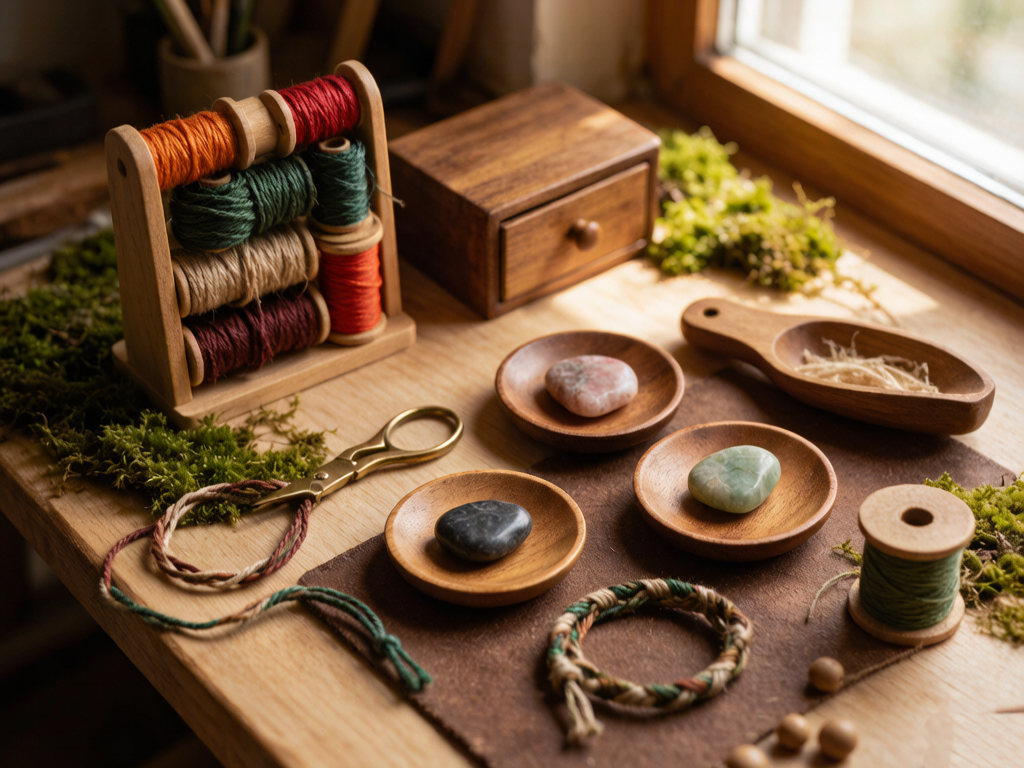
In our studio, colors are named after the places we found them: peony pink, pine green after rain, monsoon sky blue, oxblood red, saffron gold. The naming is not decoration. A thread has to match something we have actually seen before it earns a place on the shelf, and that rule keeps the palette honest. Nothing here is a shade we invented on a screen.
If you lean cool and soft, start where the light is gentle. Our sky-blue-and-blush handwoven bracelet carries the exact hues of early morning on a wet garden — pale blue, a hint of pink, nothing shouting. If you lean warm, look for gold, cream, and honey brown instead. Either way, let the color make the first move and let everything else follow.
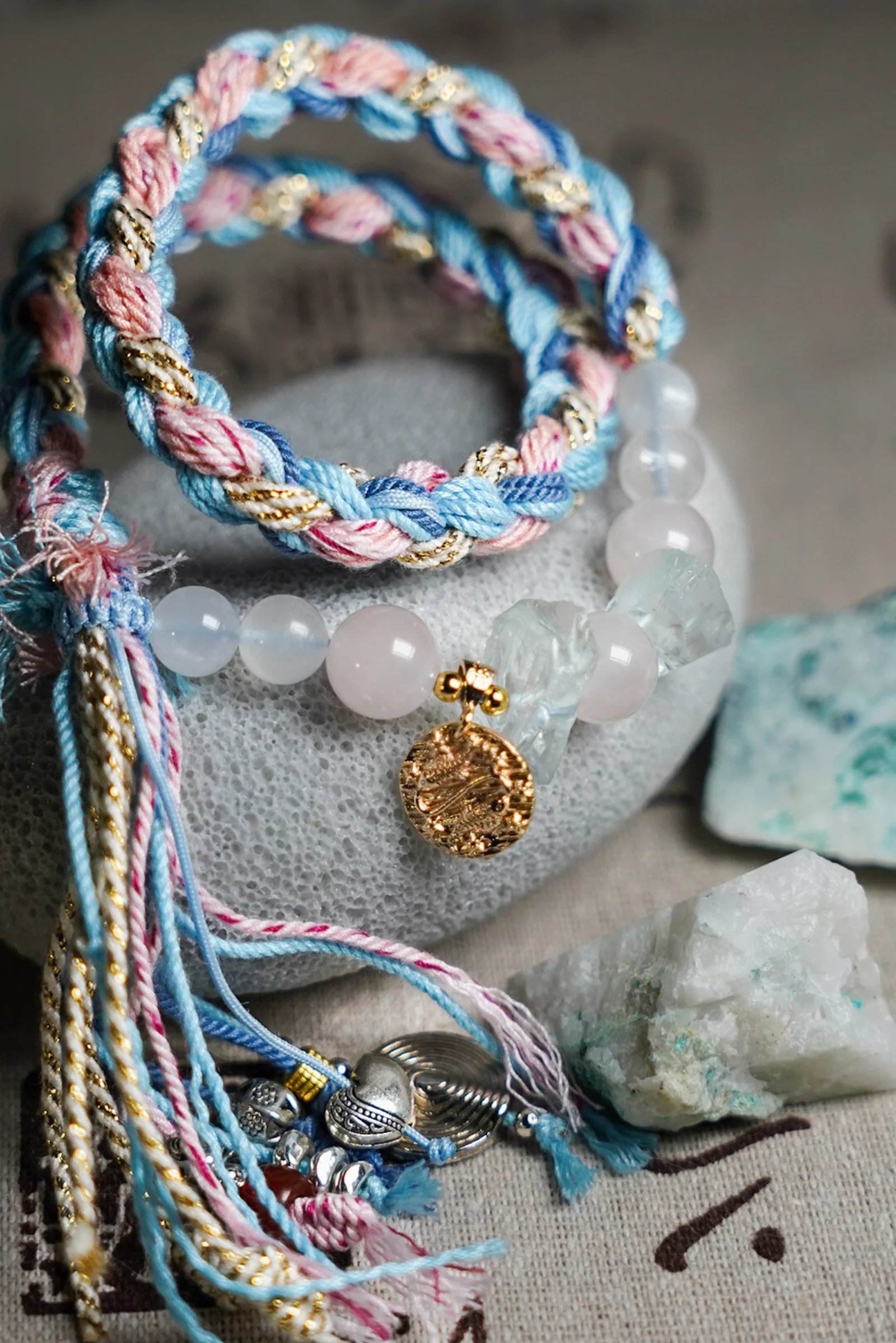
Turn It Over — What Good Knots Look Like
A handwoven piece will tell you how it was made if you are willing to look at the back of it. Turn it over in your hand, and run through four small checks before you decide.
Check the tension first. Draw the strand gently between your fingers. The knots should hold their spacing rather than sliding into bunches, and the weave should feel firm without feeling rigid. Then look at the knots themselves. They should be the same size and face the same direction, row after row. Hand work has rhythm, not uniformity — a machine-made piece looks perfect and dead, while a hand-knotted one moves like handwriting.
Check the ends. On a well-finished bracelet the cord ends are tucked and sealed tight, with no frayed whiskers poking out at the closure. Then work the slide knots. They should travel smoothly along the cord and hold their position the moment you stop pulling them. A closure that creeps loose during the day is a closure you will resent by Friday.
The material matters as much as the technique. Waxed cord arrives firm and matte, never sticky. It softens over the first weeks as the wax settles into the fiber, and the color deepens by a shade or two. That change is not wear. It is the material arriving at itself, the way leather does with a good pair of shoes.
We knot one piece at a time, one pair of hands, from the first loop to the last. So no two are exactly alike — a knot pulled a little tighter on a humid afternoon, a slight shift between dye lots, a stone that sits a millimeter off from its neighbor. That is the signature of hand work, and it is the whole reason we say made by hand, one at a time instead of talking about precision. If you want to study the structure plainly, our gold-and-cream single-strand bracelet shows every knot the whole way around, with nothing layered over it to hide behind.
Get the Fit Before You Fall for It
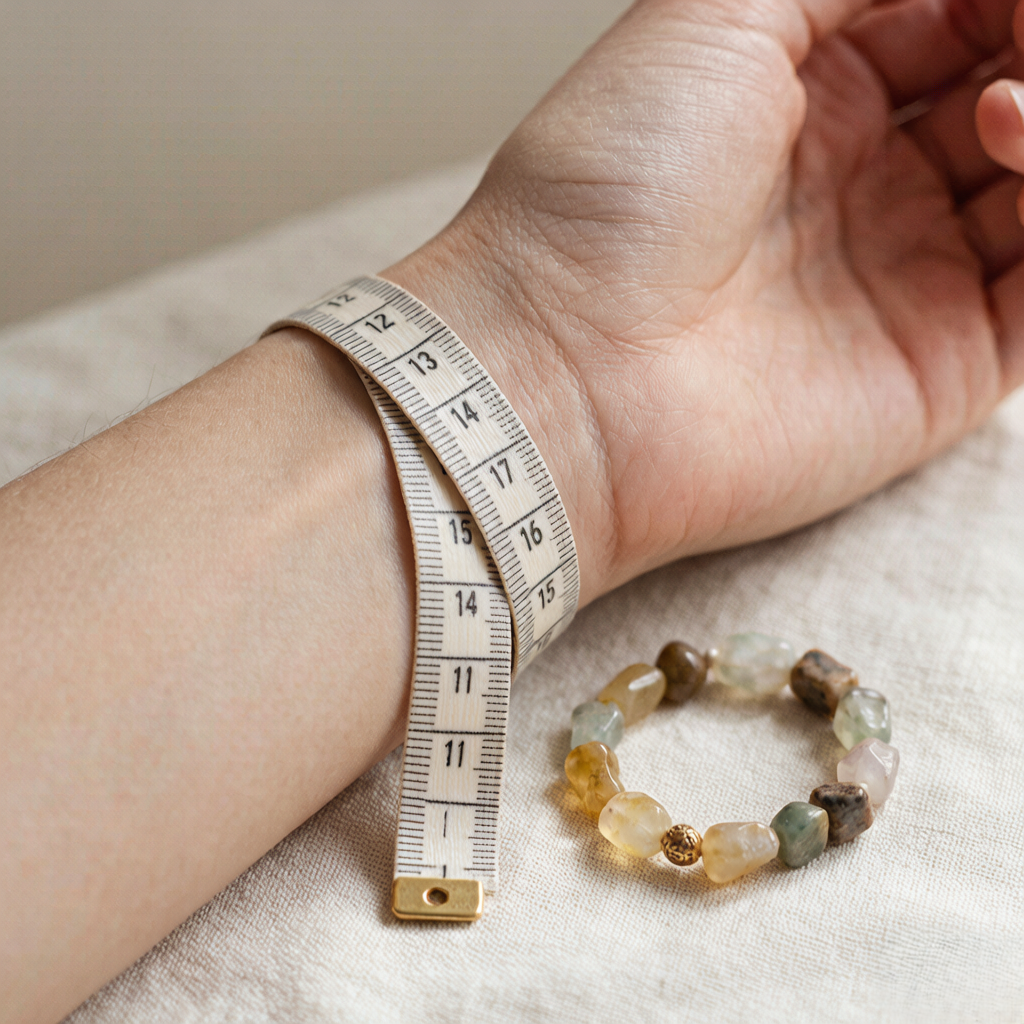
Fit is where most first purchases go wrong, and it takes ninety seconds to get right. Wrap a strip of paper or a piece of ribbon around your wrist just below the wrist bone, mark where it overlaps, lay it flat, and measure it. That number is your wrist. Now add about one finger’s width — roughly one to one and a half centimeters — for a bracelet that moves with you instead of gripping you.
Most of our bracelets close with sliding knots, so there is room to adjust after the fact. Knowing the number still helps. It tells you how much thread will rest against your skin, how the piece will drape next to a watch, and whether it will roll under your sleeve or sit proud of it. Two people with the same wrist size can want completely different amounts of give.
Palette changes the read as much as size does. Light palettes — sky blue, blush, cream — float against the skin and appear slightly larger. Deep palettes — oxblood red, forest green, deep brown — sit close and appear narrower. Same weave, same hands, different impression. This is why our deep brown and forest green bracelet works as a first neighbor for almost any stack: it goes with everything without competing for attention.
If you are planning to wear two or three together, buy one piece first and wear it for a week. Notice how it sits when you type, when you cook, when you carry a bag. Then add the neighbors. A stack built slowly looks like a person; a stack bought in one afternoon looks like a photograph of one.
Care Is Simple — and So Is Choosing
Looking after a waxed cord piece takes almost nothing. Keep it out of long soaks, wipe it with a soft cloth when it needs it, let it rest while you swim or spend the afternoon in the garden, and store it flat rather than knotted. That is the whole routine, and we go through it properly in our care guide for waxed cord jewelry.
Choosing is simpler than most people expect, because there is no commission to place and no brief to write. We keep a wide shelf of finished pieces in many palettes. You browse, and you pick the one that already holds the colors you were about to describe. It is faster than waiting, and the result is the same — something on your wrist that looks as though it were made for you, because a pair of hands made it, one at a time, before you ever asked.
Three questions will settle it. Which color did your eye go to first, before you started reasoning? Do you want the piece to sit close and quiet, or to float and be noticed? And will you wear it alone, or is this the start of a stack? Answer those and the shelf narrows to two or three candidates in about a minute.
Start with the soft blues of our sky-blue handwoven bracelet, the warm neutrals of our gold-and-cream single-strand bracelet, or the deep tones of our forest green bracelet. Then see the full handwoven bracelet collection and find the piece your hand was already reaching for.
Nature, woven by hand. Color, woven into stories.
Want studio notes and new palette drops in your inbox? Join our newsletter.
