 Skip to content
✨ New Year Offer: Up to 20% off ·
Begin 2026 with something handmade ✨
✨ New Year Offer: Up to 20% off ·
Begin 2026 with something handmade ✨

The Five Sacred Root Colors: The Most Revered Colors in Tibetan Culture

Introduction
Anyone who has visited Tibet will quickly notice a powerful and consistent color system woven into daily life, architecture, religious art, and spiritual objects.
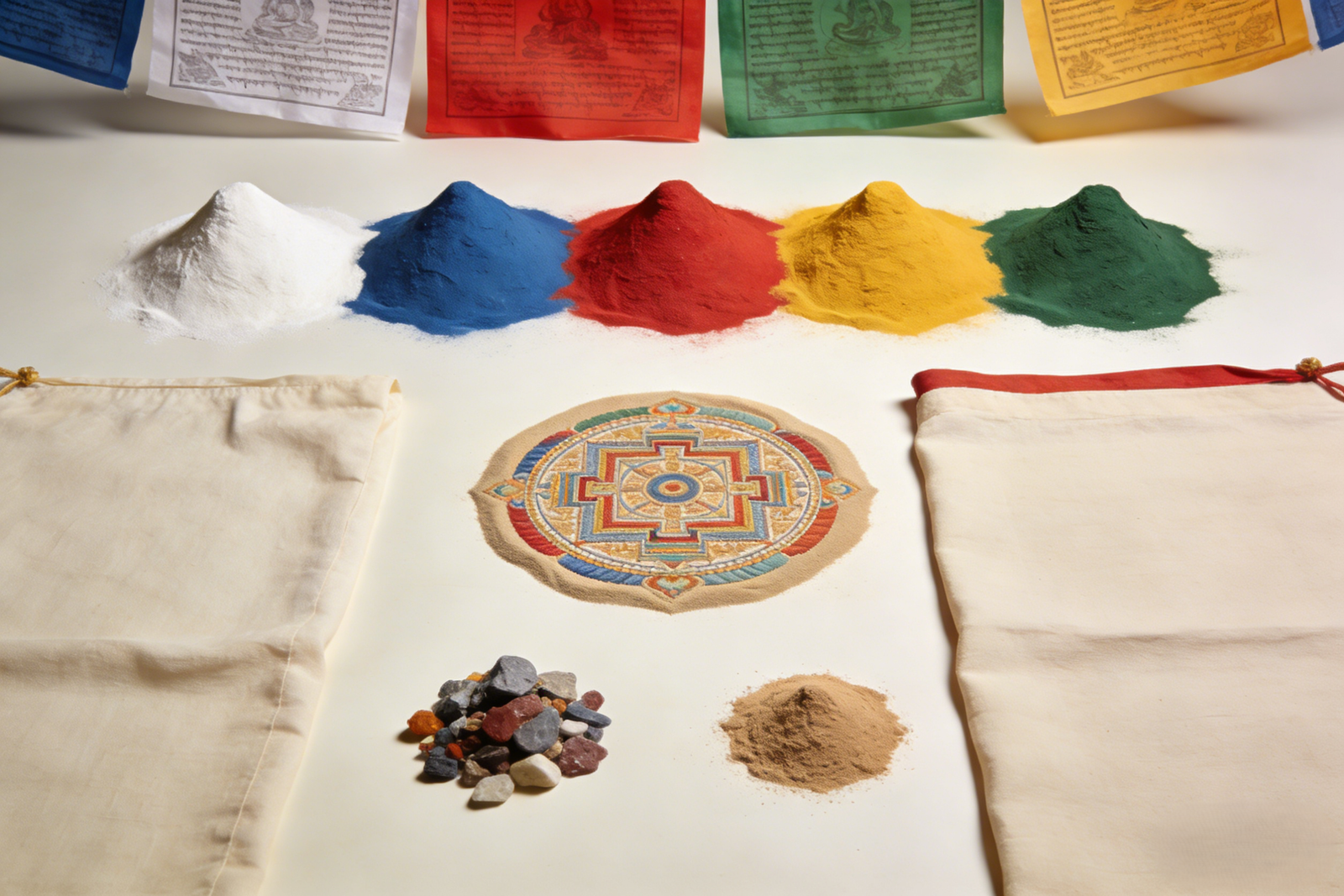
Among all colors, five are considered sacred and fundamental in Tibetan culture:
White, Blue, Red, Yellow, and Green.
These five colors are not chosen at random.
They originate from Bön, Tibet’s ancient indigenous religion, where they represent the five primal elements of the universe.
- White — Cloud / Air
- Blue — Space / Sky
- Red — Fire
- Yellow — Earth
- Green — Water
Together, these colors form the spiritual foundation of Tibetan visual culture.
🟦 Blue — The Color of Power, Space, and Protection
In Tibetan Buddhism, blue represents the central direction.
This comes from Akshobhya Buddha, the blue, immovable Buddha who symbolizes the center of the mandala and unshakable wisdom.
In Tibetan opera, blue masks are reserved for hunters—figures associated with strength, survival, and courage.
In Tibetan art, especially thangkas and murals, deep Tibetan blue is commonly used to depict:
- Wrathful deities
- Protective guardian gods

This color amplifies their power, authority, and spiritual force, creating a strong sense of depth and dimensionality.
Beyond religious art, Tibetan blue appears extensively in:
- Traditional door curtains
- Tents used in villages and towns
- Auspicious patterns symbolizing abundance and protection
🔗 【BLUE LINK】Discover Tibetan blue handcrafted crystal phone charm
🟨 Yellow — The Color of Earth, Prosperity, and Sacred Authority
Yellow symbolizes prosperity and land, and holds strict hierarchical meaning in Tibetan culture.
In Buddhist directional symbolism, Ratnasambhava Buddha, associated with the south, is golden yellow.
Therefore, in sand mandalas, the southern direction must be represented by yellow.
Yellow is also the defining color of the Gelug School (Yellow Hat Sect).
Monks of this lineage wear yellow robes and ceremonial garments.
In Tibetan opera, yellow masks represent:
- High monks
- Great spiritual masters
- The highest social and spiritual status
Because of its sacred authority, yellow functions as a restricted symbolic color—it represents identity, rank, and spiritual legitimacy.

Sacred Yellow Pigments
Traditional yellow pigments such as orpiment (stone yellow) are mineral-based and reserved for:
- Religious objects
- Buddha statues
- Living quarters of high monks and reincarnated lamas
Gold used in temples, thangkas, and statues is produced through:
- Hand-ground gold powder
- Ultra-thin gold leaf
- Fire-gilding (mercury gilding), an ancient and highly skilled technique
Due to its sanctity, yellow is never used in ordinary Tibetan homes.
🔗 【BLUE LINK】Discover Tibetan blue handcrafted crystal phone charm
🔴 Red — The Color of Devotion, Authority, and Protection
(Insert Image)
In ancient India, where Buddhism originated, red was considered the lowest-status color.
Monks deliberately chose red robes to symbolize:
- Detachment from material beauty
- Spiritual humility
- Focus on inner perfection
Ironically, red later became the exclusive color of monks, high lamas, and temples.
In sand mandalas, red represents Amitabha Buddha, ruler of the Western Pure Land.
In Tibetan opera:
- Dark red masks represent kings
- Light red masks represent ministers
Red & Bön Belief
In Bön cosmology, existence is divided into gods, humans, and spirits.
Ancient Tibetans believed applying red ochre to the face could repel harmful spirits.
Over time, this practice shifted from the body to architecture, where red walls remain a dominant feature in monasteries and sacred buildings.
🔗 【BLUE LINK】Discover Tibetan blue handcrafted crystal phone charm

⚪White — The Color of Purity, Auspiciousness, and Life
In sand mandalas, the east is represented by white, associated with Vajrasattva, the Buddha of purification.
In Tibetan opera, white masks symbolize male characters.
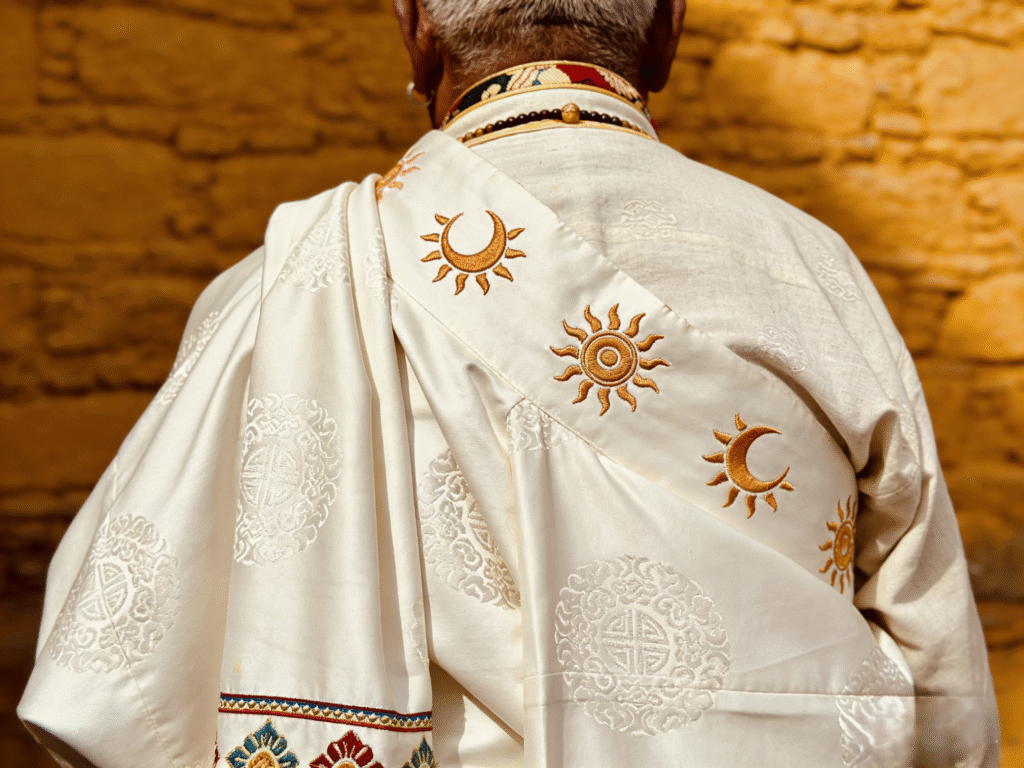
Among Tibetan elders, it is customary for a person celebrating a milestone birthday to wear a white garment decorated with sun and moon symbols, expressing blessings for longevity and harmony.
White represents:
- Purity
- Good fortune
- Moral clarity
🔗 【BLUE LINK】Discover Tibetan blue handcrafted crystal phone charm
🟢 Green — The Color of Action, Balance, and Completion
Green represents the north in sand mandalas and corresponds to Amoghasiddhi Buddha, symbolizing accomplishment and enlightened action.
Green embodies:
- Movement
- Balance
- Life force
It bridges spiritual intention with real-world action.

🔗 【BLUE LINK】Discover Tibetan blue handcrafted crystal phone charm
🎨 Traditional Tibetan Color Philosophy
Color is abstract and mystical—it must exist through form.
In Tibetan culture, color is:
- A spiritual language
- An emotional carrier
- A symbolic identity
Living on the Qinghai–Tibet Plateau, Tibetans developed a unique color system shaped by:
- Harsh natural environments
- Religious devotion
- Cross-cultural exchange with India, Nepal, and Central China
Whether in architecture, painting, or daily objects, Tibetan color usage preserves:
- Raw spiritual vitality
- Deep faith
- Emotional sincerity
It is both connected to broader Chinese cultural roots and distinctly Tibetan in character.

Sweet blog! I found it while searching on Yahoo News. Do you have any tips on how to get listed in Yahoo News? I’ve been trying for a while but I never seem to get there! Cheers
wish you best and best