 Skip to content
✨ New Year Offer: Up to 20% off ·
Begin 2026 with something handmade ✨
✨ New Year Offer: Up to 20% off ·
Begin 2026 with something handmade ✨

Unique Handwoven Jewelry: Why No Two Knots Are Alike | TibetanTwist

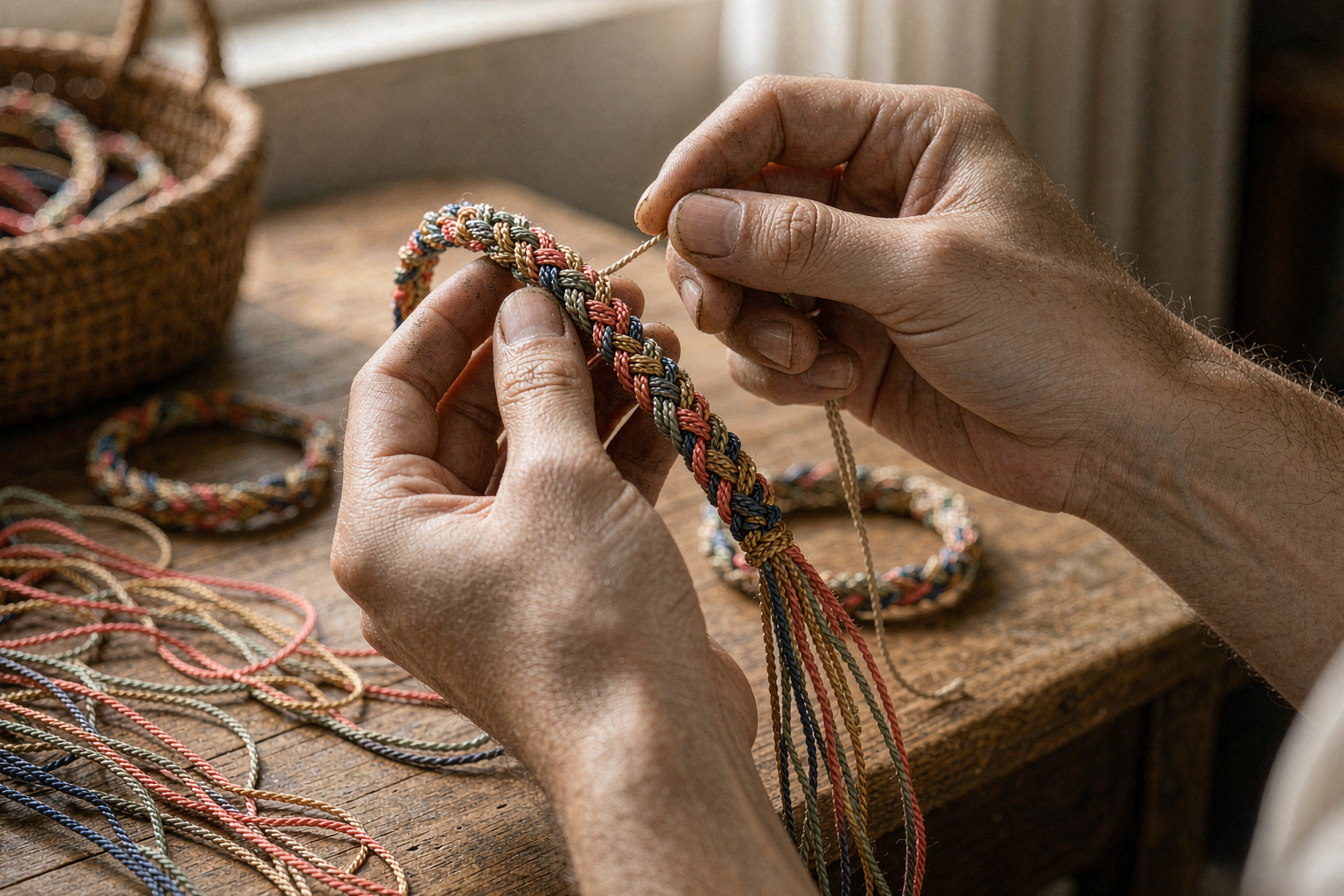
Set two branches of the same pine side by side and you will never find twin needles. Handwoven jewelry keeps that same habit. Every piece that leaves our studio was knotted once, by hand, one at a time — and the small differences between them are not flaws to hide. They are the signature.
Same Knot, Different Morning
On the surface, our days repeat: measure the cord, anchor the strand, tie, tighten, repeat. But the hands doing it are not machines. Tension moves with the hour. Knots tied early, while fingers are still cool from the walk to the studio, sit a shade tighter than the ones tied after lunch. On a damp day the waxed cord yields a little more under the thumb; on a dry one it grips and snaps into place. By late afternoon, when the light drops low and gold across the worktable, the rhythm of the knot changes again.
The maker changes too. A morning with cold hands knots differently than one that began with strong tea and sun on the bench. A long session leaves a looser, more patient line in the work; a short one leaves it brisk. None of this shows up in the pattern. All of it shows up in the piece.
Our bench holds the same few tools it always has: a spool rack of waxed cord in every color of the year, a brass needle worn smooth at the grip, a wooden clamp that has held a thousand strand-ends. Even the tools age into the work. The clamp grips a hair differently than it did last spring; the needle carries a worn spot exactly where a thumb rests. Small as they are, these things pass into the knots.
So a bracelet finished on Tuesday is not the twin of one finished on Friday, even from the same spools and the same plan. Each piece keeps a quiet record of the day it was made — the weather, the light, the pace of that session. We could flatten all of that out. Machines would. We let the day in.
Where to Look: The Small Marks of the Hand
You do not need a jeweler’s loupe to read these differences. None of the marks are hidden, and none need an expert’s eye — it is the same pleasure as finding the maker’s stamp on the bottom of a bowl, except here the stamp runs all the way through the piece. Four places will show you where the hand passed.
Knot spacing. Along a woven strand the knots drift by a millimeter or two, the way fence posts never quite repeat down a hillside. Look for the gentle unevenness of spacing that is set by feel, not by gear.
Color transitions. Where one hue hands the strand to the next — river blue meeting cream, pine green easing into earth brown — the overlap point is a small decision made in the moment. No two handovers land the same way.
The finish of the wax. We rub the wax in by hand, so the sheen pools where the cord was held and thins where it was pulled. Hold a piece to the window and turn it slowly; the light will draw you the map of its making.
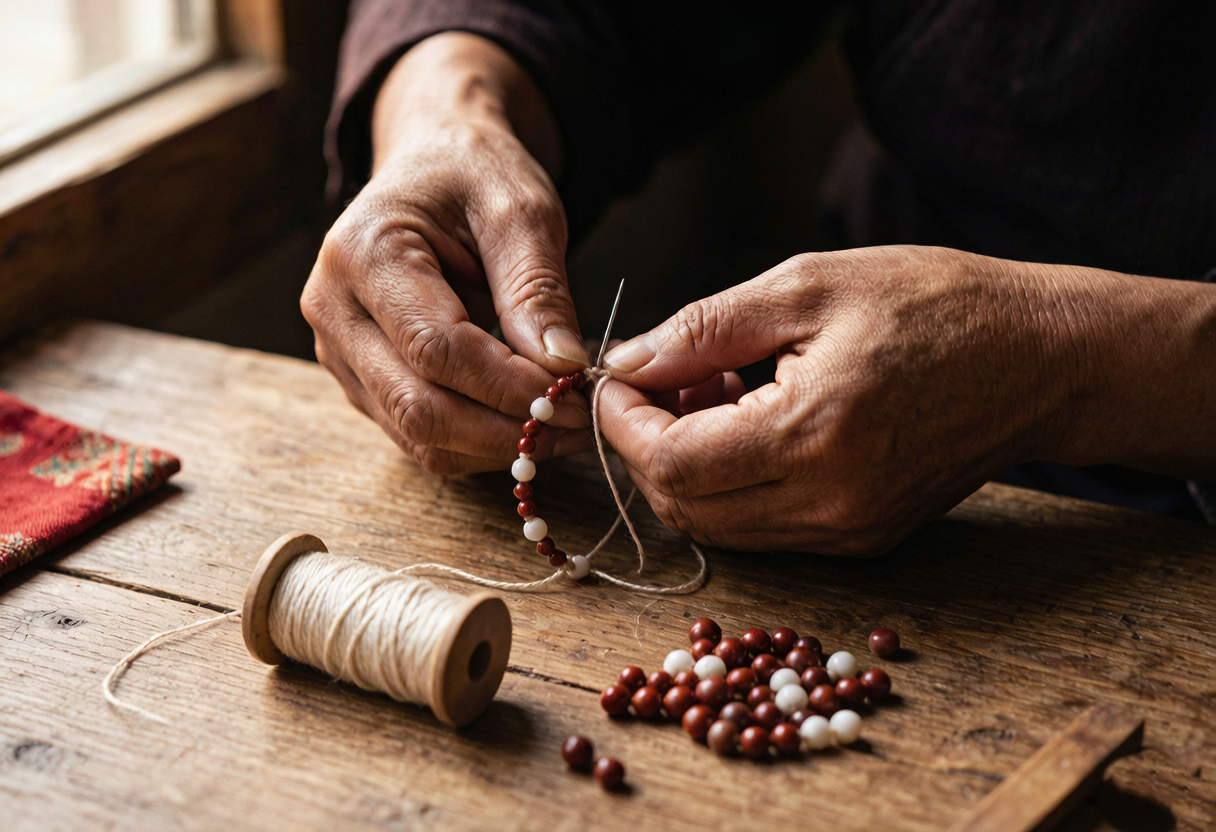
The stones themselves. No two beads share the same stripes. One agate carries a fine grey vein, its neighbor a wider band of rust. We set the finer vein where the eye lands first and let the bolder stone anchor the far end of the strand; another day we might swap them, and no one could call either choice wrong. So the arrangement on your wrist exists exactly once.
Natural Materials Refuse to Repeat
The materials have their own vote. Waxed cord is dyed in small lots, and every lot leans its own way. One batch of sky blue dries a little grey, like the hour before rain; the next runs greener, like shallow water over stones. We could order a single dye lot large enough to keep every spool interchangeable for a season. We do not. Small lots mean small shifts, and small shifts mean each bracelet carries its own reading of a color.
We learned this the honest way, early on. Two spools that the label swore were the same blue sat side by side on the shelf, and the two half-finished bracelets beside them already disagreed — one closer to a September evening, one closer to deep water. We finished both. Later, two different people each told us their bracelet was the one we had photographed. Neither was wrong.
Weather keeps writing too. Humidity softens how the cord sits, and a strand knotted in the wet weeks settles differently than one knotted in the dry. Even the same pattern, made twice, will part ways within the first hour of wear. So we plan around it: knots pulled a touch tighter in the wet weeks, and a day of rest for the cord before the final pass in the dry ones. The calendar becomes part of the pattern whether we like it or not.
And the story does not stop when the piece leaves the bench. Waxed cord earns a soft patina as it is worn — it darkens where your wrist bends, glosses where a sleeve brushes it. After a few months, the bracelet is not just one of a kind from our hands; it has become one of a kind from your days as well. No other piece will age along quite the same line.
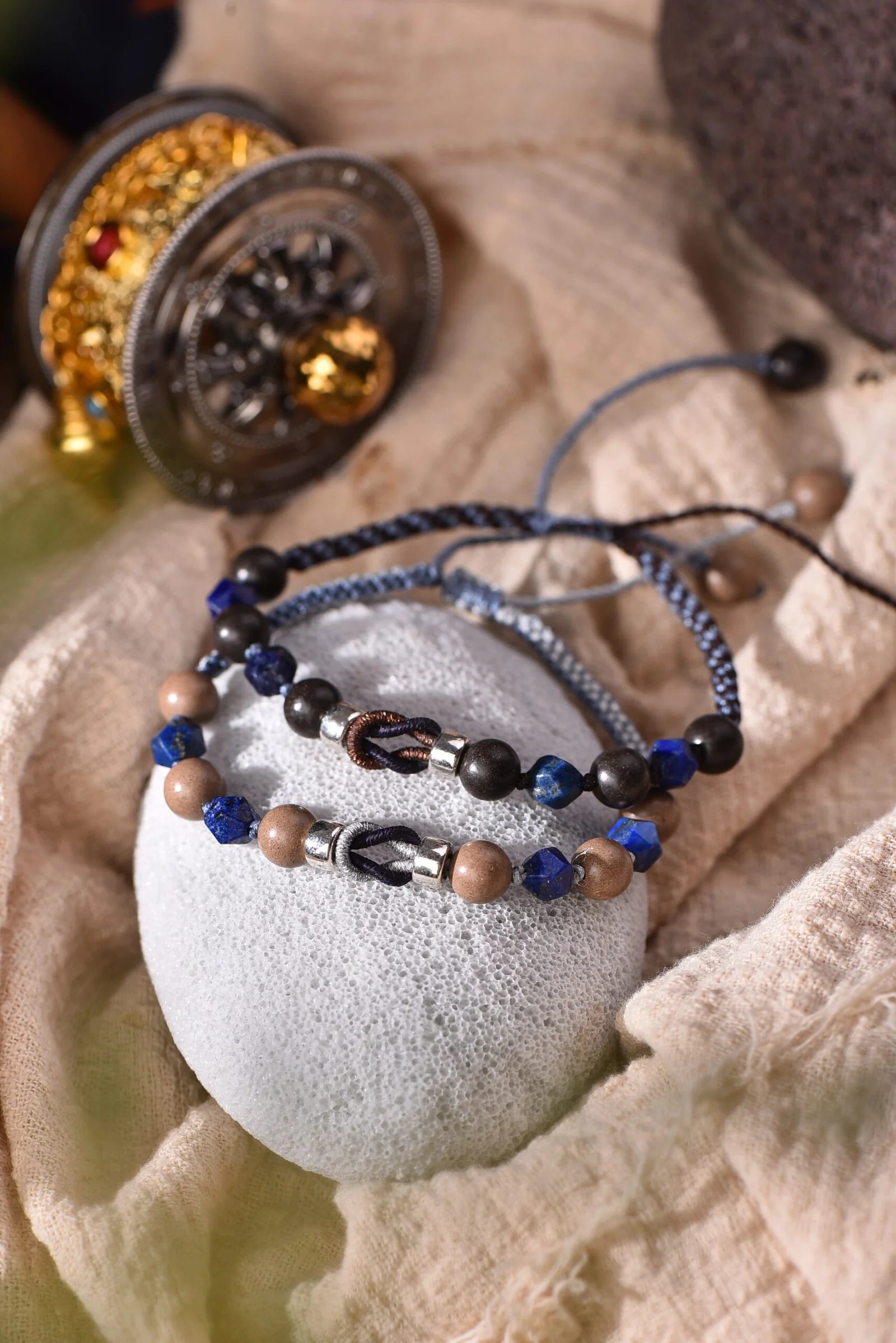
Look at our dual-tone bracelet in monsoon-sky blue and deep indigo: two colors share one strand, and the place where sky hands off to storm is knotted by feel. Make the same piece a hundred times and you would get a hundred slightly different weather fronts.
Which One Is Yours?
If no piece repeats, choosing becomes simpler, not harder. You are not comparing a wall of near-identical options; you are looking for the palette that matches your days.
Start with what you already wear. If your closet lives in denim and cream, the river-blue-and-white single strand will slip into it without asking. If you reach for greens, the fern-green-and-earth-brown piece will read like a walk under the pines.
Then think of a landscape you would like to keep close. A river under a pale sky. A pine slope after rain. A monsoon afternoon with the first drops on the sill. There is usually one palette on the shelf that matches the picture in your head better than the others — that is the one to try first.
Choosing for someone else works the same way, with one extra pleasure. Because no two pieces are alike, the one you give will not be the twin of any other gift this year. Pick the palette that sounds like them — a person who loves early mornings rarely argues with river blue and cream.
Everything on the product pages is already knotted and photographed as it is; what you see on the page is the exact piece that ships. Browse the dual-tone monsoon-sky and indigo bracelet, the river-blue-and-white single strand, or the fern-green-and-earth-brown strand, and pick the one that feels like your weather. More studio notes and process stories live in our Craft & Process journal.
Nature, woven by hand. Color, woven into stories.
Want a first look at new palettes? Join our email list — one short note when a new batch leaves the bench. No noise, just knots.
